Decoding ATRA Resistance in Acute Promyelocytic Leukemia: The Role of PML::RARA Mutations Enhancing Basal Repression
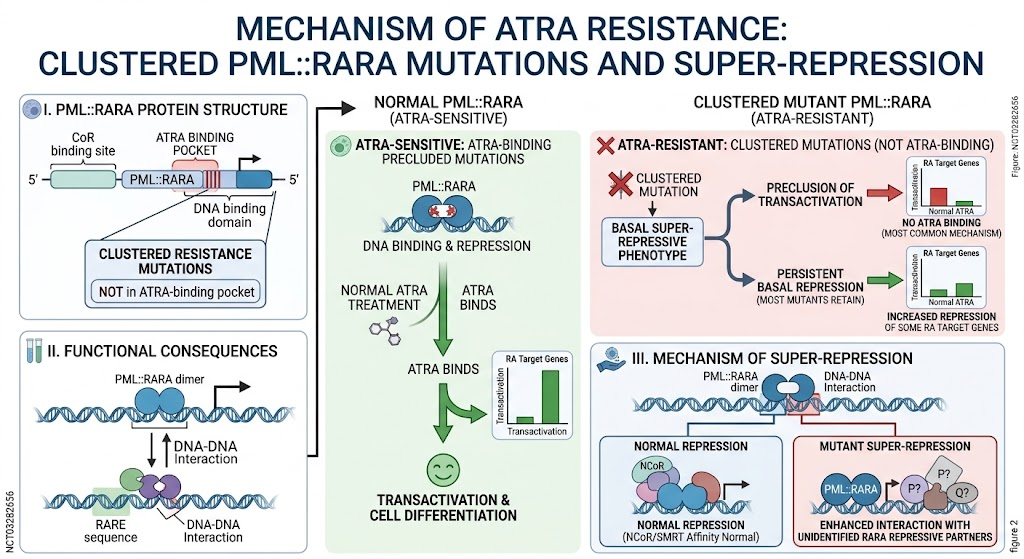
Highlight
- Some acute promyelocytic leukemia (APL) cases develop resistance to all-trans retinoic acid (ATRA) therapy due to specific PML::RARA mutations.
- A subset of hotspot PML::RARA mutations does not impede ATRA binding but enhances basal transcriptional repression, leading to drug resistance.
- Resistance is associated with gain-of-function effects involving unidentified retinoic acid receptor alpha (RARA) partners rather than classical corepressor recruitment.
- Findings emphasize persistent transcriptional repression as a key mechanism in acquired ATRA resistance, paralleling patterns in PLZF::RARA variants.
Study Background
Acute promyelocytic leukemia (APL) is a distinct subtype of acute myeloid leukemia characterized by the presence of the PML::RARA fusion protein, a product of the t(15;17)(q24;q21) translocation. This fusion protein disrupts normal retinoic acid signaling, blocking the differentiation of promyelocytes and leading to leukemogenesis. Therapeutically, the use of all-trans retinoic acid (ATRA), in combination with arsenic trioxide or chemotherapy, has revolutionized APL treatment — resulting in cure rates exceeding 80%.
However, a subset of patients still experiences treatment failure due to acquired resistance to ATRA. Historically, resistance mechanisms linked to PML::RARA mutations have been attributed mainly to direct interference with ATRA binding, thereby preventing receptor activation and subsequent transcription of differentiation genes. The current study by Barbosa et al. explores a distinct cluster of hotspot mutations within PML::RARA that confer resistance despite retaining ATRA responsiveness.
Understanding these molecular resistance mechanisms is critical for improving relapse prevention strategies and guiding next-generation therapeutic development for APL patients.
Study Design
Barbosa and colleagues conducted a comprehensive molecular characterization of PML::RARA mutations found in APL patients who exhibited resistance to earlier ATRA/chemotherapy regimens. The study involved in vitro analyses to evaluate the ligand-binding capacity of mutant fusion proteins, their corepressor interactions, basal transcriptional repression activity, and transcriptional response to ATRA.
Key endpoints included:
– Assessment of ATRA binding affinity and ligand responsiveness of mutant PML::RARA variants.
– Measurement of basal repression levels exerted by mutant proteins.
– Evaluation of interactions with known corepressors such as NCoR and SMRT.
– Functional investigation into potential gain-of-function properties linked to unidentified corepressor partners.
This thorough approach combined molecular biology assays with biochemical techniques to dissect the functional impact of clustered hotspot mutations within the receptor’s ligand-binding and repression domains.
Key Findings
The study revealed a subset of clustered hotspot PML::RARA mutations that confer resistance to ATRA without impairing the fusion protein’s ability to bind ATRA or activate target gene transactivation. Instead of hindering ligand binding — the classical mechanism of resistance — these mutants demonstrated a phenotype characterized by enhanced basal transcriptional repression.
Notably, this super-repressive activity was not explained by increased affinity for the canonical corepressors NCoR or SMRT. This indicates a novel gain-of-function mechanism where the mutated PML::RARA fusion interacts with as-yet unidentified transcriptional repressors, resulting in persistent suppression of retinoic acid-responsive genes even in the presence of ATRA. This persistent repression likely contributes to the failure of differentiation therapy in these resistant leukemias.
These findings mirror previous observations in ATRA-resistant PLZF::RARA variants that similarly maintain transcriptional repression despite ligand presence, reinforcing persistent repression as a theme in resistance pathways.
Functionally, these mutants retained normal or near-normal ligand responsiveness in transactivation assays, strongly suggesting that targeting ligand binding alone will not overcome this subtype of resistance.
Expert Commentary
The work by Barbosa et al. sheds light on a nuanced mechanism of ATRA resistance that transcends the classical model based solely on ligand binding disruption. The identification of gain-of-function mutations that enhance basal repression without altering transactivation capacity broadens our understanding of the molecular complexity of APL resistance.
Clinically, these findings may explain why some patients relapse despite adequate ATRA therapy levels and underscore the need for therapeutic strategies beyond simple ligand receptor interactions. Targeting the repressive complexes or the unknown RARA partners mediating super-repression could emerge as novel approaches.
Limitations include the current unidentified nature of the repressors involved, which necessitates further proteomic or interactome studies. Moreover, this work emphasizes the principle that mutant fusion proteins can subvert normal differentiation pathways through multiple mechanisms, complicating resistance phenotypes.
This study invites comparisons to other receptor fusion-driven malignancies and suggests a broader paradigm of transcriptional repression-driven resistance that might be relevant in other cancers.
Conclusion
The study by Barbosa and colleagues advances the molecular understanding of ATRA resistance in APL by identifying a cluster of hotspot PML::RARA mutations that confer resistance through enhanced basal transcriptional repression rather than loss of ligand binding. This gain-of-function repression involves novel RARA partner interactions and highlights persistent transcriptional repression as a central mechanism in acquired therapeutic resistance.
These insights open new avenues for research into targeted therapies aimed at disrupting aberrant repression complexes in APL, which may improve outcomes for patients who relapse after standard ATRA-based regimens. Further molecular characterization of the unidentified corepressor partners and validation in clinical cohorts remain essential next steps.
Funding and Clinical Trials
Specific funding sources were not disclosed in the abstract. Future clinical trials investigating agents that can modulate transcriptional repression in APL could be a logical extension of these findings.
References
1. Barbosa GM, Yuan H, Tambones I, et al. ATRA resistance conferred by a clustered subset of hotspot PML::RARA mutations enhancing basal repression rather than precluding transactivation. Haematologica. 2026;111(8):xxxx-xxxx. doi:10.3324/haematol.2026.42610425
2. de Thé H, Chen Z. Acute promyelocytic leukaemia: novel insights into the mechanisms of cure. Nat Rev Cancer. 2010;10(11):775-783. doi:10.1038/nrc2943
3. Borrow J, Goddard AD, Sheer D, Solomon E. Molecular analysis of acute promyelocytic leukemia breakpoint cluster region on chromosome 17. Cancer Res. 1990;50(9):2574-2578.
4. Nervi C, Boccuni P, Valtieri M. Transcriptional repression by PML-RARA in acute promyelocytic leukemia. Oncogene. 1998;17(26):3249-3258. doi:10.1038/sj.onc.1202333
This article was created using several editorial tools, including AI, as part of the process. Human editors reviewed this content before publication.