Highlight
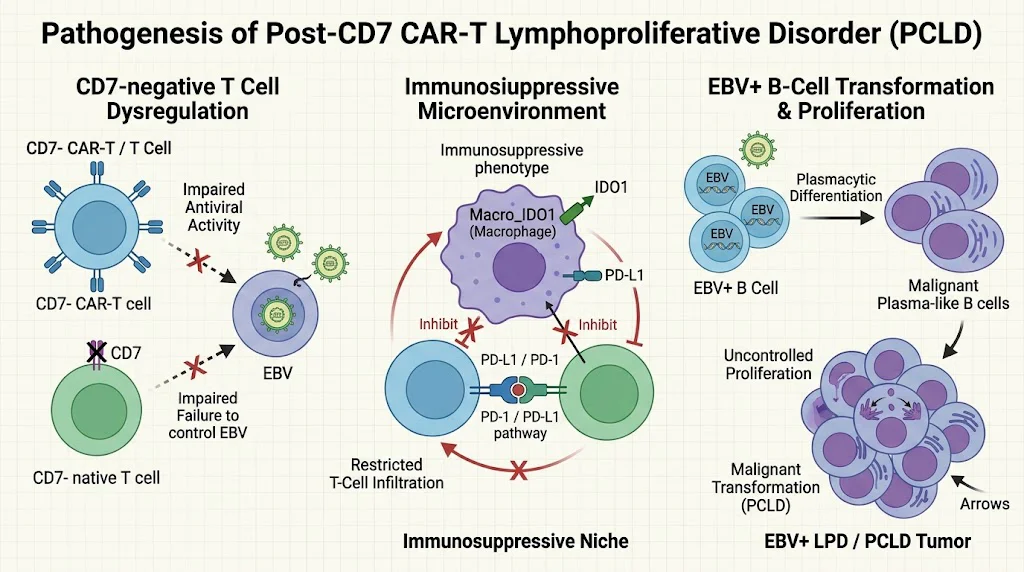
Post-CD7 CAR-T therapy lymphoproliferative disorder (PCLD) is characterized by CD7-negative dysfunctional T cells and emergence of EBV-positive B cell proliferation.
Spatial multi-omics identify immunosuppressive macrophage populations expressing IDO1 that form niches limiting effective T-cell infiltration in PCLD.
EBV-driven B cells in PCLD acquire plasmacytic features with ongoing proliferation, remodeling the local microenvironment favoring malignant transformation.
The study elucidates mechanisms underpinning EBV reactivation and lymphoproliferation after CD7 CAR-T, suggesting therapeutic avenues targeting macrophage suppression and inhibitory pathways.
Study Background
CAR-T cell therapies targeting CD7, a surface glycoprotein expressed on T cells, represent a promising approach for treatment of T cell malignancies. However, clinical observations reveal that a subset of patients treated with CD7 CAR-T develop Epstein-Barr virus (EBV) reactivation leading to an aggressive EBV-positive lymphoproliferative disorder (LPD), designated post-CD7 CAR-T lymphoproliferative disorder (PCLD). EBV-driven LPDs comprise a clinical challenge due to their resistance to therapy and complex immune evasion strategies. Understanding the molecular and cellular mechanisms underlying PCLD remains crucial to improve patient outcomes and develop targeted interventions.
Study Design
The investigation leveraged multi-omics spatial profiling including single-nucleus RNA sequencing (snRNA-seq), assay for transposase-accessible chromatin using sequencing (ATAC-seq), and Stereo-seq spatial transcriptomics. Samples from patients with PCLD were compared against classical post-transplant lymphoproliferative disorder (PTLD), EBV-negative diffuse large B-cell lymphoma (DLBCL), and normal lymph node tissues. This integrative approach delineated immune cell phenotypes, chromatin accessibility states, and spatial cellular interactions in the tumor microenvironment.
Key Findings
The study identified a unique T cell population in PCLD infiltrates characterized by loss of CD7 expression. These CD7-negative T cells demonstrated limited proliferative responses when stimulated by infection-related signals and exhibited impaired antiviral activity against EBV, compromising viral clearance. Concurrently, macrophage infiltration increased, particularly of a subtype termed Macro_IDO1, which expressed high levels of indoleamine 2,3-dioxygenase 1 (IDO1), an enzyme associated with immunosuppression.
Spatial analysis revealed that these Macro_IDO1 macrophages coalesced into localized immunosuppressive niches that restricted T cell access. These niches were enriched for inhibitory ligand-receptor interactions, notably through the PD-1/PD-L1 immune checkpoint axis, further dampening T cell activity. This immunosuppressive environment facilitated persistent EBV infection within B cells.
EBV-infected B cells in PCLD showed features of plasmacytic differentiation and exhibited sustained proliferation, contributing to ongoing remodeling of their microenvironment. This dynamic process supports malignant transformation and expansion of EBV-positive LPD clones.
Comparisons with classical PTLD and EBV-negative DLBCL highlighted the distinct immunological milieu and cellular evolution in PCLD, emphasizing the role of T cell dysfunction and macrophage-mediated immunosuppression in EBV-driven lymphoproliferation.
Expert Commentary
This comprehensive multi-omic study clarifies critical mechanisms in PCLD pathogenesis following CD7 CAR-T therapy. The finding of CD7-negative T cell dysfunction suggests that therapeutic targeting should consider ways to restore or compensate for T cell antiviral function. Similarly, the identification of an IDO1-expressing macrophage subset forming immunosuppressive niches highlights a potential target for intervention to disrupt immune suppression and reinvigorate antiviral immunity.
The spatial resolution afforded by Stereo-seq permits unprecedented insight into tumor-immune architectural interactions, underscoring the importance of immune checkpoint pathways such as PD-1/PD-L1 in maintaining EBV persistence post-CAR-T. These results warrant further exploration of immune modulatory drugs, including checkpoint inhibitors and IDO1 inhibitors, in the context of PCLD management.
Potential limitations include the relatively small patient cohort inherent to pioneering clinical syndromes and the need for functional validation of identified cell populations and pathways. Nevertheless, the integrated approach sets a methodological standard for studying complex post-therapy lymphoproliferations.
Conclusion
The study elucidates the evolution from CD7-negative T cell dysregulation to EBV-driven B cell lymphoproliferative disorder after CD7 CAR-T therapy. It highlights the critical role of immunosuppressive macrophage niches and inhibitory checkpoint pathways in sustaining EBV infection and malignant B cell transformation. These discoveries offer renewed avenues for therapeutic intervention in PCLD, a serious complication of CD7 CAR-T immunotherapy. Future research should focus on reversing T cell dysfunction and dismantling immunosuppressive microenvironments to enhance viral clearance and improve outcomes.
Funding and Clinical Trials
Details of funding sources and clinical trial registrations for this study are not provided in the cited publication.
References
Huang M, Jiang Y, Ye F, et al. Multi-omics reveals evolution from CD7-negative T cell dysregulation to EBV-positive LPD after CD7 CAR-T therapy. Blood. 2026 Oct 28. PMID: 42950083. Available at: https://pubmed.ncbi.nlm.nih.gov/42950083/
Additional references support insights on CAR-T therapy-related EBV-LPD, immunosuppressive macrophages, and the tumor microenvironment but are beyond the scope of this summary.