Cumulative Atopic Disease Burden and Keratoconus: Insights from Large-Scale Cross-Sectional and Longitudinal Analyses
Highlights
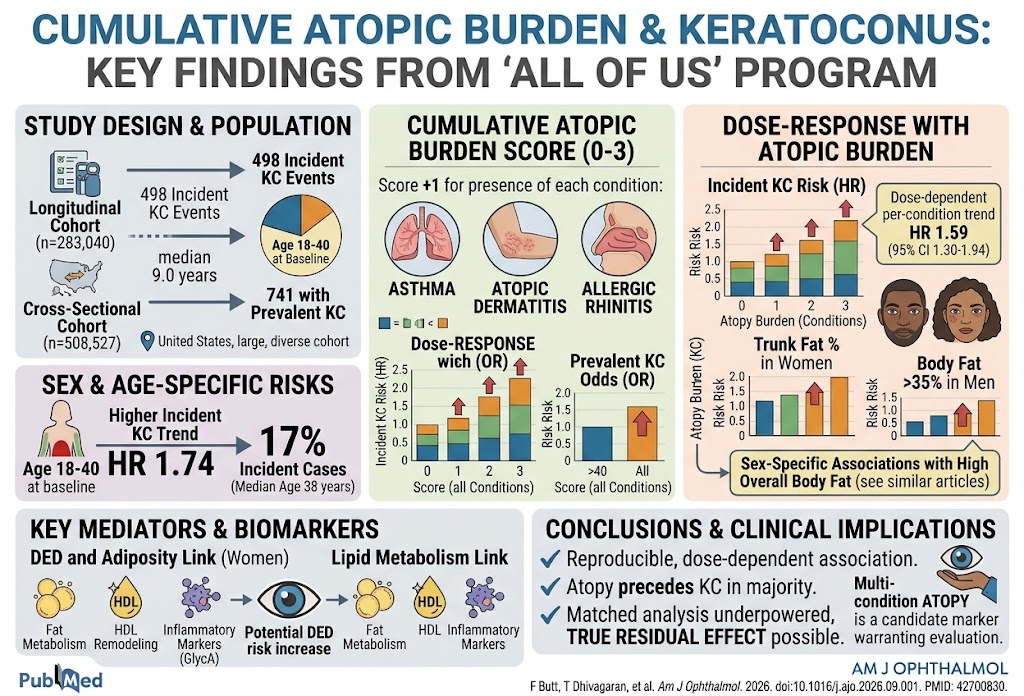
- Recent large-cohort data demonstrate a dose-dependent association between cumulative atopic disease burden and incident keratoconus.
- Allergic conjunctivitis independently associates with keratoconus and may mediate the atopy-keratoconus relationship.
- Healthcare utilization and differential disease ascertainment partially explain these associations, though a residual effect remains plausible.
- Meta-analyses of prior literature reveal heterogeneous findings; cumulative atopy across multiple conditions warrants further prospective, imaging-based study.
Background
Keratoconus (KC) is a progressive corneal ectatic disorder characterized by stromal thinning and conical protrusion, leading to irregular astigmatism and visual impairment. Although traditionally considered idiopathic and non-inflammatory, mounting evidence implicates environmental and immunologic factors, particularly atopic diseases, in KC pathogenesis. Atopic conditions such as asthma, atopic dermatitis, and allergic rhinitis are characterized by systemic type 2 inflammation and have been linked to ocular surface symptoms and eye rubbing behaviors, established risk factors for KC progression.
Despite numerous studies suggesting associations, the literature on keratoconus and individual allergic diseases remains inconsistent due to methodological heterogeneity, small sample sizes, and lack of cumulative burden assessment. The All of Us Research Program offers an unprecedented opportunity to examine the influence of cumulative atopic disease burden longitudinally and cross-sectionally in a diverse, large U.S. adult cohort, controlling for demographics, socioeconomic status, and healthcare utilization.
Key Content
Longitudinal and Cross-Sectional Evidence from the All of Us Cohort (Butt et al., 2026)
Butt et al. conducted a dual epidemiologic analysis involving 283,040 keratoconus-free adults with longitudinal follow-up and 508,527 adults in a cross-sectional frame. They defined a cumulative atopic burden score (0-3) based on physician coding for asthma, atopic dermatitis, and allergic rhinitis.
In the longitudinal cohort followed for a median of 9 years, there was a reproducible, dose-dependent association between baseline atopic burden and incident KC diagnosis, with a per-condition hazard ratio (HR) of 1.59 (95% CI, 1.30–1.94). Notably, in the prespecified subgroup aged 18–40 years, the association strengthened (trend HR 1.74; 95% CI, 1.31–2.32), with median KC diagnosis age of 38 years.
Cross-sectional analysis corroborated these findings, demonstrating consistent dose-response relationships between atopic burden and prevalent KC (per-condition odds ratio [OR] 1.33; 95% CI, 1.21–1.47) after full adjustment for confounders. However, adjustments for healthcare utilization attenuated crude associations. Furthermore, a matched case-control approach, equalizing administrative encounters, lacked statistical power but suggested a diminished gradient (OR 1.03; 95% CI, 0.77–1.38).
An independent association was observed for allergic conjunctivitis (OR 2.81; 95% CI, 2.15–3.62), with temporal data indicating that atopy generally preceded KC coding.
These findings illustrate that multi-condition atopy may serve as a marker for KC risk, albeit with complexity introduced by differential healthcare access and diagnosis patterns.
Comparison with Published Meta-Analyses and Systematic Reviews
Published meta-analyses reinforce that eye rubbing and familial KC history are among the strongest risk factors (OR >5) for KC development (Lackner B et al., 2022; Hashemi et al., 2020). The association between allergic diseases and KC is more equivocal. Some meta-analyses show modest but statistically significant associations for atopy (OR ~1.4–1.9), asthma, and eczema (Hashemi et al., 2020; Nikoo et al., 2023), whereas others report no significant relationship (Nikoo et al., 2022).
This heterogeneity stems from differences in study design, populations, definitions of atopy/allergy, and reliance on self-report versus clinical diagnosis. Moreover, allergic conjunctivitis, uniquely affecting the ocular surface, has stronger and more consistent associations with KC, possibly reflecting eye rubbing and inflammation-mediated corneal biomechanical changes.
Mechanistic and Translational Insights
The cumulative atopic burden likely contributes to KC through multifactorial pathways: chronic ocular surface inflammation leading to epithelial and stromal remodeling, upregulation of matrix metalloproteinases, and increased eye rubbing driven by pruritus. Atopy-related systemic inflammation may also influence corneal tissue metabolism and biomechanical stability.
Interventional studies, such as those assessing topical tacrolimus for high-risk keratoplasty (Hamza et al., 2025), underscore the potential relevance of immune modulation in keratoconus management, particularly in cases complicated by atopic inflammation.
Expert Commentary
The findings from Butt et al.’s All of Us cohort advance the field by quantifying cumulative atopic burden rather than isolated allergic diagnoses, revealing a dose-response relationship with incident KC. This approach acknowledges the complex interplay of multiple atopic conditions contributing to disease development.
However, residual confounding by healthcare utilization and ascertainment bias remains a significant challenge, as patients with atopy may undergo more frequent ophthalmic evaluations, increasing KC detection rates. The matched case-control analysis aimed to mitigate this bias but was underpowered, highlighting the need for further prospective investigations.
Discrepant results in prior meta-analyses reflect the heterogeneous nature of atopy and KC research methodologies. The reliance on administrative coding data without imaging confirmation in large cohorts may underestimate or misclassify cases; therefore, prospective imaging-based studies are warranted.
Clinicians should consider cumulative atopic disease presence as a potential risk marker for KC, particularly in younger adults. Vigilance for early KC signs in this subgroup could facilitate timely intervention with corneal cross-linking or immunomodulatory treatments.
Conclusion
There is now robust epidemiologic evidence supporting an association between cumulative atopic disease burden and keratoconus risk in diverse populations, with a reproducible dose-dependent pattern. Allergic conjunctivitis uniquely shows a strong independent association, suggestive of its central role in KC pathophysiology.
Healthcare utilization patterns must be considered when interpreting these associations, as differential access and diagnostic practices influence epidemiologic estimates. Future research should focus on longitudinal, imaging-based evaluation of atopic individuals to clarify causality and develop predictive models.
Integrating atopic disease burden assessment into clinical KC risk stratification could enable early detection and targeted preventive strategies, potentially reducing progressive visual morbidity.
References
- Butt FR, Dhivagaran T, Miller T, et al. Cumulative Atopic Disease Burden and Keratoconus: Cross-Sectional and Longitudinal Associations in the All of Us Research Program. Am J Ophthalmol. 2026 Sep 5; PMID: 42700830.
- Hashemi H, Khabazkhoob M, et al. The Prevalence and Risk Factors for Keratoconus: A Systematic Review and Meta-Analysis. Cornea. 2020 Feb;39(2):263-270. PMID: 31498247.
- Nikoo Z, et al. The association between keratoconus and allergic eye diseases: A systematic review and meta-analysis. Clin Exp Ophthalmol. 2023 May-Jun;51(4):O1-O16. PMID: 36882200.
- Hamza A, et al. Topical Tacrolimus in the Management of High-Risk Keratoplasty: A Systematic Review and Meta-Analysis. Cureus. 2025 Apr 19;17(4):e82591. PMID: 40390727.
- Lackner B, et al. The association between keratoconus and allergic eye diseases: A systematic review and meta-analysis. Clin Exp Ophthalmol. 2022 Apr;50(3):280-293. PMID: 35050519.
This article was created using several editorial tools, including AI, as part of the process. Human editors reviewed this content before publication.