Rethinking Surgical Quality Metrics: The Role of Operative-to-Nonoperative Management Ratio in Elderly Emergency General Surgery Outcomes
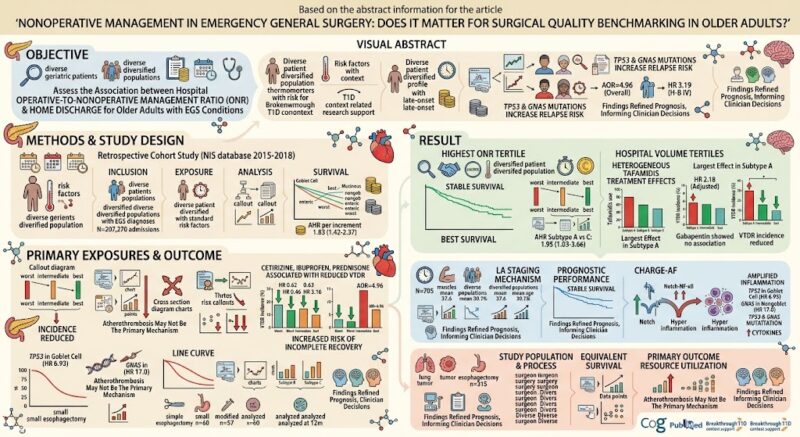
Highlight
This study investigates the impact of the hospital-specific operative-to-nonoperative management ratio (ONR) on the likelihood of home discharge among elderly patients undergoing emergency general surgery (EGS). Findings reveal that hospitals with a higher ONR have increased odds of favorable discharge outcomes, suggesting that ONR may serve as a superior surrogate for hospital quality in this population compared to traditional metrics such as operative volume or morbidity/mortality rates.
Study Background
Emergency general surgery (EGS) conditions, including acute appendicitis, cholecystitis, bowel obstruction, and diverticulitis, present significant management challenges in older adults. This demographic is rapidly growing and exhibits greater vulnerability to complications and functional decline following surgery. Recent trends show an increased reliance on nonoperative management for certain EGS indications to potentially reduce perioperative risks. However, existing hospital quality benchmarking primarily focuses on surgical morbidity and mortality outcomes, which may not fully capture institutional practice patterns or meaningful patient-centered outcomes such as discharge disposition to home. Moreover, older adults are frequently excluded from quality metrics due to their complex comorbidities and diverse trajectories postoperatively.
Study Design
This investigation is a retrospective cohort analysis drawn from the National Inpatient Sample database spanning 2015 to 2018. The study population consisted of adults aged 65 years and older admitted with common EGS diagnoses: diverticulitis, bowel obstruction, acute pancreatitis, peptic ulcer disease, ischemic bowel, appendicitis, and cholecystitis. Patients undergoing urgent or emergent surgery within 48 hours of admission were included. For each hospital, a risk-adjusted operative-to-nonoperative management ratio (ONR) was calculated, representing the proportional use of surgery relative to nonoperative approaches.
Hospitals were categorized into tertiles based on their ONR as well as operative volume, permitting comparative analyses between these metrics. The primary outcome measure was discharge disposition, particularly the likelihood of discharge home, reflecting a key patient-centered goal emphasizing functional independence. Multivariable logistic regression models were employed to adjust for confounders and assess the independent association of ONR and operative volume with home discharge odds.
Key Findings
The study encompassed a total of 1,470,114 EGS admissions, among which 207,270 (14.1%) involved older adults who underwent surgery. The mean hospital ONR across facilities was 0.28 (standard deviation 0.07), indicating that, on average, about 28% of such patients received operative treatment. Following adjustment for patient-level factors and hospital characteristics, care at hospitals in the highest ONR tertile was associated with a statistically significant 10% increase in the odds of home discharge (odds ratio [OR] 1.10; 95% confidence interval [CI], 1.06–1.14).
In contrast, operative volume alone did not demonstrate a significant correlation with discharge disposition, highlighting that the sheer quantity of surgical procedures at a hospital may be less informative than the relative inclination to pursue operative therapy in appropriate cases. These results suggest that higher ONR might reflect a hospital’s aggressive and effective surgical management strategy aligned with improved functional outcomes in older adults.
Interestingly, the study controlled for various confounders such as patient comorbidities, severity of illness, and hospital characteristics, strengthening the validity of ONR as an independent metric. While morbidity and mortality remain important endpoints, they may inadequately capture nuances in institutional treatment philosophies or the prioritization of discharge to home, a critical recovery milestone for older patients.
Expert Commentary
This study adds a novel dimension to quality benchmarking in emergency general surgery by emphasizing a management ratio metric (ONR) that integrates nonoperative decision-making relevance. Older adults often face a complex interplay of risks and benefits regarding surgery; thus, measuring quality solely through operative volume or traditional outcome rates does not fully appreciate the tailored decision-making necessary for this group.
The findings resonate with evolving paradigms in geriatric surgery that prioritize functional preservation and patient-centric outcomes over mere survival. Higher ONR hospitals may have optimized surgical protocols, multidisciplinary teams, or more adept infrastructure to safely deliver operative care, leading to better post-discharge independence.
Nonetheless, some limitations warrant consideration. The retrospective design is subject to residual confounding, and administrative coding data may lack granular clinical detail regarding decision rationale or patient preferences. Additionally, the study does not elucidate the quality of nonoperative management or potential selection biases influencing hospital ONR.
Future prospective studies could explore causality, dissect institutional differences driving ONR variation, and incorporate patient-reported outcomes and frailty assessments to refine benchmarking frameworks. Incorporation of ONR into quality metrics could incentivize balanced, evidence-based care tailored to older adults’ unique needs.
Conclusion
This large-scale retrospective analysis highlights that an increased hospital operative-to-nonoperative management ratio is independently associated with better odds of discharge home for older adults undergoing emergency general surgery. This suggests ONR may serve as a meaningful and practical quality metric, supplementing or complementing traditional volume and outcome measures. Such a measure emphasizes the importance of institutional treatment patterns and aligns quality assessment with outcomes valued by older patients, namely functional recovery and independence.
Incorporating ONR into surgical quality benchmarking has the potential to guide hospital practices, improve patient-centered outcomes, and ultimately enhance care for the growing geriatric EGS population. Further validation and integration into clinical registries and policy frameworks are warranted.
Funding and ClinicalTrials.gov
No specific funding sources were reported. The study is a retrospective analysis of a publicly available dataset and does not report a clinical trial registration.
References
1. Castillo-Angeles M, Dey T, Salim A, Havens JM. Nonoperative Management in Emergency General Surgery: Does It Matter for Surgical Quality Benchmarking in Older Adults? Ann Surg. 2026 Sep 10. PMID: 42717371.
2. Flum DR, Koepsell T. The clinical and economic burden of nonoperative management in emergency general surgery. Surg Clin North Am. 2020;100(6):1151-1164.
3. Mohanty S, Rosenthal RA, Russell MM, et al. American College of Surgeons National Surgical Quality Improvement Program best practice guidelines for preoperative assessment of the geriatric surgical patient. J Am Coll Surg. 2016;222(5):930-947.
4. Cocanour CS, Fakhry SM. Nonoperative management gains importance in modern emergency surgery. Surgery. 2018;163(3):470-474.
5. Kwon S, Varela C, Cichowski L, Pietsch J. Functional status as a predictor of discharge disposition in elderly emergency surgical patients. J Trauma Acute Care Surg. 2019;86(4): 644-650.
This article was created using several editorial tools, including AI, as part of the process. Human editors reviewed this content before publication.