We use cookies

Our website uses essential cookies and, with your consent, additional cookies to measure performance and improve our services. Cookie Policy.

You can change your choice at any time.

MMedXYNews
HomeVideos
MedXY AI/MedXY News/Section: Gastroenterology

Assessing Survival Outcomes of Simultaneous Liver-Kidney Versus Liver Alone Transplantation in the Era of the 2017 OPTN Policy
MedXY Editorial Team•Oct 13, 2026•Gastroenterology
liver transplantationOPTN Policyrối loạn chức năng thậnSimultaneous Liver-Kidney Transplantation

Highlight

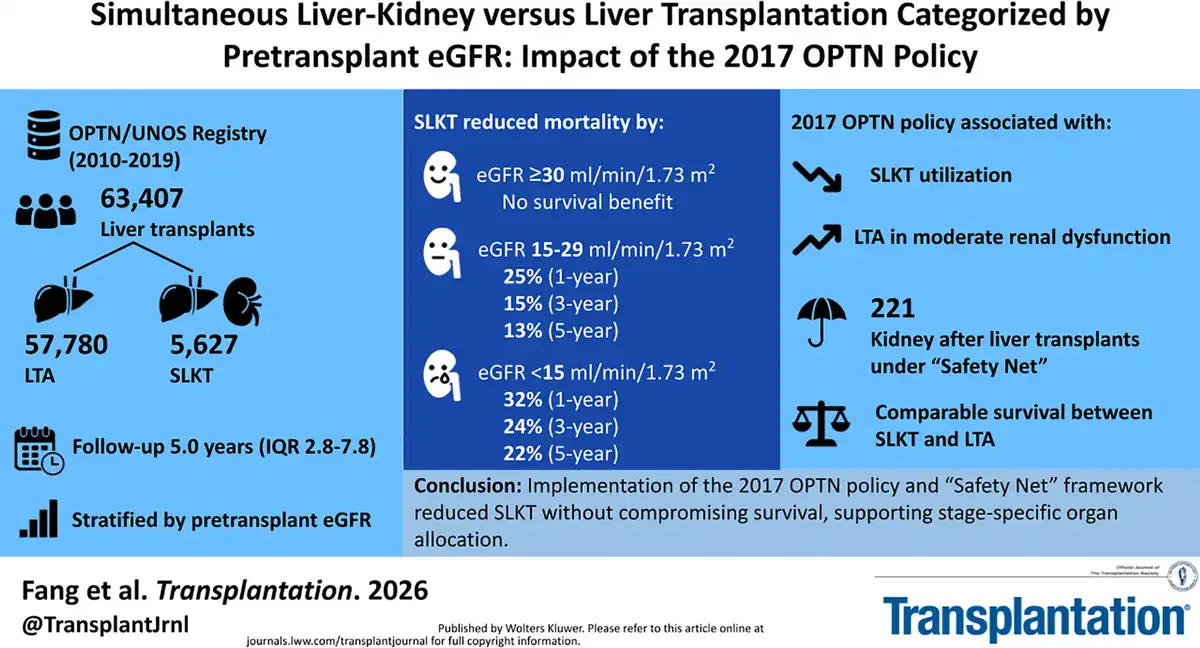
  • Simultaneous liver-kidney transplantation (SLKT) improved survival only in patients with severe renal dysfunction (eGFR <30 mL/min/1.73 m2).
  • For patients with pretransplant eGFR ≥30, liver transplantation alone (LTA) yielded comparable or superior survival outcomes versus SLKT.
  • The 2017 OPTN policy and Safety Net reduced SLKT rates without adversely affecting posttransplant survival.
  • These findings endorse a stage-specific allocation paradigm incorporating the Safety Net for post-liver transplant kidney allocation.

Study Background

MedXY registered readers

Sign in free to continue reading

Create or use your MedXY account to unlock the complete article.

This article was created using several editorial tools, including AI, as part of the process. Human editors reviewed this content before publication.

Related articles

Open language-specific specialty feeds and department pages.

Impact of Poor Food Access on Metabolic Dysfunction-associated Liver Disease and Frailty Among Liver Transplant Candidates: A Geospatial AnalysisPoor food access correlates with higher MASLD and frailty prevalence in liver transplant candidates, with geospatial clustering highlighting socioeconomic and environmental determinants impacting transplant candidacy and outcomes.Oct 15, 2026Liver Transplantation for Hepatocellular Carcinoma: Prognostic Impact of Complete Pathologic Response and Influence of Treatment Modality—A US National Database StudyComplete pathologic response (cPR) after locoregional therapies notably improves survival in hepatocellular carcinoma (HCC) patients undergoing liver transplantation. Yttrium-90 radioembolization shows superior cPR rates, particularly when Oct 6, 2026Immune Checkpoint Inhibitor-Based Downstaging Therapy for Hepatocellular Carcinoma: Evidence, Outcomes, and Clinical PerspectivesThis review synthesizes recent evidence on immune checkpoint inhibitor (ICI)-based downstaging therapy for hepatocellular carcinoma (HCC) beyond Milan criteria prior to liver transplantation, highlighting improved oncologic outcomes alongsiOct 5, 2026
Loading comments...
MedXY briefing

Get the free newsletter

Evidence-led clinical news, trends, and analysis—delivered to your inbox.

Ask MedXY AI

Most popular

Intimate Health
Five Benefits for Women Continuing Sexual Activity After Menopause
Intimate Health
Why Some Women Have a Strong Sex Drive—And Why Men Shouldn't Worry About It
Nursing &amp; care
How often should a couple have sex?
Cardiology
Precision Medicine for Long QT Syndrome Type 2: Lumacaftor Corrects Trafficking Defects and Shortens QT Interval
General Surgery
Optimizing Postoperative Opioid Prescriptions After Intra-Abdominal Cancer Surgery: Comparing the 5x-Multiplier and 3-Tier Models
© 2026 MedXY
Contact usAbout usPrivacy PolicyMedXY story
Mitigating Innate Immune Response in Liver Transplantation: Insights from HOPE and NMP Machine Perfusion
This article reviews how hypothermic oxygenated and normothermic machine perfusion reduce hepatic and systemic inflammation after liver transplantation, improving immune regulation and clinical outcomes.
Oct 4, 2026
Impact of Medicaid Expansion on Adult Liver Transplant Outcomes: A Decade-Long AnalysisMedicaid expansion is associated with improved graft and patient survival following adult liver transplantation, highlighting the benefits of broader health insurance access on transplant outcomes.Oct 2, 2026
Impaired Pulmonary Function and Dyspnea in Liver Transplant Recipients: Insights from a Nationwide Matched Cohort StudyThis study reveals that liver transplant recipients exhibit significantly reduced lung function and increased dyspnea compared to the general population, highlighting the need for heightened pulmonary surveillance in this vulnerable group.Oct 2, 2026