We use cookies

Our website uses essential cookies and, with your consent, additional cookies to measure performance and improve our services. Cookie Policy.

You can change your choice at any time.

MMedXYNews
HomeVideos
MedXY AI/MedXY News/Section: Cardiology

Bridging the Gap: ESC Prevention and Cardiac Rehabilitation Recommendations and What EUROASPIRE VI Reveals About Reality in Europe
MedXY Editorial Team•Aug 29, 2026•Cardiology
ESC GuidelinesEUROASPIRE VIPhục hồi chức năng timSecondary Prevention

Introduction

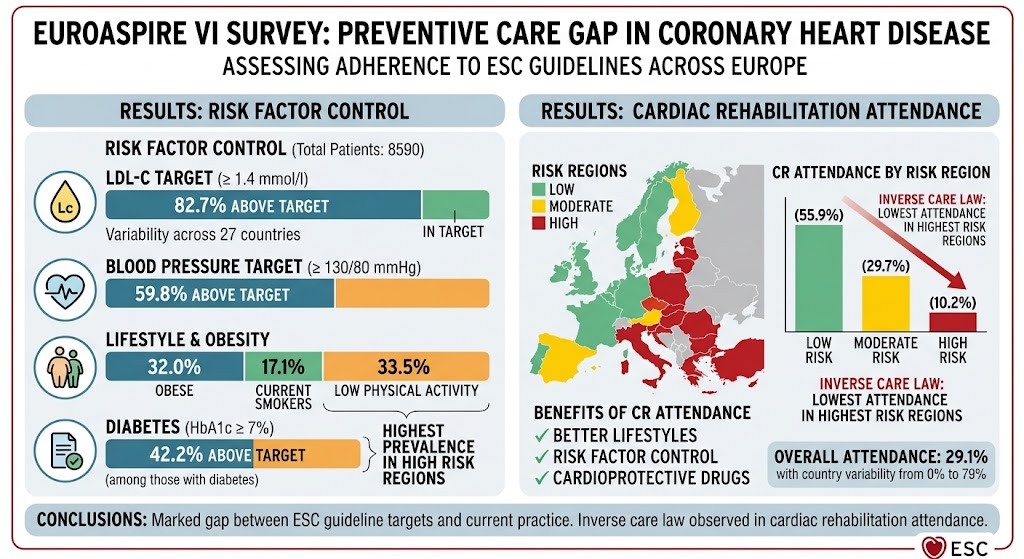
Coronary heart disease (CHD) remains a leading cause of death and disability worldwide. Over the last decade European Society of Cardiology (ESC) guidance has moved toward more ambitious preventive goals—lower LDL-C, tighter blood-pressure control, broader use of cardioprotective glucose-lowering drugs, and strong endorsement of structured cardiac rehabilitation (CR). The EUROASPIRE programme has repeatedly measured how far routine care keeps pace with those recommendations. The latest iteration, EUROASPIRE VI (Wood et al., 2026), is the largest contemporary snapshot: 8,590 patients across 160 hospitals in 27 countries (September 2024–February 2026). It provides sobering evidence about what guideline-concordant care actually looks like in the real world.

Why this matters now
– ESC prevention recommendations set ambitious, evidence-based targets intended to reduce recurrent events in people with established CHD.
– Cardiac rehabilitation, long recognized as essential secondary prevention, now features in ESC workstreams as an implementation priority.
– EUROASPIRE VI demonstrates persistent shortfalls in risk-factor control and highly variable CR access and uptake—especially in the highest cardiovascular risk regions in Europe—highlighting an “inverse care” problem: where need is greatest, delivery is poorest.

MedXY registered readers

Sign in free to continue reading

Create or use your MedXY account to unlock the complete article.

This article was created using several editorial tools, including AI, as part of the process. Human editors reviewed this content before publication.

Related articles

Open language-specific specialty feeds and department pages.

Inpatient Rehabilitation and Major Adverse Cardiovascular Events After Ischemic Stroke: Clinical Implications and Evidence SynthesisPostacute discharge to inpatient rehabilitation facilities (IRF) after acute ischemic stroke (AIS) is associated with a reduced 1-year risk of major adverse cardiovascular events (MACE) compared to discharge to home or skilled nursing facilSep 19, 2026Association of Adherence to Various Dietary Patterns With Mortality Among Survivors of Myocardial Infarction: An Evidence-Based ReviewPost-MI adherence to diverse healthy dietary patterns is consistently linked to reduced mortality and cardiovascular events, underscoring the importance of diet quality in secondary prevention among MI survivors.Aug 26, 2026Unraveling Attenuated Risk Factor Associations in Secondary Coronary Prevention: Implications for Clinical PracticeThis study reveals that risk factor associations for subsequent coronary heart disease (CHD) events are systematically attenuated due to index event bias, challenging their clinical interpretation in secondary prevention and emphasizing theAug 24, 2026
Loading comments...
MedXY briefing

Get the free newsletter

Evidence-led clinical news, trends, and analysis—delivered to your inbox.

Ask MedXY AI

Most popular

Intimate Health
Five Benefits for Women Continuing Sexual Activity After Menopause
Intimate Health
Why Some Women Have a Strong Sex Drive—And Why Men Shouldn't Worry About It
Nursing & care
How often should a couple have sex?
Intimate Health
Classic Intimacy Recommendations: How to Help Women Reach Orgasm and Enjoy Mutual Pleasure
Intimate Health
What Makes a Woman "Physiologically Addicted" Is Never Money, But These Two Relationship Qualities
© 2026 MedXY
Contact usAbout usPrivacy PolicyMedXY story
Advancements in Heart Failure Management: Insights from the JROADHF and JROADHF-NEXT Registries
This article reviews improvements in heart failure management and outcomes in Japan between 2013 and 2019-21, highlighting increased guideline-based therapy use and enhanced post-discharge care leading to reduced mortality and readmission r
Aug 22, 2026
Optimizing LDL-C Reduction Strategies in Ischemic Stroke: Impact of Achieving ≥50% LDL-C Reduction from BaselineAchieving a ≥50% reduction in LDL-C from baseline independently reduces recurrent cardiovascular events post-ischemic stroke, suggesting that combining relative and absolute LDL-C targets improves long-term outcomes.Aug 21, 2026
Persistence of Blood Inflammatory Biomarkers as Predictors of Long-Term Recurrent Stroke Risk: Insights From the Oxford Vascular StudyInflammatory blood biomarkers consistently predict long-term recurrent stroke risk up to 10 years post-event, independent of traditional vascular risk factors, underscoring the potential for anti-inflammatory secondary prevention strategiesAug 6, 2026