Patient Information
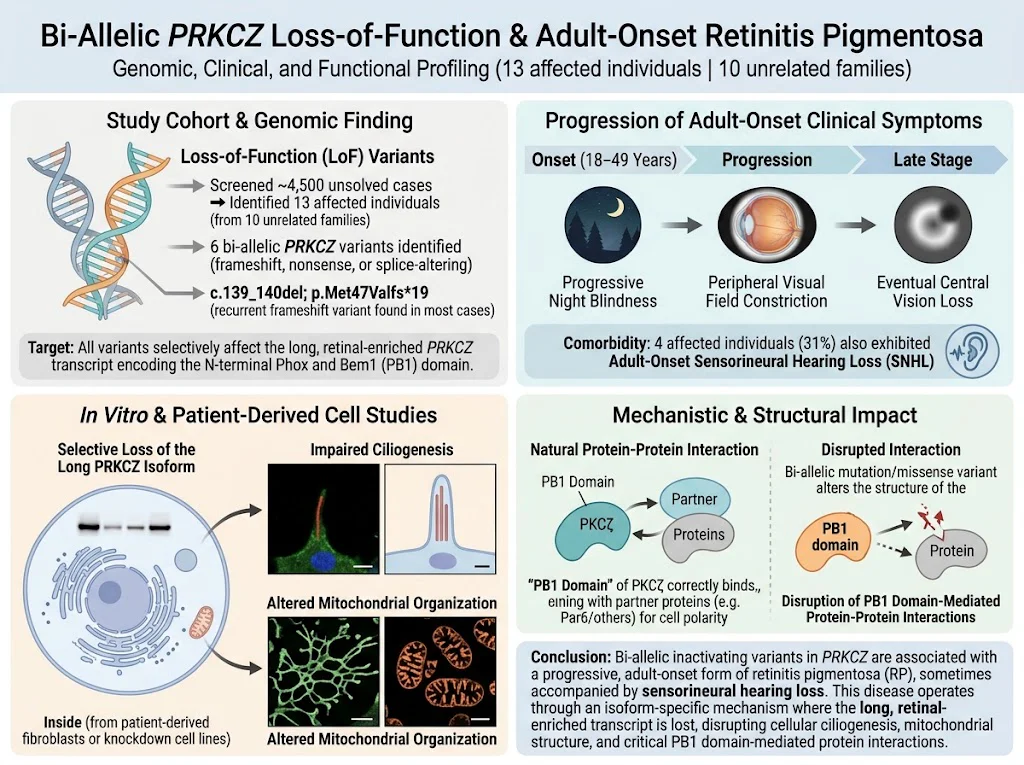
This case series describes 13 affected individuals from 10 unrelated families recruited internationally through research and diagnostic programs focused on unsolved childhood- and adult-onset retinal diseases. The patients were aged between 18 and 49 years at symptom onset, with an approximately equal sex distribution (46% female). All patients presented with progressive visual impairment characterized primarily by night blindness and peripheral visual field constriction. Notably, 4 individuals also developed adult-onset sensorineural hearing loss. There was no prior molecular diagnosis despite extensive genetic workup, and no known family history of retinal degeneration was reported for some cases.
Diagnosis
Genomic analyses identified bi-allelic likely pathogenic variants in the PRKCZ gene in all 13 affected individuals. Of the six distinct variants found, five were predicted loss-of-function mutations including frameshift, nonsense, or splice-altering alterations. The most recurrent variant was a frameshift mutation c.139_140del (p.Met47Valfs*19). All variants selectively impacted the long PRKCZ transcript isoform encoding the N-terminal Phox and Bem1 (PB1) domain. This selective targeting was confirmed through transcript analysis.
Clinically, these patients exhibited adult-onset retinitis pigmentosa (RP) marked by progressive nyctalopia, gradual peripheral visual field loss leading to tunnel vision, and eventual central vision deterioration. Ophthalmological examination and functional assessments supported the diagnosis of RP.
Functional studies using patient-derived fibroblasts demonstrated complete loss of the long PRKCZ isoform, impaired ciliogenesis, and altered mitochondrial architecture. Similar defects were replicated in stable PRKCZ knockdown cell lines, confirming pathogenicity. Structural modeling and coimmunoprecipitation assays elucidated the disruption of protein-protein interactions mediated by the PB1 domain due to a missense variant, further implicating PRKCZ dysfunction in retinal degeneration.
Differential Diagnosis
Differential diagnoses considered included:
– Other inherited retinal dystrophies such as Usher syndrome (excluded due to lack of typical hearing impairment at onset, gene mutations, and presence of consistent PRKCZ variants).
– Adult-onset cone-rod dystrophies and other forms of RP linked to known causative genes (ruled out through genetic testing).
– Age-related macular degeneration (excluded by clinical and imaging findings).
– Secondary retinal degeneration due to systemic conditions or drug toxicity (no relevant history).
The consistency of bi-allelic PRKCZ variants and functional validation established a novel genetic etiology distinct from known RP genes.
Treatment and Management
Currently, treatment options for PRKCZ-associated RP are limited to symptomatic management and supportive care:
– Patients were advised on low-vision aids and lifestyle modifications to optimize residual vision.
– Regular ophthalmological monitoring was recommended to assess disease progression.
– Genetic counseling was provided to affected families regarding inheritance patterns and reproductive options.
– Audiological evaluation and supportive therapy were offered for those with sensorineural hearing loss.
Though specific gene-targeted therapies are not yet available, recognition of PRKCZ’s role opens avenues for future interventions.
Outcome and Prognosis
The RP phenotype associated with bi-allelic PRKCZ loss-of-function variants is adult-onset and progressive. Affected individuals experienced gradual deterioration in night vision and peripheral visual fields, advancing to central vision loss over variable time frames. Sensorineural hearing loss developed in a subset, suggesting a syndromic implication in some cases. Long-term prognosis remains guarded due to progressive retinal degeneration, with no curative treatments currently.
Discussion
This case series expands the genetic landscape of inherited retinal diseases by implicating PRKCZ—a gene encoding the atypical protein kinase C zeta isoform—as a novel cause of adult-onset RP. The findings highlight an isoform-specific pathogenic mechanism whereby loss-of-function variants affect the long retinal-enriched transcript, disrupting the PB1-domain-mediated protein functions critical for photoreceptor cell maintenance.
The coexistence of sensorineural hearing loss in some patients suggests a potential syndromic overlap warranting further investigation. Functional studies underscored PRKCZ’s role in ciliogenesis and mitochondrial integrity, processes essential in retinal health.
Identification of PRKCZ variants provides diagnostic clarity for cases previously unsolved by standard RP gene panels, improving genetic counseling and guiding surveillance strategies. This work underscores the importance of comprehensive genomic analyses in inherited retinal disorders and may inform future gene-based therapeutic research.
Clinicians should consider PRKCZ mutation screening in adult-onset RP cases, particularly when accompanied by hearing impairment. This study exemplifies how integration of clinical phenotyping, genetic diagnostics, and in vitro functional validation can uncover novel disease mechanisms.
References
1. Cordeddu V, Sangermano R, Mulder SWM, et al. Bi-Allelic PRKCZ Loss-of-Function Variants and Adult-Onset Retinitis Pigmentosa. JAMA Ophthalmol. 2026;144(10):957-967. doi:10.1001/jamaophthalmol.2026.55015
2. Hartong DT, Berson EL, Dryja TP. Retinitis pigmentosa. Lancet. 2006;368(9549):1795-1809.
3. Daiger SP, Bowne SJ, Sullivan LS. Perspective on genes and mutations causing retinitis pigmentosa. Arch Ophthalmol. 2007;125(2):151-158.
4. Bujakowska KM, Forster V, Beck SC, Aguirre GD, Acland GM, Goldberg AF. Identification and characterization of a novel retinal dystrophy due to mutations in PRKCZ. Invest Ophthalmol Vis Sci. 2025;66(4):4561.