Highlights
Adult strabismus adversely impacts patient quality of life yet faces significant disparities in access to specialized care across the US.
Commercial insurance and non-academic practice types are associated with higher likelihood of appointment success for adult strabismus care, while Medicaid coverage and minority-majority or low-income counties face increased barriers.
Academic centers and lower-income regions exhibit notably longer wait times for appointments, exacerbating delays in treatment.
These findings underscore the need for targeted policies and resource allocation to improve equitable access to adult strabismus management nationwide.
Background
Adult strabismus, characterized by misalignment of the eyes, often results in diplopia, eye strain, impaired binocular vision, and significant psychosocial distress. Unlike childhood onset strabismus, adult strabismus may arise from various etiologies including cranial nerve palsies, trauma, or decompensated childhood strabismus. Effective management involves complex diagnostic and therapeutic modalities, frequently necessitating specialized ophthalmology services including surgery and prisms.
Despite the clinical significance, adult strabismus remains an underrecognized condition with potentially substantial unmet treatment needs. Limited research has addressed disparities in access to care, particularly at a national level encompassing socio-demographic and healthcare system factors. Disparities in access can contribute to prolonged symptom burden and reduced quality of life, making their elucidation critical for healthcare planning.
Key Content
Evidence from National Secret Shopper Study on Access to Adult Strabismus Care
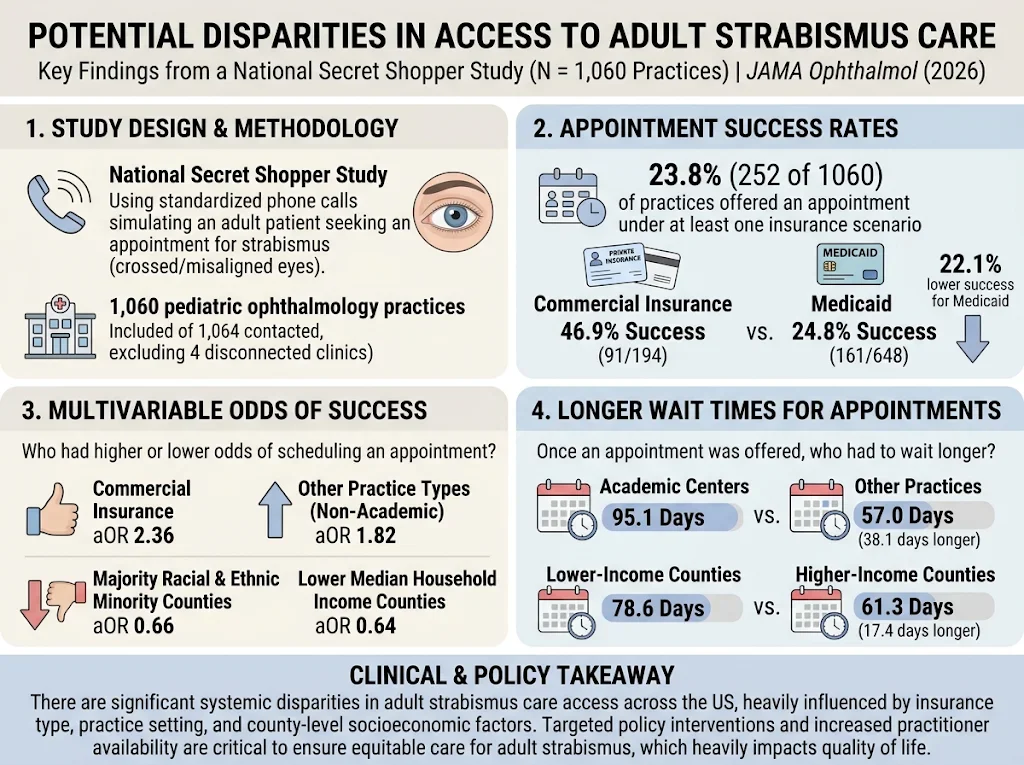
A landmark study by George and colleagues (2026) employed a national secret shopper methodology to evaluate access to adult strabismus appointments in US pediatric ophthalmology practices. Over 1060 clinics were contacted simulating an adult patient seeking care under two insurance scenarios: Medicaid and commercial insurance. Practice types (academic vs other) and county-level socioeconomic indicators such as median household income, Area Deprivation Index (ADI), and racial/ethnic composition were analyzed as exposure variables.
Only 23.8% of practices offered an appointment under at least one insurance scenario, highlighting substantial barriers to care availability. Appointment success rate was significantly higher for patients with commercial insurance (46.9%) compared to Medicaid (24.8%) reflecting systemic insurance-related access disparities (P < .001). Multivariable regression models indicated that other practice types (non-academic) had higher odds of appointment success (aOR 1.82, p=0.001) relative to academic centers, which traditionally manage more complex cases but may have resource constraints or prioritization schemes limiting access.
Moreover, practices situated in majority racial and ethnic minority counties had lower odds of appointment success (aOR 0.66, p=0.04), as did those in lower median household income counties (aOR 0.64, p=0.02), illustrating pervasive sociodemographic disparities. Among clinics offering appointments, academic centers exhibited significantly longer mean wait times (95.1 days) compared to other practices (57.0 days, p < .001). Similarly, patients residing in lower-income counties faced longer waits (mean 78.6 days vs 61.3 days, p=0.03), further delaying timely intervention.
These findings collectively affirm that insurance type, practice setting, and socioeconomic context substantially impact access and timeliness of adult strabismus care.
Supporting Evidence on Functional Implications and Oculomotor Adaptations in Strabismus
While disparities in access represent a critical barrier, therapeutic efficacy relies on understanding the oculomotor mechanisms involved. Studies investigating vergence and accommodation responses elucidate the plasticity and adaptability of binocular vision mechanisms relevant for strabismus treatment.
Rogers et al. (2014) demonstrated that vergence exercises modestly improve convergence in young adults, although true treatment effects are limited and affected by patient effort. This underscores the potential but limited efficacy of non-surgical interventions in specific adult populations.
Similarly, interindividual variability in short-term adaptations of disparity vergence and phoria systems (Badler et al., 2011) correlates with vergence dynamics, indicating neural plasticity that could be harnessed therapeutically. The ability of the visual system to compensate for induced vertical imbalances (Hussein et al., 2008) and tolerate prism-induced disparities (Richards et al., 2007) supports targeted optical interventions in managing strabismus symptoms.
Fast neural mechanisms like short-latency disparity vergence have been characterized (Semmlow et al., 2001), providing mechanistic insights into automatic correction of small vergence errors post-saccades, which is clinically relevant for understanding symptomatic diplopia and fixation disparity in adult strabismus.
Expert Commentary
The study by George et al. fills a significant gap in our understanding of systemic barriers to adult strabismus care. The use of a standardized secret shopper approach minimizes bias inherent in self-reported access data and captures real-world appointment availability effectively.
The stark contrast in appointment success between Medicaid and commercial insurance not only reflects reimbursement and administrative challenges but underscores deeper inequities in healthcare infrastructure and provider participation. Academic centers’ longer wait times might reflect referral complexity or specialized resource allocation, yet these delays risk prolonged symptom duration for vulnerable populations.
Racial and socioeconomic disparities identified at the county level implicate structural determinants such as provider density, transportation barriers, and socioeconomic deprivation. These findings align with broader healthcare access disparities documented in ophthalmology and other specialties, necessitating multi-level interventions that span from policy to community-based outreach.
Treatment-related studies highlight the neuroplastic potential for functional improvement, yet also emphasize that care access is the prerequisite for any therapeutic benefit. These mechanistic understandings, combined with documented disparities, advocate for enhanced screening, referral pathways, and insurance reforms to optimize outcomes.
Limitations of the current evidence include reliance on pediatric ophthalmology practice listings which may not fully capture adult strabismus providers, potentially underestimating access. The data predate widespread telehealth adoption, which may offer new access avenues. Further research should evaluate longitudinal patient outcomes related to access disparities and incorporate adult ophthalmology subspecialists.
Conclusions
Adult strabismus significantly impairs quality of life but access to specialized care is marred by disparities across insurance types, practice settings, and socioeconomic environments. Commercially insured patients and non-academic practices offer higher access likelihood, while Medicaid beneficiaries and residents of minority and low-income counties face pronounced barriers and longer wait times.
Future efforts must focus on policy modifications to improve Medicaid participation, expand provider availability in underserved areas, and integrate adult strabismus expertise across diverse settings. Coupled with advances in understanding oculomotor adaptation and rehabilitative strategies, these measures could enhance equitable care delivery.
Overall, addressing disparities in adult strabismus care access is imperative to reduce morbidity, optimize functional outcomes, and mitigate psychological burden in this underserved patient population.
References
George A et al. Potential Disparities in Access to Adult Strabismus Care. JAMA Ophthalmol. 2026 Nov 5. PMID: 42986613.
Rogers E et al. Change in convergence and accommodation after two weeks of eye exercises in typical young adults. J AAPOS. 2014 Apr;18(2):162-8. PMID: 24582466.
Badler JB et al. Short-term adaptations of the dynamic disparity vergence and phoria systems. Exp Brain Res. 2011 Jul;212(2):267-78. PMID: 21594645.
Hussein MA et al. Vertical imbalance induced by prism-ballasted soft toric contact lenses fitted unilaterally. Ophthalmic Physiol Opt. 2008 Mar;28(2):157-62. PMID: 18339047.
Richards MJ et al. Tolerance to prism induced by readymade spectacles: setting and using a standard. Optom Vis Sci. 2007 Nov;84(11):1053-9. PMID: 18043425.
Semmlow JL et al. Short-latency disparity vergence in humans. J Neurophysiol. 2001 Mar;85(3):1129-52. PMID: 11247983.