Highlight
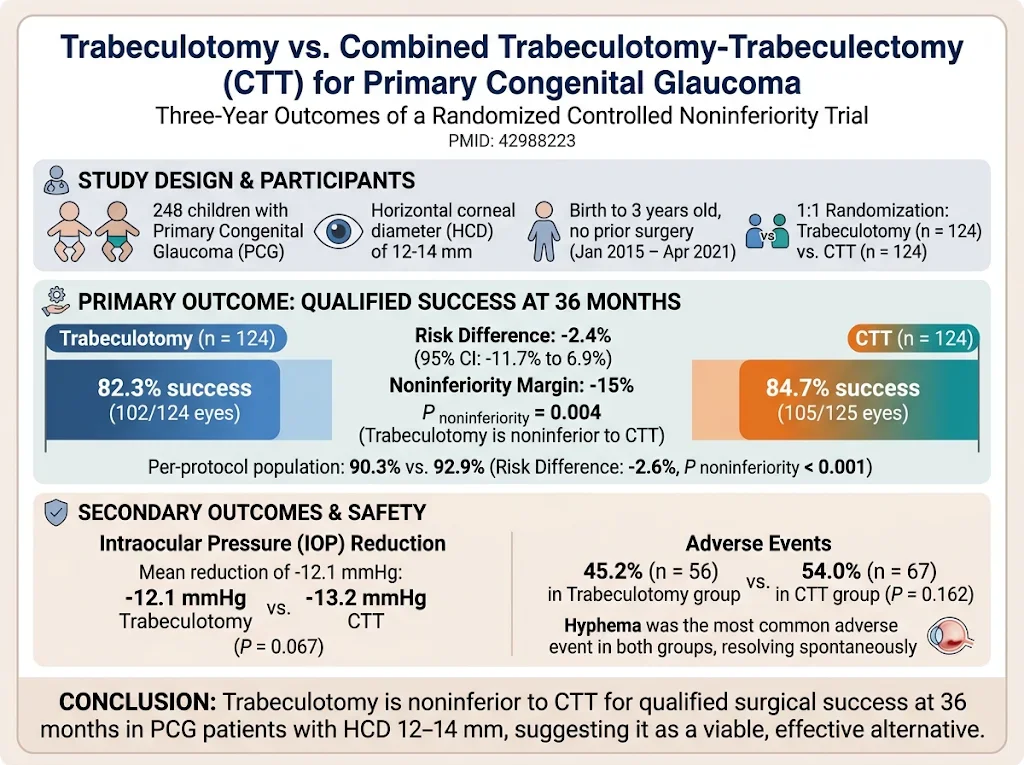
This landmark randomized trial demonstrates that trabeculotomy alone achieves noninferior 36-month qualified surgical success compared to combined trabeculotomy-trabeculectomy (CTT) in children with primary congenital glaucoma (PCG) and horizontal corneal diameters (HCD) between 12 and 14 mm. Both procedures significantly reduced intraocular pressure (IOP) with similar safety profiles, suggesting trabeculotomy as a viable less invasive alternative to CTT in moderate PCG cases.
Study Background
Primary congenital glaucoma (PCG) is a rare but serious ophthalmic condition characterized by developmental anomalies in the trabecular meshwork leading to increased intraocular pressure (IOP) within the first three years of life. Elevated IOP causes progressive optic nerve damage and visual impairment. Surgical intervention aiming to restore aqueous drainage and control IOP remains the mainstay of therapy since medical treatment is limited in efficacy for this young population.
Among surgical options, combined trabeculotomy-trabeculectomy (CTT) has been a preferred approach for moderate to severe PCG cases, especially when corneal enlargement ranges between 12 and 14 mm. However, CTT is more invasive and carries risks associated with bleb formation. Trabeculotomy alone, a less invasive angle surgery, might offer similar efficacy with potentially fewer complications. Prior data on comparative long-term outcomes between these two approaches have been limited, especially from rigorously designed randomized controlled trials.
Study Design
The study was a prospective, randomized, controlled noninferiority trial conducted from January 2015 to April 2021, with final follow-up completed in April 2024. Eligible participants were children from birth through 3 years old diagnosed with PCG characterized by a horizontal corneal diameter (HCD) of 12 to 14 mm without prior intraocular or laser surgery. Participants were randomized 1:1 to undergo either trabeculotomy alone or combined trabeculotomy-trabeculectomy (CTT).
The primary endpoint was qualified surgical success at 36 months defined as an IOP between 5 and 21 mmHg with or without glaucoma medication, absence of vision-threatening complications, and no need for additional glaucoma surgery. A noninferiority margin was set at -15 percentage points to evaluate trabeculotomy against CTT. Secondary exploratory outcomes included changes in IOP, ocular morphometric and functional parameters, and adverse event profiles.
Key Findings
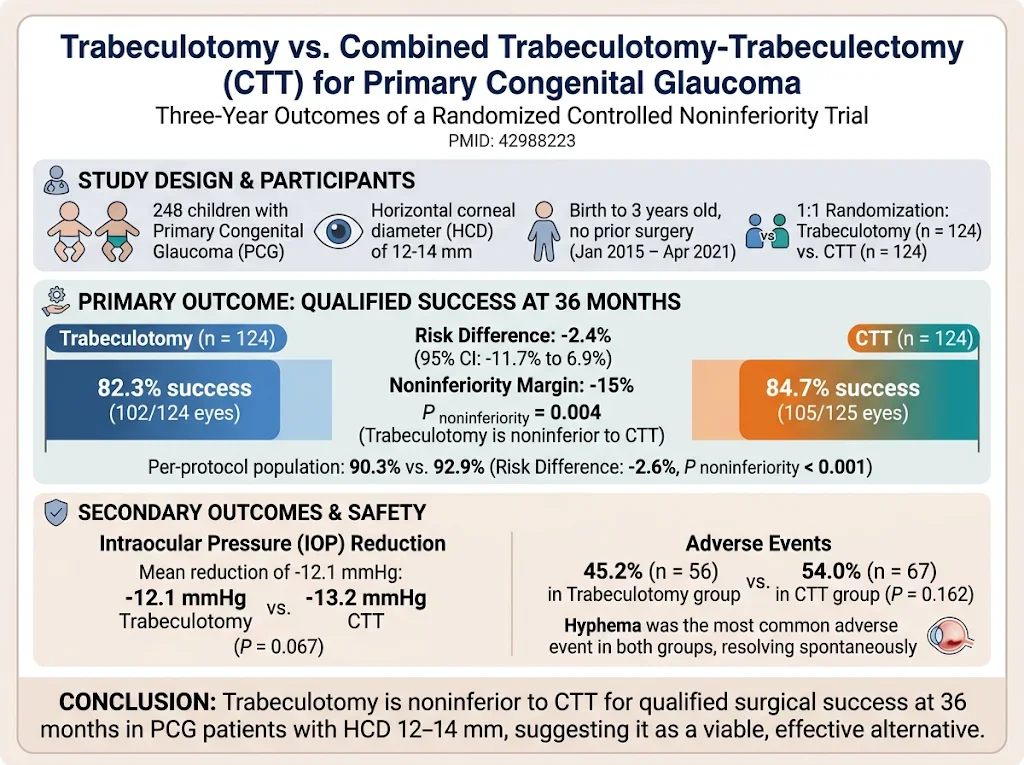
A total of 248 children were enrolled equally into the two groups: 124 underwent trabeculotomy and 124 underwent CTT. Baseline demographics were well matched, with average ages around 9.8-9.9 months and predominantly male predominance in both groups.
The three-year qualified success rates in the intention-to-treat population were 82.3% for trabeculotomy and 84.7% for CTT, with a risk difference of -2.4% (95% CI, -11.7 to 6.9), supporting the noninferiority of trabeculotomy (P_noninferiority = 0.004). The per-protocol analysis showed similar success rates (90.3% vs 92.9%; risk difference -2.6%, 95% CI -10.3 to 4.9; P_noninferiority < 0.001).
Mean reductions in IOP were both clinically and statistically significant in both groups: -12.1 mm Hg (95% CI, -12.9 to -11.4) in the trabeculotomy group and -13.2 mm Hg (95% CI, -14.0 to -12.4) in the CTT group, without significant intergroup difference (P=0.067). No differences emerged in other secondary morphological or functional ocular outcomes.
Adverse events occurred in 45.2% of trabeculotomy cases and 54.0% of CTT cases (P=0.162). The most common complication was hyphema, which resolved spontaneously in the majority of cases. No significant vision-threatening complications were reported, and no patients required additional glaucoma surgery during follow-up.
Expert Commentary
This large-scale, well-conducted randomized trial provides robust evidence supporting trabeculotomy as an effective surgical option for PCG with corneal diameters of 12 to 14 mm, a population that historically leaned toward combined trabeculotomy-trabeculectomy. The findings align with previous smaller studies suggesting angle surgery’s efficacy and safety, but this trial solidifies the role of trabeculotomy as a potentially less invasive method that spares bleb formation-related complications.
However, further research is warranted to assess outcomes beyond three years and to evaluate cases with more severe corneal enlargement or optic nerve compromise. Individual patient factors and surgeon expertise might still necessitate tailored approaches.
Conclusion
In children with primary congenital glaucoma exhibiting horizontal corneal diameters between 12 and 14 mm, trabeculotomy demonstrates noninferior 36-month qualified surgical success compared to combined trabeculotomy-trabeculectomy. Given its comparable efficacy, safety profile, and less invasive nature, trabeculotomy should be considered a valuable alternative surgical strategy in this patient population, potentially simplifying management and mitigating long-term surgical complications.
Funding and Registration
The study was funded as per institutional grants and investigator support. Clinical trial registration details were not explicitly provided in the abstract but can be referenced in the full publication.
References
1. Fang L, Lin S, Zhang J, et al. Three-Year Outcomes of Trabeculotomy vs Combined Trabeculotomy-Trabeculectomy for Primary Congenital Glaucoma. Ophthalmology. 2026 Nov 5; [PMID: 42988223].
2. Papadopoulos M, Cable N, Rahi J, et al. Childhood glaucoma in the United Kingdom: incidence, presentation, and diagnosis. Br J Ophthalmol. 2007;91(9):1174-1179.
3. Beck AD. Primary congenital glaucoma: a comprehensive clinical approach. Int Ophthalmol Clin. 2006;46(1):1-13.
4. Walton DS. Trabeculotomy versus trabeculectomy in pediatric glaucoma: contemporary surgical approaches and outcomes. Curr Opin Ophthalmol. 2021;32(2):139-145.