Bariatric Surgery and Risk of Obesity-Related Cancer by Age and Sex: A Comprehensive Review
Highlights
Bariatric surgery significantly reduces long-term risk of multiple obesity-related cancers, including liver, endometrial, and ovarian cancers.
Risk reduction after surgery is consistent across age groups (18-39 and 40-59 years) and between sexes for most cancers.
An unexpected increased risk of pancreatic cancer post-surgery among younger adults underscores need for nuanced surveillance.
Combining bariatric surgery with emerging therapies like GLP-1 receptor agonists may further optimize oncologic outcomes in obesity.
Background
Obesity is a well-established risk factor for a spectrum of malignancies, mediated through chronic inflammation, hormonal dysregulation, insulin resistance, and immune modulation. The incidence of obesity-related cancers, such as breast, endometrial, liver, and colorectal cancers, escalates proportionally with adiposity measures including body mass index (BMI) and waist circumference. Metabolic and bariatric surgery (MBS) offers one of the most effective interventions for substantial and sustained weight loss, with downstream improvements in metabolic profiles and comorbidities.
Despite mounting epidemiological evidence linking adiposity with cancer, the extent to which bariatric surgery mitigates these risks across demographic variables such as age and sex remains incompletely defined. The burgeoning obesity prevalence worldwide underscores the urgent need to clarify the oncologic benefits of surgical weight loss to guide clinical decision-making and health policy.
Key Content
Chronological and Cohort Evidence on Bariatric Surgery and Cancer Risk
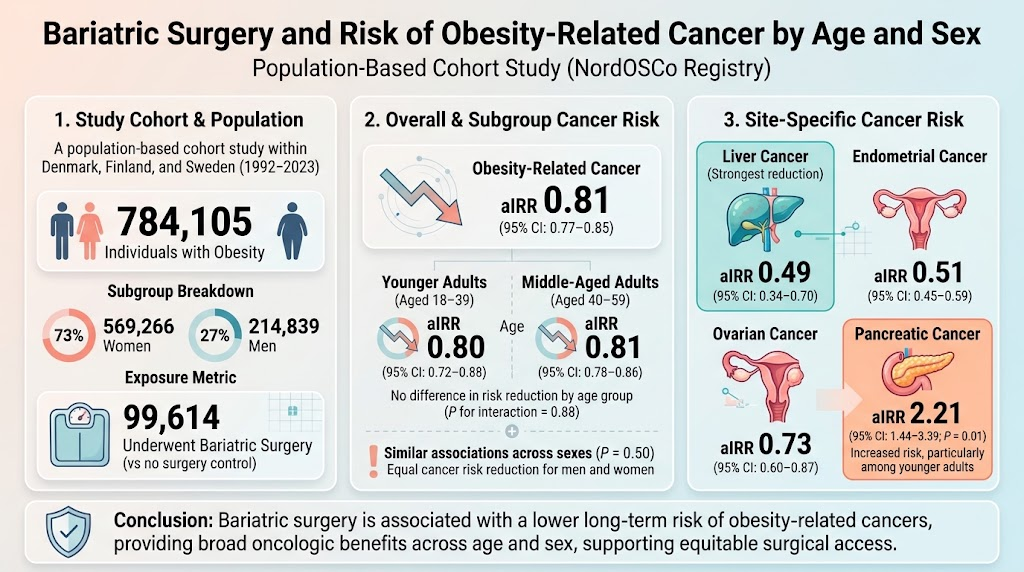
The Nordic Obesity Surgery Cohort (NordOSCo), a population-based prospective study spanning Denmark, Finland, and Sweden (1992–2023), recently provided robust data on bariatric surgery’s influence on obesity-related cancer incidence across 784,105 individuals with obesity (Radkiewicz et al., 2026). Within this cohort, 99,614 underwent bariatric surgery. Multivariable Poisson regression adjusting for confounders revealed a significant 19% reduction in overall obesity-related cancer risk (adjusted incidence rate ratio [aIRR]=0.81, 95% CI 0.77–0.85) compared with non-surgical controls. Importantly, this protective association was consistent across age groups 18–39 years (aIRR=0.80) and 40–59 years (aIRR=0.81), with no significant interaction by sex for non-sex-specific cancers.
The strongest inverse associations were observed for liver cancer (aIRR=0.49), endometrial cancer (aIRR=0.51), and ovarian cancer (aIRR=0.73). This aligns with previously established pathophysiological links between obesity, chronic hepatic inflammation, estrogen excess, and carcinogenesis in these organs.
Conversely, pancreatic cancer risk was notably increased post-surgery, particularly in younger adults (aIRR=2.21). Supplemental analyses suggest this may relate to diagnostic delays or altered pancreatic physiology post-anatomical modification, warranting heightened vigilance.
Complementing this, the Swedish Obese Subjects (SOS) study with a median follow-up approaching 27 years corroborated sex-specific effects: bariatric surgery markedly lowered female-specific cancer incidence and mortality, especially in women with elevated baseline insulin levels, underscoring mechanistic links to insulin resistance (Berglund et al., 2026).
Population-based studies from France further affirm metabolic and bariatric surgery reduces hematologic cancer risks, including Hodgkin and non-Hodgkin lymphoma, leukemia, and multiple myeloma, independent of surgery type (sleeve gastrectomy or Roux-en-Y gastric bypass) and gender, highlighting broader oncologic benefits (Couet et al., 2025).
Mechanistic Insights
Obesity-induced carcinogenesis stems from a complex interplay of metabolic, inflammatory, hormonal, and immune pathways. Bariatric surgery induces weight loss that modulates these etiologies, as evidenced by reversal of peripheral blood monocytosis and normalization of pro-inflammatory monocyte subpopulations within one year postoperatively, reducing chronic inflammation and potentially mitigating cancer risk (Schmidt et al., 2026).
In parallel, reductions in intramuscular fat have been associated with improved insulin sensitivity and muscle function after bariatric surgery, offering additional plausible mechanisms for lowered cancer risk (Fischer et al., 2026). Furthermore, bariatric surgery may decrease circulating estrogens and alter gut microbiome composition, both implicated in tumorigenesis.
It is noteworthy that emerging pharmacotherapies like glucagon-like peptide-1 receptor agonists (GLP-1RAs) exhibit synergistic benefits with bariatric surgery, improving breast cancer outcomes in obese postmenopausal women likely through metabolic and anti-inflammatory effects beyond mere weight loss (Wang et al., 2026).
Screening and Clinical Implications
While bariatric surgery confers significant cancer risk reductions, preoperative cancer screening remains essential. Systematic reviews advocate individualized colorectal cancer screening in bariatric candidates, focusing on age (≥45 years), family history, and comorbidities to optimize surgical candidacy and postoperative surveillance (Smith et al., 2026).
The increased risk of gastric adenocarcinoma in the excluded stomach post-gastric bypass highlights the need for tailored endoscopic surveillance, despite its rarity (Larsen et al., 2026). Moreover, challenges in pancreatic cancer diagnosis post-bariatric surgery underscore integration of specialized diagnostic approaches.
Expert Commentary
The accumulated evidence from large, well-characterized cohorts and meta-analyses confirm bariatric surgery as a potent intervention to reduce the incidence of many obesity-related malignancies, with benefit spanning sexes and age ranges. The differential effects on pancreatic cancer risk and rare gastric adenocarcinoma post-surgery warrant nuanced clinical vigilance and further research on pathophysiological underpinnings.
Mechanistically, reversal of obesity-related chronic inflammation, hormonal milieu normalization, and improved metabolic profiles provide biologic rationale for observed epidemiologic findings. The synergistic potential of combination therapies, including GLP-1 receptor agonists, introduces promising avenues to enhance cancer risk reduction.
Despite compelling benefits, disparities in bariatric surgery access remain a global challenge. These findings support equitable surgical provision to diverse patient populations regardless of age or sex. Current guidelines encourage integration of cancer risk assessment into obesity management, tailoring perioperative care to mitigate rare but serious adverse outcomes such as thromboembolism.
Limitations include reliance on observational data with inherent confounding, lack of randomized controlled trials focused exclusively on cancer endpoints, and evolving surgical techniques impacting generalizability. Future randomized or quasi-experimental studies with long-term follow-up are essential to refine risk estimates and clarify mechanisms.
Conclusion
Bariatric surgery significantly lowers the long-term risk of multiple obesity-related cancers across age groups and sexes, reinforcing its role in comprehensive obesity care. Strongest risk reductions are evident for liver, endometrial, and ovarian cancers, with important considerations for pancreatic and gastric cancers postoperatively. Integration of bariatric surgery with adjunctive metabolic therapies and personalized screening strategies promises to optimize oncologic and metabolic outcomes. Addressing barriers to surgery access and implementing standardized surveillance protocols remain priorities. Further mechanistic and interventional studies will inform precision prevention strategies in obesity-driven oncogenesis.
References
Radkiewicz C, Santoni G, Kauppila JH, et al. Bariatric Surgery and Risk of Obesity-Related Cancer by Age and Sex. JAMA Surg. 2026 Oct 14. PMID: 42873495.
Berglund L, Andersson-Assarsson JC, Olbers T, et al. Sex-specific associations between surgery-induced weight loss and cancer outcomes: A post hoc analysis of the Swedish Obese Subjects study. PLoS Med. 2026 Jan 5;23(1):e1004876. PMID: 41490246.
Couet C, Bozec E, Andrault PM, et al. Metabolic and bariatric surgery reduces the risk of hematological cancer in individuals with obesity: a nationwide administrative data study in France. Int J Surg. 2025 Oct;111:6970-6977. PMID: 40693973.
Schmidt M, Bergholdt HKM, Hansen T, et al. Bariatric surgery and subsequent weight loss lead to a reversal of peripheral blood monocytosis in obesity. Int J Obes (Lond). 2026 Aug;50(8):1742-1750. PMID: 42032339.
Wang X, Li C, Nguyen A, et al. GLP-1 Receptor Agonists versus Bariatric Surgery in Breast Cancer: A Comparative Study of Oncologic Outcomes. Ann Surg. 2026 Sep 1;284(3):534-545. PMID: 42298328.
Smith D, Patel P, Kovac D. Should Bariatric Surgery Candidates Be Screened for Colorectal Cancer? A Systematic Review. J Clin Med. 2026 May 8;15(10):3612. PMID: 42194574.
Larsen M, Nielsen AL, Vilmann P, et al. Cancer in the Excluded Stomach After Gastric Bypass Surgery for Obesity. Ann Surg. 2026 Feb 20. PMID: 41718443.
This article was created using several editorial tools, including AI, as part of the process. Human editors reviewed this content before publication.