Cancer Risks in Lichen Planus: Implications from a Nationwide Danish Cohort Study
Highlight
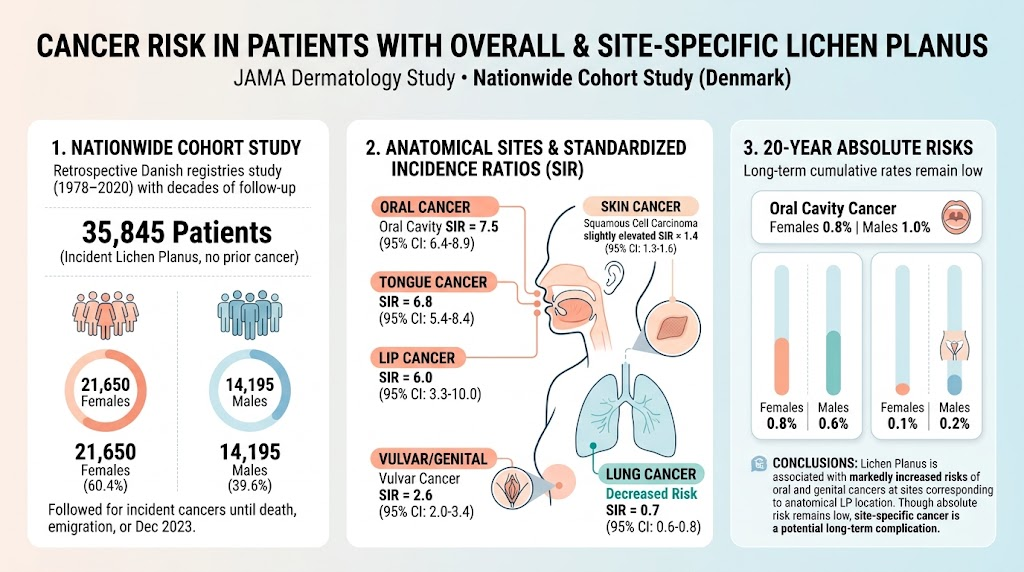
This large Danish cohort study identified that patients with lichen planus have significantly increased risks of developing oral and genital cancers, specifically squamous cell carcinomas at sites corresponding to their LP location. While cancer risk is elevated, the absolute 20-year risks remain low. Notably, lung cancer risk was decreased in this population. The findings suggest a need for targeted long-term cancer monitoring, particularly for oral and genital malignancies in LP patients.
Background
Lichen planus (LP) is a chronic inflammatory mucocutaneous disorder classically characterized by pruritic, violaceous papules on the skin and distinctive white reticulated lesions on the oral and genital mucosa. It affects around 0.5% to 1% of the general population and can significantly impact quality of life due to symptoms and recalcitrance.
Although LP has been suspected to confer increased risk of malignancy, particularly squamous cell carcinoma of the oral mucosa and genital areas, existing evidence has been inconsistent due to small sample sizes and heterogeneous case definitions. The potential carcinogenic link is thought to derive from chronic inflammation, immune dysregulation, and epithelial damage providing a microenvironment conducive to malignant transformation.
Establishing the magnitude and specificity of cancer risk in LP is important to guide clinical surveillance, counseling, and management strategies.
Study Design
This was a retrospective nationwide cohort study conducted in Denmark, utilizing comprehensive national registers from 1978 through 2020. Patients with incident LP diagnoses were identified from the National Patient Register and the Danish Pathology Register. Importantly, patients with previous cancer diagnosis were excluded to focus on incident cancer risk post-LP diagnosis.
LP cases were classified by anatomical location: oral, cutaneous, and genital forms. Individuals were followed until death, emigration, or the end of 2023. Incident cancers were ascertained from the Danish Cancer Register, allowing for robust linkage and outcome validation.
The primary outcome was the incidence of site-specific and overall cancers compared to the general Danish population, expressed as standardized incidence ratios (SIRs) with 95% confidence intervals (CIs). Separate analyses were performed for females and males.
Key Findings
The cohort included 35,845 individuals diagnosed with LP (21,650 females and 14,195 males). Key cancer risk findings were:
Oral cancers: Females with any form of LP showed markedly increased risk of lip cancer (SIR=6.0), oral cavity cancer (SIR=7.5), and tongue cancer (SIR=6.8). Male patients exhibited a similar elevated risk pattern. These risks were especially pronounced among patients with oral LP, reflecting a site-specific cancer predisposition.
Genital cancers: Females with LP had increased risk of vulvar cancer (SIR=2.6). Genital LP patients showed the highest genital cancer risk, underscoring anatomical correlation.
Skin cancers: There was a slight elevation in squamous cell carcinoma risk overall (SIR=1.4), mainly involving cutaneous LP.
Lung cancer: An unexpected decreased risk was observed (SIR=0.7) in LP patients, possibly reflecting confounding factors such as smoking prevalence, although the explanation remains uncertain.
Absolute risks: Despite elevated relative risks, absolute 20-year cancer risks were low: up to 1% for oral cavity cancers and under 0.5% for genital cancers in both genders.
Importantly, the increased risks persisted consistently across the follow-up period, implying the need for sustained vigilance in clinical practice.
Expert Commentary
This study robustly confirms the association between LP, particularly oral and genital LP, and elevated risks of site-specific squamous cell carcinomas. The biologic plausibility lies in chronic inflammation promoting carcinogenesis through oxidative stress, DNA damage, and persistent epithelial injury in LP lesions. These findings align with prior smaller studies and meta-analyses evidencing oral LP as a premalignant condition requiring surveillance.
The decreased lung cancer risk is intriguing and warrants further investigation, considering potential biases including smoking patterns or misclassification.
Limitations include reliance on registry-based diagnosis without histopathologic confirmation of all cases and lack of data on lifestyle confounders like tobacco and alcohol. Nevertheless, the nationwide sample and long follow-up enhance generalizability and statistical power.
Conclusion
This comprehensive Danish cohort study validates that lichen planus is associated with significantly increased risks of oral and genital cancers, especially squamous cell carcinomas corresponding to LP lesion sites. Although the absolute risk remains low, clinicians should be aware of this long-term complication to enable early detection and management.
Future directions should incorporate prospective studies integrating clinical, histopathologic, and lifestyle factors to refine cancer risk stratification in LP and optimize surveillance guidelines. Patient education on malignancy signs and tailored follow-up remain prudent clinical measures.
Funding and Trials
This study was supported by Danish health research institutions as per the original publication. No clinical trial registration was applicable due to the observational design.
References
Medianfar CE et al. Cancer Risk in Patients With Overall and Site-Specific Lichen Planus. JAMA Dermatol. 2026 Oct 14;PMID: 42873519.
Coates AR et al. Oral lichen planus and cancer: An overview. Oral Surg Oral Med Oral Pathol Oral Radiol. 2021;131(1):25-32.
Ferreira UR et al. Risk of Malignant Transformation of Oral Lichen Planus: A Systematic Review. J Oral Pathol Med. 2020;49(5):389-394.
This article was created using several editorial tools, including AI, as part of the process. Human editors reviewed this content before publication.