We use cookies

Our website uses essential cookies and, with your consent, additional cookies to measure performance and improve our services. Cookie Policy.

You can change your choice at any time.

MMedXYNews
HomeVideos
MedXY AI/MedXY News/Section: General Surgery

Beyond Age: Frailty as a Superior Predictor of Postoperative Outcomes in Older Adults
MedXY Editorial Team•Oct 6, 2026•General Surgery
ageFrailtyolder adultssurgical risk术后结局

Highlight

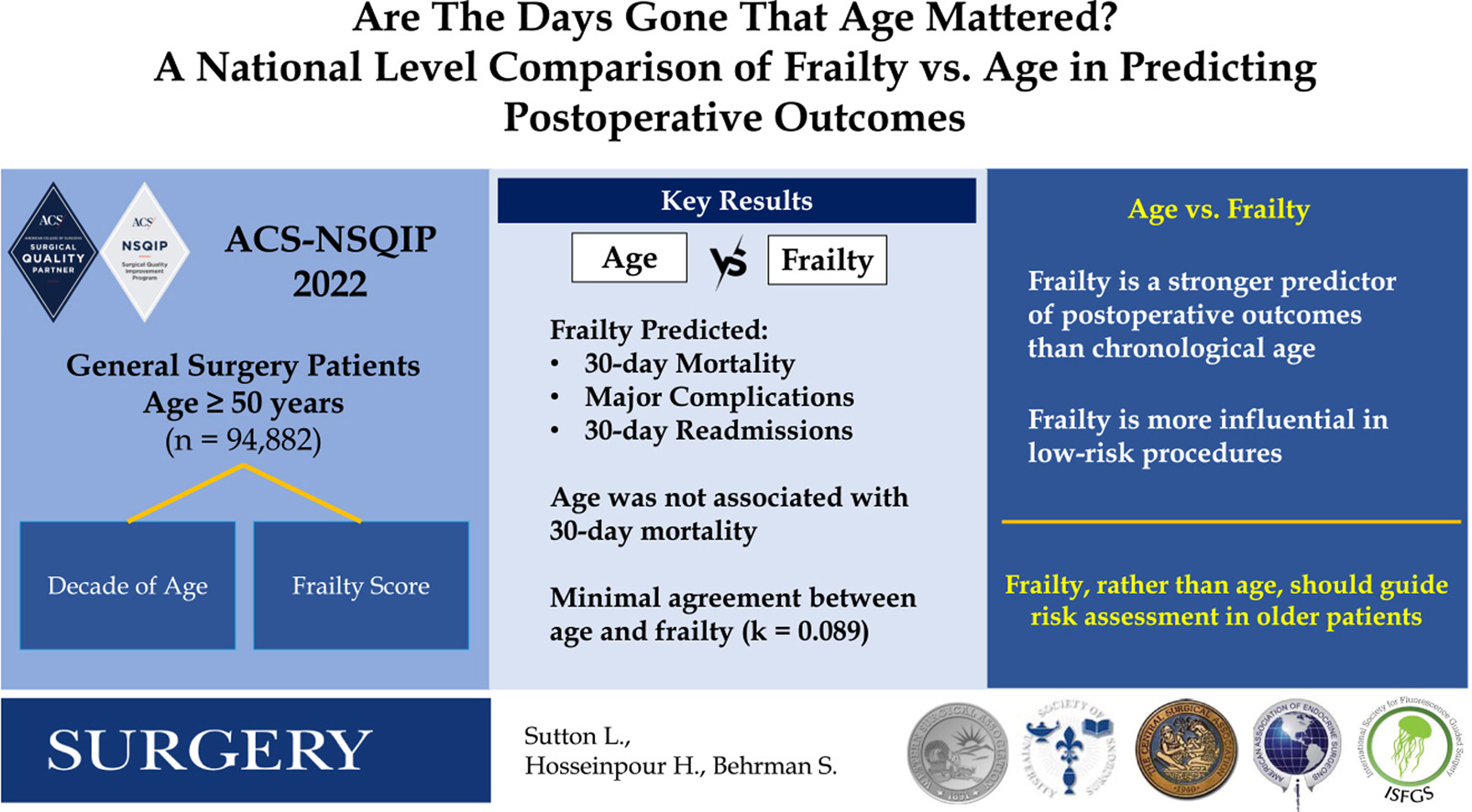
  • Frailty score is a more accurate predictor of 30-day postoperative mortality than chronological age in patients aged 50 and above undergoing general surgery.
  • The predictive value of frailty increases as procedural risk decreases, highlighting its broad applicability across surgical complexities.
  • There is a poor correlation between age and frailty, indicating these are distinct metrics and supporting frailty’s clinical utility over age in surgical risk stratification.

Study Background

MedXY registered readers

Sign in free to continue reading

Create or use your MedXY account to unlock the complete article.

This article was created using several editorial tools, including AI, as part of the process. Human editors reviewed this content before publication.

Related articles

Open language-specific specialty feeds and department pages.

Bariatric Surgery and Risk of Obesity-Related Cancer by Age and Sex: A Comprehensive ReviewThis review synthesizes evidence from large cohort studies and meta-analyses highlighting bariatric surgery’s association with reduced risks of many obesity-related cancers, consistent across age and sex. Mechanistic insights and implOct 19, 2026Impact of Poor Food Access on Metabolic Dysfunction-associated Liver Disease and Frailty Among Liver Transplant Candidates: A Geospatial AnalysisPoor food access correlates with higher MASLD and frailty prevalence in liver transplant candidates, with geospatial clustering highlighting socioeconomic and environmental determinants impacting transplant candidacy and outcomes.Oct 15, 2026Facilitated vs Self-Guided Advance Care Planning in Black and White Older Adults: Insights from the EQUAL ACP Randomized TrialThe EQUAL ACP trial compared facilitated and self-guided advance care planning in Black and White older adults with serious illnesses, revealing no significant difference in overall ACP completion but greater facilitated approach efficacy aOct 14, 2026
Loading comments...
MedXY briefing

Get the free newsletter

Evidence-led clinical news, trends, and analysis—delivered to your inbox.

Ask MedXY AI

Most popular

Intimate Health
Five Benefits for Women Continuing Sexual Activity After Menopause
Intimate Health
Why Some Women Have a Strong Sex Drive—And Why Men Shouldn't Worry About It
Nursing & care
How often should a couple have sex?
Cardiology
Precision Medicine for Long QT Syndrome Type 2: Lumacaftor Corrects Trafficking Defects and Shortens QT Interval
General Surgery
Optimizing Postoperative Opioid Prescriptions After Intra-Abdominal Cancer Surgery: Comparing the 5x-Multiplier and 3-Tier Models
© 2026 MedXY
Contact usAbout usPrivacy PolicyMedXY story
Navigating the Shift: Insights into a Department’s Transition from Total to Intracapsular Tonsillectomy
This mixed methods study details a six-year transition from total tonsillectomy to intracapsular tonsillectomy, highlighting improved postoperative outcomes and surgeon motivators behind adopting this safer surgical technique.
Oct 10, 2026
Evolving Surgical Patterns and Outcomes in Young Women with Breast Cancer: Insights from a Decade of National DataThis large-scale study reveals that adolescent and young adult women with breast cancer predominantly undergo mastectomy and experience comparable perioperative outcomes to older women, despite a higher metastatic burden.Oct 8, 2026
Evaluating Postoperative Outcomes in Children with Autism Spectrum Disorder Undergoing Gastrostomy Tube PlacementAutism spectrum disorder (ASD) does not independently affect postoperative length of stay or complication rates after gastrostomy tube placement in children. Instead, outcomes are more strongly influenced by developmental delay and preoperaSep 30, 2026