ABILITY NeuroTech Commences First In-Human Testing of Novel Brain-Computer Interface
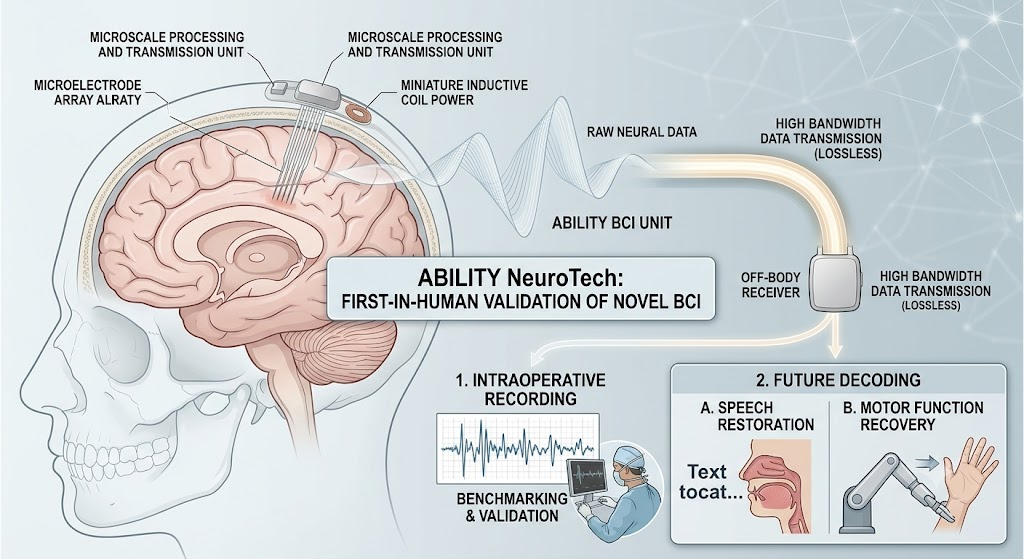
First-in-human procedure for ABILITY NeuroTech's fully implantable BCI conducted at Technical University of Munich.
Up to five individuals undergoing brain tumor surgery will have neural data recorded intraoperatively.
Initial patients underwent system validation under general anesthesia; next phase involves conscious patients performing speech and motor tasks.
The company aims to restore communication and movement for patients with severe neurological impairment.
ABILITY NeuroTech, a clinical-stage brain-computer interface (BCI) company, has announced the first-in-human procedure for its fully implantable neural data platform. The procedure was performed at the Department of Neurosurgery at the Technical University of Munich (TUM) University Hospital Rechts der Isar, marking the first real-world validation of the company’s signal acquisition system in a live surgical setting. The procedure was conducted by a team led by Drs. Wagner, Meyer, and Jacob from the Department of Neurosurgery and the Laboratory for Translational Neurotechnology.
How the Technology Works
ABILITY’s BCI is designed to be fully implantable, capturing raw, high-resolution brain signals and transmitting lossless data at significantly higher bandwidth than conventional Bluetooth-based systems. The company describes the device as minimally invasive and engineered for long-term implantation while maintaining high-fidelity neural data capture. The system is intended to decode brain activity to restore communication, movement, and autonomy in individuals with paralysis or speech loss due to severe neurological conditions such as amyotrophic lateral sclerosis, spinal cord injury, or stroke.
What the Evidence Shows
In the initial phase of the study, patients under general anesthesia underwent end-to-end system validation. The researchers were able to capture known neural phenomena, including evoked potentials and high-gamma activity, and benchmark ABILITY's signal quality against established clinical electrophysiology systems. According to Professor Simon Jacob, MD, who leads the Laboratory for Translational Neurotechnology, 'Establishing this scientific basis is what will allow brain-computer interface technology to mature responsibly from research into a reliable clinical tool.'
The study, which will enroll up to five participants undergoing brain tumor surgery, includes 20–30 minutes of intraoperative recording per patient. The next stage will involve neural decoding while conscious patients perform speech and motor tasks, providing critical data for the device's intended use.
Rotem Kopel, PhD, CEO of ABILITY NeuroTech, noted that recording neural data from humans for the first time is a key milestone toward enabling safe, ethical long-term BCI implantations. The company plans to use these initial data to refine the device and move toward a first long-term implantation study.
Why It Could Matter
Brain-computer interfaces have been a focus of intense research for decades, with both non-invasive and invasive approaches being developed. ABILITY’s approach emphasizes high-bandwidth, lossless data transmission and a fully implantable design, which could offer advantages for long-term use and real-time decoding. If the technology proves safe and effective in future studies, it could provide a new communication and control option for individuals with severe motor impairment.
The collaboration with a leading neurosurgery department in Europe adds clinical credibility and demonstrates a path from engineering proof-of-concept to real-world surgical validation. Intraoperative recording allows the team to validate signal acquisition against gold-standard electrophysiology systems in a controlled setting, an important step before pursuing chronic implantation.
Important Limitations
This is an early feasibility study with several important limitations. The sample size is very small (up to five patients) and the data are limited to intraoperative recordings of short duration. The study population consists of patients undergoing brain tumor surgery, which may not represent the eventual target population of chronic paralysis or communication loss. The results have not been peer-reviewed or published in a scientific journal. Long-term safety, device durability, clinical utility, and patient outcomes remain unknown. The company has not disclosed device specifications in detail, and funding sources have not been stated.
What Comes Next
Following this feasibility testing, ABILITY NeuroTech intends to proceed with its first long-term implantation study. The ongoing early feasibility study will inform device design, surgical protocol, and regulatory strategy for that next phase. The company has not announced a timeline for those studies or any regulatory submissions.