We use cookies

Our website uses essential cookies and, with your consent, additional cookies to measure performance and improve our services. Cookie Policy.

You can change your choice at any time.

MMedXYNews
HomeVideos
MedXY AI/MedXY News/Section: Cardiology

Unraveling the Vascular Impact of Immune Checkpoint and VEGF Inhibitors: Insights from PET Imaging and Immune Profiling
MedXY Editorial Team•Sep 13, 2026•Cardiology
arterial inflammationatherothrombosisimmune checkpoint inhibitorsPET imagingVEGF inhibitors

Highlight

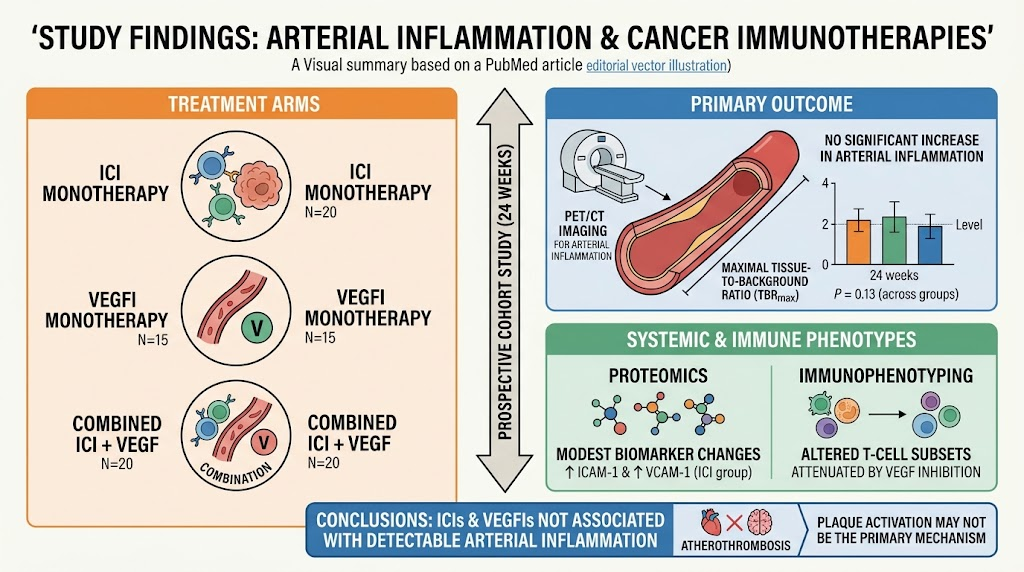
This prospective cohort study found that immune checkpoint inhibitors (ICIs), vascular endothelial growth factor inhibitors (VEGFIs), and their combination do not increase arterial inflammation detectable by (18F)fluorodeoxyglucose positron emission tomography computed tomography (18F-FDG-PET/CT) over 24 weeks. Alterations in specific T-cell subsets were observed with ICI therapy, attenuated by combined VEGFI treatment. Systemic inflammatory biomarkers showed minimal changes except for increased adhesion molecules with ICIs, suggesting endothelial activation rather than macrophage-driven plaque inflammation as potential contributors to cardiovascular risk.

Study Background

MedXY registered readers

Sign in free to continue reading

Create or use your MedXY account to unlock the complete article.

This article was created using several editorial tools, including AI, as part of the process. Human editors reviewed this content before publication.

Related articles

Open language-specific specialty feeds and department pages.

Pembrolizumab Plus Quad-Shot Radiotherapy: A Promising Approach for Recurrent, Unresectable Head and Neck CancerA phase 2 trial shows pembrolizumab combined with low-dose quad-shot radiotherapy yields encouraging response rates and survival outcomes in recurrent, unresectable head and neck squamous cell carcinoma.Aug 21, 2026Extracellular Vesicles as Liquid Biopsy Biomarkers Predicting Immune Checkpoint Therapy Resistance in Hepatocellular CarcinomaCirculating extracellular vesicles carrying PD-1, PD-L1, and CTLA-4 can non-invasively predict responses and early resistance to immune checkpoint inhibitors in advanced hepatocellular carcinoma, improving patient stratification and managemAug 9, 2026MLH1 Promoter Hypermethylation Does Not Impact Survival Outcomes in dMMR Endometrial Cancer Treated with Immune Checkpoint InhibitorsThis study analyzes real-world data showing that MLH1 promoter hypermethylation and Lynch syndrome-associated genetic mutations confer similar response rates and survival outcomes in mismatch repair deficient endometrial cancer treated withAug 18, 2026
Loading comments...
MedXY briefing

Get the free newsletter

Evidence-led clinical news, trends, and analysis—delivered to your inbox.

Ask MedXY AI

Most popular

Intimate Health
Five Benefits for Women Continuing Sexual Activity After Menopause
Intimate Health
Why Some Women Have a Strong Sex Drive—And Why Men Shouldn't Worry About It
Nursing & care
How often should a couple have sex?
Intimate Health
Classic Intimacy Recommendations: How to Help Women Reach Orgasm and Enjoy Mutual Pleasure
Intimate Health
What Makes a Woman "Physiologically Addicted" Is Never Money, But These Two Relationship Qualities
© 2026 MedXY
Contact usAbout usPrivacy PolicyMedXY story
DR5/Ligase 3 Feedback Loop: Unlocking the Immunogenicity of Mismatch Repair-Deficient Colorectal Cancer
This study uncovers a novel DR5/Ligase 3 feedback mechanism that sustains immunogenicity and enhances immune checkpoint inhibitor response in mismatch repair-deficient colorectal cancer.
Jul 20, 2026
Immune Checkpoint Inhibitor-Associated Uveitis: Comparative Risk Across Cancers and Drug ClassesA multicenter study found that immune checkpoint inhibitor–associated uveitis risk varies by cancer type and drug class, with melanoma showing the highest intrinsic risk and RCC risk largely linked to ipilimumab/nivolumab exposure.Jun 4, 2026
Beyond Extrapolation: Immunotherapy Outcomes in Recurrent Vulvovaginal CarcinomaThis retrospective study found that immune checkpoint inhibitors produced modest overall benefit in recurrent vulvar and vaginal carcinoma, but a small subset of patients had durable responses lasting months.Aug 18, 2026