We use cookies

Our website uses essential cookies and, with your consent, additional cookies to measure performance and improve our services. Cookie Policy.

You can change your choice at any time.

MMedXYNews
HomeVideos
MedXY AI/MedXY News/Section: Diabetes & Endocrinology

Unraveling the Role of 11-Oxygenated Androgens in PCOS: Phenotype-Specific Profiles and Treatment Responses
MedXY Editorial Team•Sep 3, 2026•Diabetes & Endocrinology
PCOSmetformin11-oxygenated androgensoral contraceptivesphenotype-specific androgen excess

Highlight

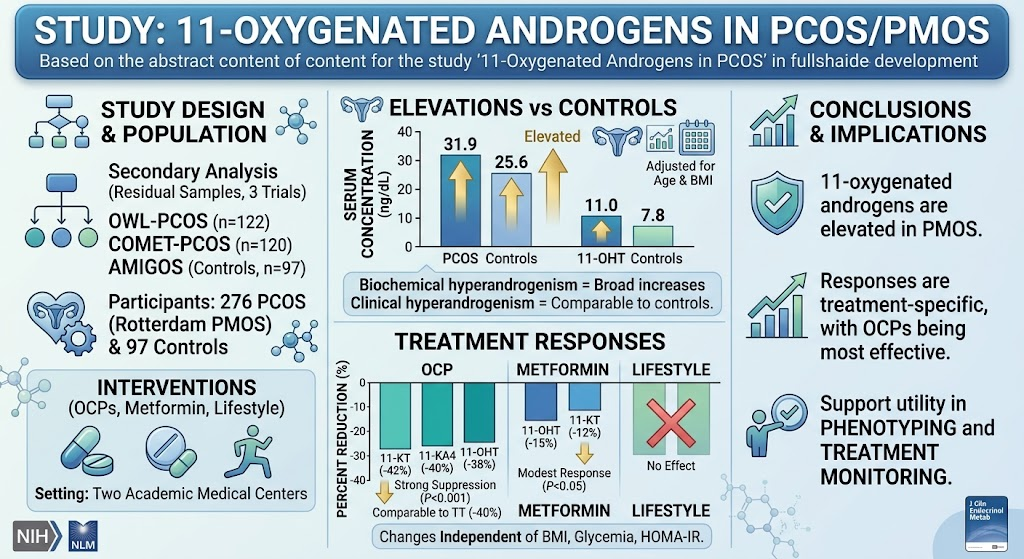
11-oxygenated androgens, notably 11β-hydroxytestosterone and 11-ketotestosterone, are elevated in women with polycystic ovary syndrome (PCOS) in a phenotype-dependent manner. Oral contraceptive pills (OCPs) markedly suppress these adrenal-derived androgens, whereas metformin induces modest reductions, and lifestyle modification shows no significant short-term effect. These findings support the potential of 11-oxygenated androgen profiling in refining PCOS diagnosis and monitoring therapeutic responses.

Study Background

MedXY registered readers

Sign in free to continue reading

Create or use your MedXY account to unlock the complete article.

This article was created using several editorial tools, including AI, as part of the process. Human editors reviewed this content before publication.

Related articles

Open language-specific specialty feeds and department pages.

New Consensus on Testosterone Reference Ranges for Females and Children: Outcomes of the 2024 PCOS Challenge–CDC Stakeholder MeetingA stakeholder consensus sets a roadmap to develop standardized, age- and sex-specific testosterone reference intervals for women, adolescent girls, and children to improve diagnosis and care for androgen-related disorders.Sep 19, 2026Early Life Adversity and Polycystic Ovary Syndrome among North American Pregnancy Planners: A Comprehensive ReviewThis review synthesizes current evidence linking adverse childhood experiences with increased risk and features of PCOS, highlighting possible neuroendocrine mechanisms and clinical implications for reproductive health management.Jul 1, 2026Adolescent MASLD Plus PCOS Signals a Higher-Risk Cardiometabolic Trajectory Into AdulthoodIn the Raine Study, adolescents with both MASLD and PCOS had a substantially worse cardiometabolic profile by age 27 than peers with either condition alone, highlighting a high-risk subgroup that may warrant earlier metabolic surveillance.May 28, 2026
Loading comments...
MedXY briefing

Get the free newsletter

Evidence-led clinical news, trends, and analysis—delivered to your inbox.

Ask MedXY AI

Most popular

Intimate Health
Five Benefits for Women Continuing Sexual Activity After Menopause
Intimate Health
Why Some Women Have a Strong Sex Drive—And Why Men Shouldn't Worry About It
Nursing & care
How often should a couple have sex?
Intimate Health
Classic Intimacy Recommendations: How to Help Women Reach Orgasm and Enjoy Mutual Pleasure
Intimate Health
What Makes a Woman "Physiologically Addicted" Is Never Money, But These Two Relationship Qualities
© 2026 MedXY
Contact usAbout usPrivacy PolicyMedXY story
Prepregnancy Insulin Resistance and Fertility Outcomes in Women With PCOS
Higher insulin resistance before pregnancy was linked to poorer ovulation, lower pregnancy and live-birth rates, and more gestational diabetes in women with PCOS. Improving insulin resistance during treatment was associated with better preg
Aug 18, 2026
Microbial and Metabolic Correlates of Endometrial Dysfunction in Polycystic Ovary Syndrome: A Translational StudyThis study links PCOS-related miscarriage risk to gut microbiome changes, especially reduced Parabacteroides merdae and higher isoleucine, which may promote endometrial senescence and impair pregnancy outcomes.Aug 18, 2026
Genetic Variant in CUBN Gene Identified as Key Risk Factor for Metformin-Induced Vitamin B12 DeficiencyResearchers have identified a genetic variant in the cubilin gene (CUBN, rs1801222) that significantly increases the risk of metformin-induced vitamin B12 deficiency, with carriers of the AA genotype experiencing deficiency up to twice as fApr 17, 2026