We use cookies

Our website uses essential cookies and, with your consent, additional cookies to measure performance and improve our services. Cookie Policy.

You can change your choice at any time.

MMedXYNews
HomeVideos
MedXY AI/MedXY News/Section: Cardiology

Unraveling the Cardiovascular Benefits of Semaglutide: Insights from the SELECT Trial Mediation Analysis
MedXY Editorial Team•Sep 25, 2026•Cardiology
cardiovascular riskMediation AnalysisobesitySELECT trialsemaglutide

Highlight

  • Semaglutide administered weekly at 2.4 mg significantly reduces major adverse cardiovascular events (MACE) by 20% in adults with pre-existing cardiovascular disease and obesity without diabetes.
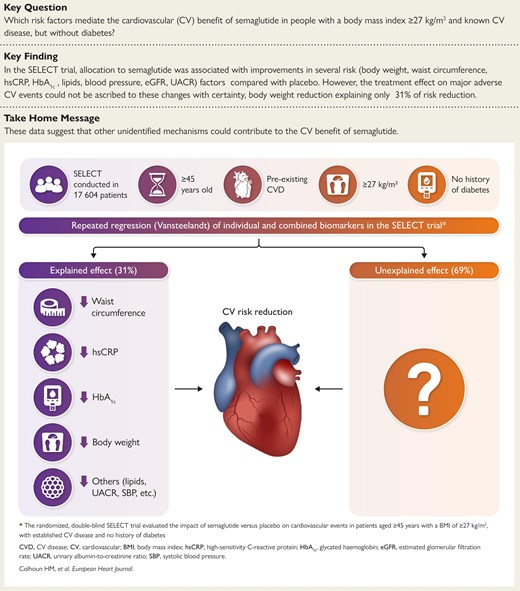
  • Mediation analysis of the SELECT trial investigated changes in traditional cardiovascular risk factors including body weight, waist circumference, inflammatory markers (hsCRP), glycemia (HbA1c), lipids, blood pressure, and renal markers as contributors to cardiovascular benefit.
  • While semaglutide improved all measured mediators, individually none fully explained the cardiovascular risk reduction with wide confidence intervals and unreliable estimates especially for weight-related parameters.
  • Combined analysis suggests known risk factors mediate approximately one-third to nearly half of the cardiovascular benefit; the remainder likely involves other unexplored pathways.

Study Background

MedXY registered readers

Sign in free to continue reading

Create or use your MedXY account to unlock the complete article.

This article was created using several editorial tools, including AI, as part of the process. Human editors reviewed this content before publication.

Related articles

Open language-specific specialty feeds and department pages.

Serum GLP-1 as a Novel Biomarker for Endometrial Cancer Detection in Obese WomenThis study reveals that lower serum GLP-1 levels are independently associated with endometrial cancer in obese, non-diabetic women, suggesting its potential as a diagnostic biomarker with high sensitivity and specificity.Oct 3, 2026Challenges in Using Insulin Dose-Adjusted HbA1c to Identify Partial Remission in Pediatric Type 1 Diabetes: Insights from the SEARCH for Diabetes in Youth StudyThis study highlights the limitations of insulin dose-adjusted hemoglobin A1c (IDAA1c) ≤9 in detecting partial remission in US youth with type 1 diabetes, especially those with overweight or obesity, suggesting BMI-specific adjustments imprOct 3, 2026Petrelintide: A Promising Human Amylin Analogue for Long-Term Obesity ManagementPetrelintide, a novel once-weekly human amylin analogue, demonstrates significant bodyweight reduction versus placebo in adults with obesity, with favorable gastrointestinal tolerability, supporting its potential as a long-term obesity therOct 3, 2026
Loading comments...
MedXY briefing

Get the free newsletter

Evidence-led clinical news, trends, and analysis—delivered to your inbox.

Ask MedXY AI

Most popular

Intimate Health
Five Benefits for Women Continuing Sexual Activity After Menopause
Intimate Health
Why Some Women Have a Strong Sex Drive—And Why Men Shouldn't Worry About It
Nursing & care
How often should a couple have sex?
Cardiology
Precision Medicine for Long QT Syndrome Type 2: Lumacaftor Corrects Trafficking Defects and Shortens QT Interval
General Surgery
Optimizing Postoperative Opioid Prescriptions After Intra-Abdominal Cancer Surgery: Comparing the 5x-Multiplier and 3-Tier Models
© 2026 MedXY
Contact usAbout usPrivacy PolicyMedXY story
Unraveling the Predictors of Peak Weight Loss with Semaglutide in Cardiovascular Patients: Insights from the SELECT Trial
In the SELECT trial, baseline clinical factors poorly predicted peak body weight loss with semaglutide, highlighting the role of sex and dosage but underscoring substantial unexplained variability in patient response.
Sep 29, 2026
Disparities in Cancer Incidence by Sex and Associated Lifestyle Factors and Health Conditions: An Integrative ReviewThis review analyzes global sex disparities in cancer incidence, highlighting modifiable lifestyle and health factors — notably smoking, alcohol, and obesity — as key contributors differing by population context, with implications for tailoSep 28, 2026
Genetically Mediated LDL Cholesterol Variations and Their Limited Impact on Venous Thromboembolism RiskThis study reveals that lifelong genetic differences in LDL cholesterol levels do not significantly affect the risk of venous thromboembolism (VTE), suggesting LDL-C may not be a major causal factor in VTE development.Sep 25, 2026