We use cookies

Our website uses essential cookies and, with your consent, additional cookies to measure performance and improve our services. Cookie Policy.

You can change your choice at any time.

MMedXYNews
HomeVideos
MedXY AI/MedXY News/Section: Cardiology

Unraveling Mitochondrial Dysfunction in RBM20-Related Dilated Cardiomyopathy: The Role of Dysregulated Ribonucleoprotein Granules
MedXY Editorial Team•Sep 19, 2026•Cardiology
RBM20ribonucleoprotein granulesDilated cardiomyopathyMitochondrial dysfunction

Highlight

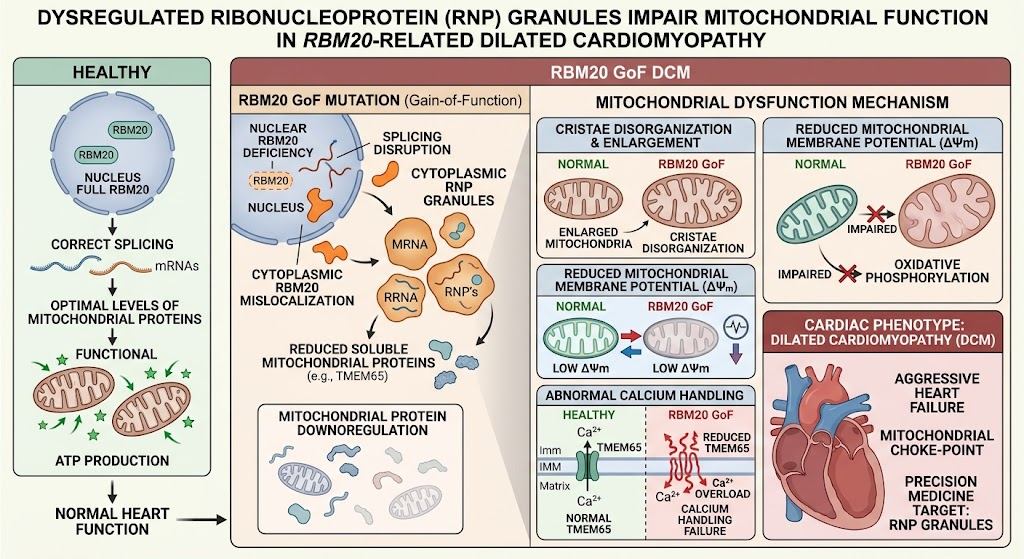
• Pathogenic RBM20 gain-of-function variants mislocalize to cytoplasmic ribonucleoprotein granules, disrupting mitochondrial protein homeostasis.
• This mislocalization causes reduced mitochondrial protein abundance, cristae disorganization, and impaired mitochondrial respiration.
• Loss-of-function RBM20 variants cause splicing defects but do not impair mitochondrial function to the same extent.
• These findings elucidate a distinct mechanism for the aggressive phenotype in RBM20-related dilated cardiomyopathy (DCM) and identify mitochondrial mRNA/protein regulation as a therapeutic target.

Study Background

MedXY registered readers

Sign in free to continue reading

Create or use your MedXY account to unlock the complete article.

This article was created using several editorial tools, including AI, as part of the process. Human editors reviewed this content before publication.

Related articles

Open language-specific specialty feeds and department pages.

Genotype-Dependent Risk and Impact of Atrial Fibrillation in Dilated Cardiomyopathy: Insights from the SHaRe RegistryThis study reveals genotype-specific differences in atrial fibrillation (AF) risk among dilated cardiomyopathy (DCM) patients, highlighting LMNA mutations as a major predictor of incident AF and its association with worse clinical outcomes,Sep 15, 2026Expanding Horizons in Dilated Cardiomyopathy: A Comprehensive Genetic Reassessment in 2024The 2024 update of the Clinical Genome Resource elucidates a rapidly expanding genetic landscape for dilated cardiomyopathy, enhancing clinical genetic interpretation with 35 genes classified as high evidence, including nine novel discoveriSep 12, 2026Targeting Acute Myeloid Leukemia through Multi-Functional Small Molecules: Insights from Cheminformatics and Mitochondrial ModulationCheminformatic screening identified novel small molecules with apoptotic, autophagic, and reductase-inhibitory activities that selectively kill AML cells, induce mitochondrial dysfunction, and synergize with current therapies, highlightingSep 1, 2026
Loading comments...
MedXY briefing

Get the free newsletter

Evidence-led clinical news, trends, and analysis—delivered to your inbox.

Ask MedXY AI

Most popular

Intimate Health
Five Benefits for Women Continuing Sexual Activity After Menopause
Intimate Health
Why Some Women Have a Strong Sex Drive—And Why Men Shouldn't Worry About It
Nursing & care
How often should a couple have sex?
Intimate Health
Classic Intimacy Recommendations: How to Help Women Reach Orgasm and Enjoy Mutual Pleasure
Intimate Health
What Makes a Woman "Physiologically Addicted" Is Never Money, But These Two Relationship Qualities
© 2026 MedXY
Contact usAbout usPrivacy PolicyMedXY story
Silent Killers: Unveiling the Hidden Cardiac Pathologies Behind Sudden Cardiac Death
This study reveals that two-thirds of community sudden cardiac deaths occur in individuals without diagnosed cardiac disease, with half harboring occult myocardial infarction or dilated cardiomyopathy, underscoring the need for improved det
Aug 18, 2026
Left Ventricular Hypertrabeculation in Dilated Cardiomyopathy: Prognostic Insights and Clinical ImplicationsThis study reveals that left ventricular hypertrabeculation, common in dilated cardiomyopathy, does not increase embolic risk or adverse outcomes, challenging previous concerns and guiding clinical management.Aug 7, 2026
Mitochondrial Rescue in HFpEF: Elamipretide Restores Skeletal Muscle Performance in a Rat ModelElamipretide improved skeletal muscle force, titin phosphorylation, and atrophy in a HFpEF rat model, supporting cardiolipin stabilization as a promising mitochondrial-targeted strategy.Jun 15, 2026