Left Ventricular Hypertrabeculation in Dilated Cardiomyopathy: Prognostic Insights and Clinical Implications
Highlight
- Left ventricular (LV) hypertrabeculation is common in dilated cardiomyopathy (DCM), detected in approximately 30% of patients.
- LV hypertrabeculation is not associated with increased risk of embolic events, major ventricular arrhythmias, or advanced heart failure in DCM.
- Genetic background and cardiac parameters such as LV ejection fraction and late gadolinium enhancement are more predictive of outcomes than hypertrabeculation.
- Prophylactic anticoagulation is not supported for DCM patients with hypertrabeculation in the absence of atrial fibrillation or other risk factors.
Study Background
Dilated cardiomyopathy (DCM) is characterized by left ventricular dilation and systolic dysfunction and represents a significant cause of heart failure and arrhythmic events. Within this heterogeneous patient population, left ventricular hypertrabeculation (previously known as left ventricular noncompaction) has been identified as a myocardial morphological variant. Initially suspected to confer increased risk for thromboembolic complications due to trabecular recesses potentially favoring thrombus formation, the clinical significance of LV hypertrabeculation in DCM remains poorly defined. Furthermore, the relationship between LV hypertrabeculation and the underlying genetic etiology of DCM—as well as its prognostic implications—has not been comprehensively characterized across populations.
Study Design and Methods
This international multicenter observational study included 1,160 patients with confirmed DCM assessed by cardiac magnetic resonance imaging (MRI). Genetic testing was performed in 997 patients (86%) to genotype DCM-associated variants. LV hypertrabeculation was quantified using fractal analysis and Petersen criteria, with good concordance between methods. Patients were followed for a median of 5.1 years (IQR 2.8–7.4) to capture key clinical endpoints including embolic events (stroke, systemic embolism), advanced heart failure events (e.g., progression to transplantation, ventricular assist device), and major ventricular arrhythmias (sustained ventricular tachycardia, ventricular fibrillation).
Key Findings
Prevalence and Genotype Associations
LV hypertrabeculation was identified in approximately 30% of DCM patients. Its prevalence varied markedly by genotype:
- Highest prevalence in patients with pathogenic variants in motor sarcomeric genes (58%) and TTN truncating variants (38%).
- Intermediate prevalence in genotype-negative patients (33%).
- Lowest prevalence among patients with variants affecting cytoskeletal/Z-disk genes (7%) and nuclear envelope genes (5%).
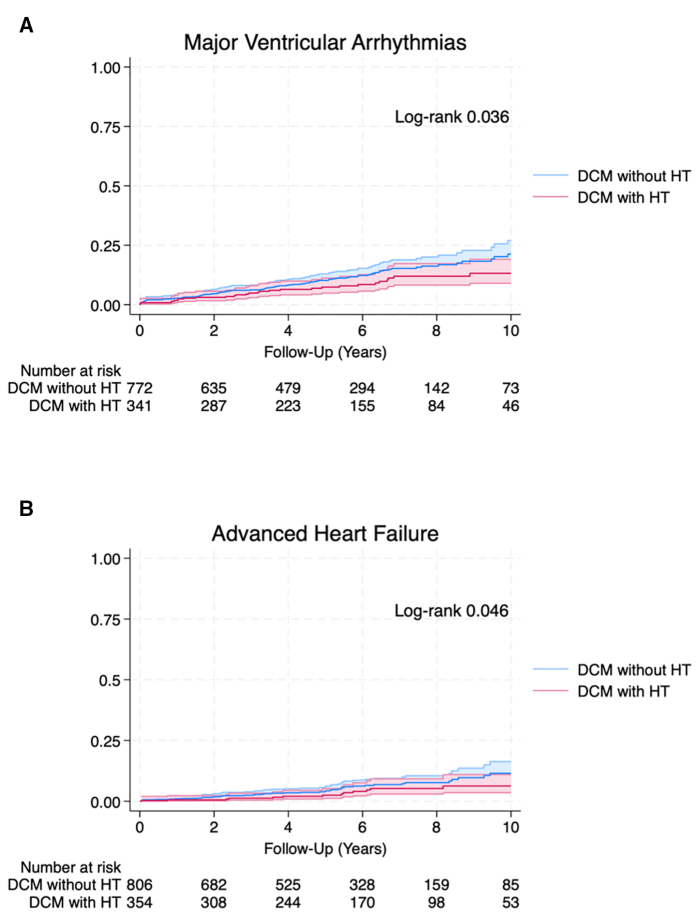
Kaplan-Meier curves for major ventricular arrhythmias and advanced heart failure according to left ventricular hypertrabeculation. A, Major ventricular arrhythmias. B, Advanced heart failure. DCM indicates dilated cardiomyopathy; and HT, hypertrabeculation.
Clinical Outcomes and Risk of Embolic Events
Despite prior concerns, LV hypertrabeculation was not associated with a statistically significant increase in embolic events. The hazard ratio (HR) for embolic events in patients with hypertrabeculation was 1.5 (95% CI, 0.75–3.00) compared to those without. Even in high-risk subgroups with left ventricular ejection fraction (LVEF) ≤40% and sinus rhythm, the embolic risk was not significantly elevated (HR 1.89, 95% CI 0.7–5.5).
Conversely, atrial fibrillation and reduced LVEF were strongly associated with embolic risk (both P<0.01), affirming their established roles in thromboembolism in DCM.
Arrhythmic and Heart Failure Risk
LV hypertrabeculation did not predict a higher risk of major ventricular arrhythmias or progression to advanced heart failure. Instead, genotype specifics, LVEF, and late gadolinium enhancement on MRI emerged as more robust predictors of adverse prognosis.
Implications for Clinical Management
Given the lack of association between LV hypertrabeculation and adverse clinical events, the study does not support changing clinical management or initiating prophylactic anticoagulation solely based on hypertrabeculation presence. This finding challenges prior assumptions warranting anticoagulant therapy due to presumed embolic risk related to trabecular morphology.
Expert Commentary
This large, well-characterized cohort provides valuable insights challenging the traditional view of LV hypertrabeculation as a high-risk phenotype within DCM. The integration of advanced cardiac MRI with genetic profiling allows nuanced understanding of myocardial morphology and genotype-phenotype correlations. While LV hypertrabeculation visually suggests a pro-thrombotic milieu, the data indicate that its clinical impact is overshadowed by established markers such as atrial fibrillation and impaired LV systolic function.
Potential limitations include variability in genetic testing panels and the observational nature precluding causality. Future studies might further clarify the mechanistic basis linking hypertrabeculation to myocardial remodeling without translating into clinical embolic or arrhythmic risk. This evidence underscores the importance of genotype-informed risk stratification over morphological criteria alone.
Conclusion
In DCM, left ventricular hypertrabeculation is a frequent morphological finding without independent prognostic significance for embolic events, ventricular arrhythmias, or advanced heart failure. Established clinical risk factors, including atrial fibrillation, reduced LVEF, and genotype, remain paramount in guiding management and prognosis assessment. Prophylactic anticoagulation is not indicated based on LV hypertrabeculation presence alone. These findings inform evidence-based clinical decision-making and emphasize the evolving role of precision phenotyping in cardiomyopathies.
Funding and ClinicalTrials.gov Registration
The study was supported by multiple international cardiovascular research foundations and institutional funding. No specific clinical trials registration number is provided.
References
1. Mora-Ayestarán N, et al. Left Ventricular Hypertrabeculation and Prognosis in Dilated Cardiomyopathy. Circulation. 2026;154(5):440-453. PMID: 42546101.
2. Elliott P, et al. Classification of the cardiomyopathies: a position statement from the ESC Working Group on Myocardial and Pericardial Diseases. Eur Heart J. 2008;29(2):270-276.
3. Towbin JA, et al. Left ventricular noncompaction cardiomyopathy. Lancet. 2015;386(9995):813-825.
4. Captur G, et al. Imaging the genetics of cardiomyopathy. Circulation. 2016;133(8):789-802.
This article was created using several editorial tools, including AI, as part of the process. Human editors reviewed this content before publication.