Ultrasound-Derived Renal Parenchymal Volume Indexed to BMI: A Novel Predictor of One-Year Kidney Graft Function
Highlight
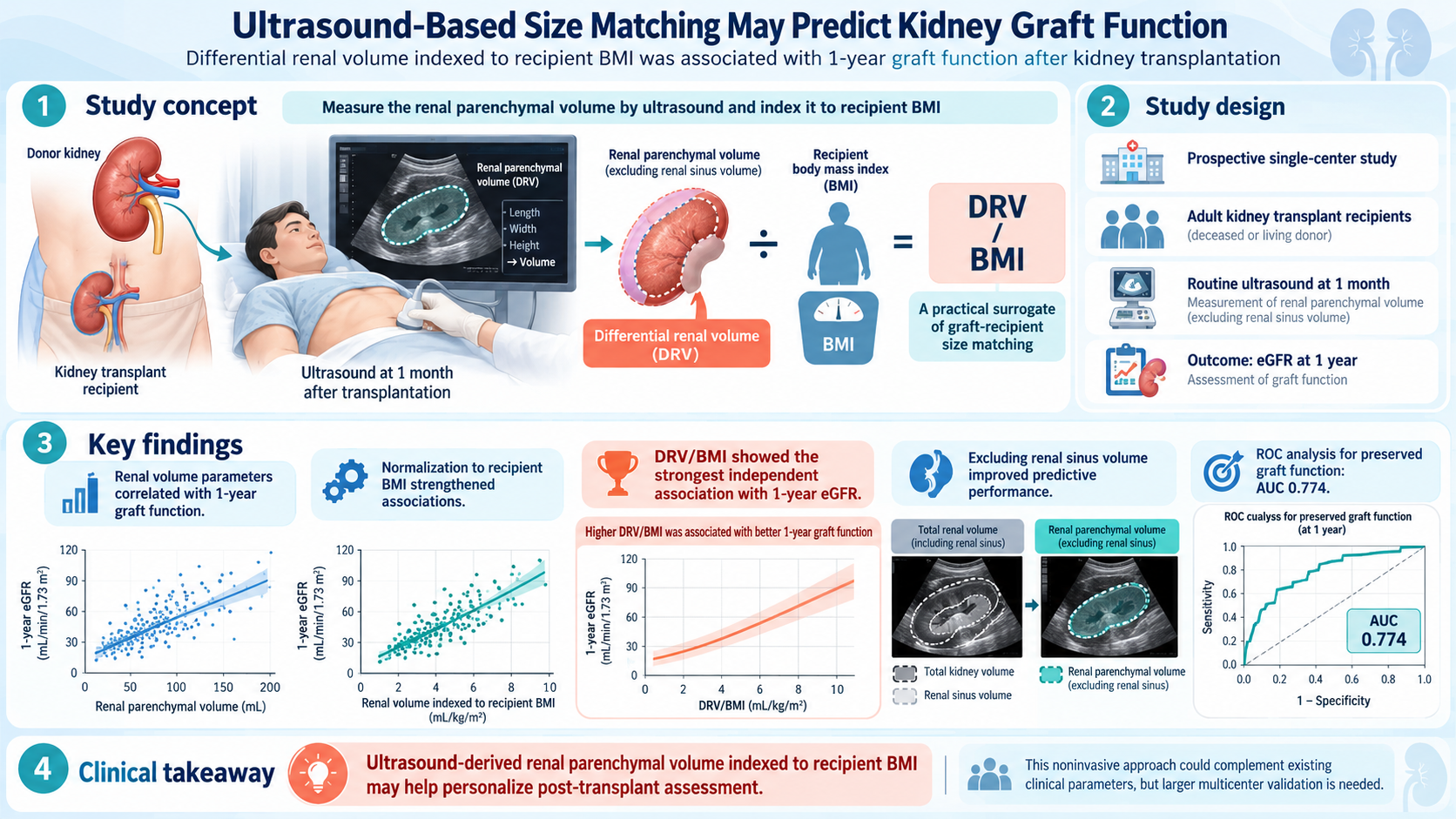
Donor renal parenchymal volume, measured by routine ultrasound one month post-transplant, correlates with kidney graft function at one year.
Normalization of differential renal volume (DRV) to recipient body mass index (BMI) enhances prediction of graft function.
Excluding non-parenchymal components like renal sinus improves volumetric assessment accuracy.
The DRV/BMI ratio demonstrates promising discriminative ability for preserved graft function, suggesting clinical applicability in individualized post-transplant monitoring.
Study Background
Kidney transplantation remains the optimal treatment for end-stage renal disease, significantly improving patient survival and quality of life. However, long-term graft survival is challenged by various factors, including immunological responses and the mismatch between donor nephron mass and recipient metabolic demands. Emerging evidence highlights the importance of graft-recipient size matching for maintaining graft function. Nephron underdosing—where the donor kidney mass inadequately meets recipient metabolic needs—may accelerate graft injury and functional decline. Thus, precise, practical methods to assess graft-recipient size compatibility are essential to guide transplant decisions and optimize outcomes.
Currently, indices such as donor-recipient body size ratios or estimated donor nephron mass derived from demographic data are used but lack direct anatomical and physiological correlation. Ultrasound, a non-invasive and widely accessible imaging modality used routinely post-transplant, offers an objective means to measure renal volumes. However, total kidney volume includes non-functional components such as renal sinus fat and vasculature, which may dilute prognostic accuracy.
This study evaluates whether ultrasound-derived differential renal volume (reflecting functional renal parenchyma) indexed to recipient BMI can serve as a novel surrogate marker of graft-recipient size matching and predict graft function at one year post-transplant.
Study Design
This prospective, single-center study enrolled adult kidney transplant recipients undergoing routine ultrasonography at one month post-transplantation. Key parameters measured included total renal volume (TRV) and differential renal volume (DRV), the latter excluding renal sinus volume to focus on functional tissue.
Renal volumetric measurements were normalized to recipient BMI to reflect metabolic demand, hypothesizing that the donor kidney parenchymal volume relative to recipient body size more accurately characterizes size matching. The primary endpoint was the estimated glomerular filtration rate (eGFR) at one year, an established marker of graft function.
Statistical analyses involved correlation and multivariable linear regression adjusted for donor and recipient demographic and clinical covariates. Receiver operating characteristic (ROC) analysis assessed the discriminative ability of volumetric indices to classify preserved graft function.
Key Findings
A total cohort of adult kidney transplant recipients underwent ultrasound evaluation, and volumetric data were acquired at one month post-transplantation.
1. Associations with One-Year Graft Function: Renal volumetric parameters correlated significantly with eGFR at one year. The strength of association improved markedly when renal volumes were indexed to recipient BMI, emphasizing the importance of accounting for recipient metabolic demand.
2. Superiority of Differential Renal Volume/BMI Ratio: Among volumetric indices, the ratio of DRV to recipient BMI (DRV/BMI) demonstrated the highest correlation coefficient with one-year eGFR. Multivariable regression confirmed the independent association of DRV/BMI with graft function after adjusting for confounders such as donor age and immunosuppressive regimen.
3. Excluding Renal Sinus Enhances Predictive Accuracy: Removal of the renal sinus volume—comprised mainly of fat and vascular structures—in the measurement improved the predictive value of ultrasound-derived volume, supporting the clinical focus on functional parenchymal tissue.
4. ROC Curve Analysis and Threshold Identification: The DRV/BMI ratio exhibited good discriminative ability for defining preserved graft function (eGFR threshold typically used in clinical practice). The reported area under the curve (AUC) of 0.774 suggests meaningful clinical utility. However, the authors highlight the necessity for external validation of the proposed cutoff to confirm generalizability.
5. Practical Advantages: This approach leverages routine post-transplant ultrasound without requiring additional imaging or invasive measurements, offering a cost-effective, widely applicable tool to complement existing clinical assessments.
Expert Commentary
The study presents compelling evidence that ultrasound volumetry, particularly when indexed to recipient BMI, can serve as a practical surrogate for assessing graft-recipient size matching. This aligns with the physiological concept that nephrons should be functionally sufficient to meet the recipient’s metabolic activity to preserve long-term graft function.
Excluding the renal sinus volume is a notable methodological refinement, as fat and vascular components do not contribute to filtration capacity. This enhances the biological plausibility of the DRV/BMI ratio as a functional marker.
Limitations include the single-center design and a relatively modest sample size, which may affect external validity. Additionally, other factors influencing graft function, such as immunological injury, were accounted for but might confound volumetric associations. The timing of ultrasound at one month post-transplant is clinically practical but may miss early alterations; serial measurements could provide dynamic insights.
Future directions should include multicenter validation, investigation of longitudinal volumetric changes, and potential integration with other biomarkers to refine individualized transplant management.
Conclusion
Ultrasound-derived differential renal volume indexed to recipient BMI is a promising, non-invasive surrogate marker for graft-recipient size matching that predicts kidney graft function at one year. This method offers a practical and accessible means to enhance prognostication and guide personalized post-transplant care. Validation in multicenter cohorts and assessment in diverse populations will be crucial before widespread clinical adoption.
Funding and Clinical Trials Registration
The study was supported by institutional funding from the involved transplant center; however, specific funding sources and clinical trial registrations were not detailed in the publication.
References
1. Gianassi I, Allinovi M, Caroti L, et al. Ultrasound-Derived Differential Renal Volume Indexed to Recipient Body Mass Index Predicts One-Year Kidney Graft Function: A Novel Surrogate of Graft-Recipient Size Matching. Clinical Transplantation. 2026;40(10):e70721. doi:10.1111/ctr.70721
This article was created using several editorial tools, including AI, as part of the process. Human editors reviewed this content before publication.