Transforming Kidney Transplant Care: The SETI Operational Redesign Enhances Access and Efficiency
Highlight
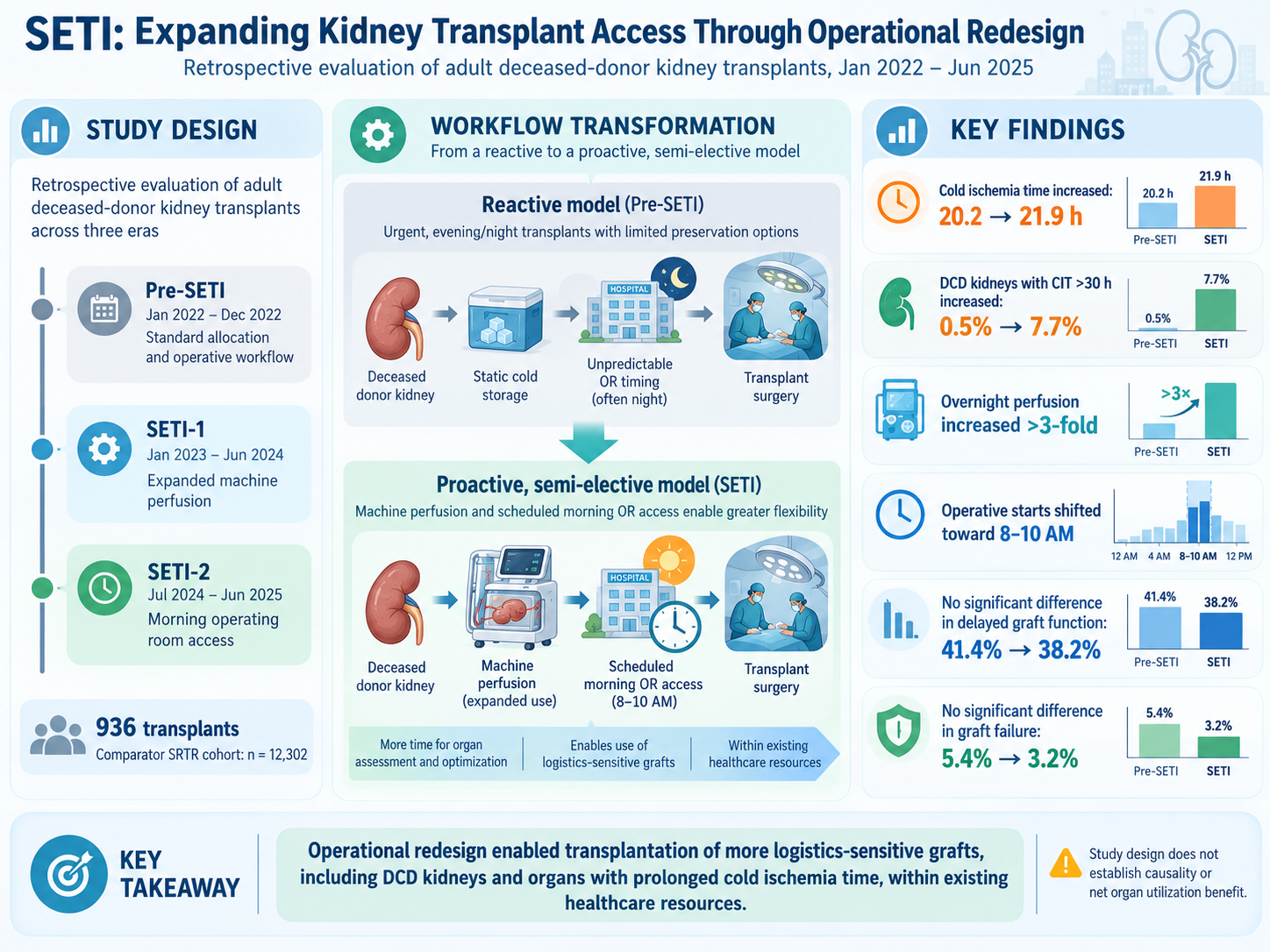
The Semi-Elective Transplant Initiative (SETI) redesigned transplant operations for deceased-donor kidneys, integrating advanced preservation and morning OR scheduling.
Cold ischemia time increased modestly and use of machine perfusion expanded, enabling transplantation of more logistics-sensitive grafts including high-risk DCD kidneys.
Transplant timing shifted to predictable morning slots (8-10 AM), transforming a historically reactive process into a proactive, manageable workflow.
No significant differences in delayed graft function or graft failure were observed, indicating safety despite logistical changes, although analysis was underpowered to confirm equivalence.
Study Background
Deceased donor kidney transplantation remains a cornerstone treatment for end-stage renal disease (ESRD), offering improved survival and quality of life over dialysis. However, the process is traditionally reactive and time-sensitive, often requiring urgent mobilization of hospital resources at any hour. As transplant volumes increase and hospital capacities become strained, operational barriers arise that limit broader kidney organ utilization. Particularly, grafts sensitive to logistics—such as those from donors after circulatory death (DCD) or organs with longer cold ischemia times (CIT)—are challenging to transplant under emergency conditions. Optimizing transplant workflows to accommodate these complexities is thus a pressing clinical need.
Study Design
This retrospective evaluation analyzed adult deceased donor kidney transplants performed from January 2022 through June 2025 at a single center implementing the Semi-Elective Transplant Initiative (SETI). SETI combined expanded use of machine perfusion preservation (SETI-1) with dedicated predictable morning operating room (OR) access (SETI-2). The cohort was stratified into three eras: pre-SETI (baseline), SETI-1 (expanded machine perfusion without scheduled OR access), and SETI-2 (complete implementation with morning OR slots). Outcomes were compared internally and against a contemporaneous Scientific Registry of Transplant Recipients (SRTR) dataset of 12,302 deceased donor kidney transplants.
Key variables included cold ischemia time (CIT), use of machine perfusion, donation after circulatory death (DCD) grafts transplanted, timing of operative starts, Kidney Donor Profile Index (KDPI), rates of delayed graft function (DGF), and early graft failure. Statistical comparisons assessed changes across eras, noting limitations due to study design precluding causal inference.
Key Findings
Among 936 total transplants, mean cold ischemia time increased slightly from 20.2 hours pre-SETI to 21.9 hours after full SETI implementation (p=0.0039). Notably, the proportion of DCD kidneys with CIT exceeding 30 hours rose sharply from 0.5% pre-SETI to 7.7% in the SETI-2 era (p<0.0001). The frequency of overnight machine perfusion increased more than threefold, reflecting broader adoption of preservation strategies aimed at mitigating ischemic damage.
Operative start times shifted significantly to morning hours between 8-10 AM, consolidating procedures into predictable work periods rather than variable or overnight slots. This operational redesign preferred scheduled access to OR resources, enabling smoother coordination.
KDPI scores increased from a median of 29 pre-SETI to 33 in SETI-1 and 43 in SETI-2 (p<0.001), indicating that organs with higher risk or lower expected function were increasingly transplanted under the new system.
Regarding early clinical outcomes, rates of delayed graft function decreased nonsignificantly from 41.4% pre-SETI to 38.2% post-implementation (p=0.071), and 1-year graft failure rates showed a nonsignificant decline from 5.4% to 3.2% (p=0.34). These comparisons were underpowered, and while suggestive of stable clinical safety, equivalence cannot be concluded. Multivariate analysis identified donor hypertension as a significant predictor of graft failure, whereas CIT duration, DCD status, and SETI era did not exhibit independent adverse effects.
Expert Commentary
The SETI approach addresses a critical operational challenge in kidney transplantation—the unpredictable logistics demanding rapid response—which often limits use of marginal or logistics-sensitive grafts. By formalizing preservation techniques such as expanded machine perfusion and establishing predictable morning OR access, SETI transforms the transplant pathway from reactive to semi-elective.
This operational transition has notable biological plausibility. Extended machine perfusion can mitigate ischemia-reperfusion injury, allowing safer transplantation despite longer CIT. Scheduled surgeries enhance resource utilization without necessarily compromising graft function or early outcomes.
However, the study’s retrospective and single-center design limits causal inferences and generalizability. Further multicenter, prospective studies are warranted to validate whether such operational redesigns improve overall organ utilization and patient outcomes on a larger scale. Additionally, cost-effectiveness and staff workflow impacts merit evaluation.
Conclusion
The Semi-Elective Transplant Initiative represents a promising systems-based innovation in deceased-donor kidney transplantation, strategically integrating expanded preservation and predictable OR scheduling. This redesign facilitates transplantation of a greater proportion of logistics-sensitive kidneys, including higher-risk DCD grafts with prolonged cold ischemia times, without demonstrable detriment to early clinical outcomes. While this approach does not establish causality or affect net organ utilization directly, it lays the groundwork for more proactive, efficient transplant programs capable of maximizing scarce organ resources within existing healthcare system constraints. Future research should focus on validating these findings and examining long-term impacts on graft survival, patient outcomes, and transplant program sustainability.
Funding and Clinical Trials
The article did not specify funding sources or clinical trial registrations.
References
1. Kaltenmeier C, Hanish SI, Nagaraju S, et al. SETI—The Semi-Elective Transplant Initiative: A Systems-Based Approach to Expanding Kidney Transplant Access Through Operational Redesign. Ann Surg. 2026 Oct 15. PMID: 42875848.
2. Murad MH, Stubbs JR, Smith SN. Operational challenges in deceased-donor kidney transplantation: a review. Transplantation Reviews. 2021;35(3):100592.
3. Moers C, Smits JM, Maathuis MH, et al. Machine perfusion or cold storage in deceased-donor kidney transplantation. N Engl J Med. 2009;360(1):7-19.
4. Ojo AO. Delayed graft function: The clinical implications and management strategies. Clin J Am Soc Nephrol. 2005;6(7):1534-1540.
This article was created using several editorial tools, including AI, as part of the process. Human editors reviewed this content before publication.