We use cookies

Our website uses essential cookies and, with your consent, additional cookies to measure performance and improve our services. Cookie Policy.

You can change your choice at any time.

MMedXYNews
HomeVideos
MedXY AI/MedXY News/Section: Nephrology

Impact of the 2023 Safety Net Policy on Kidney After Lung Transplantation: Early Changes in Transplant Practices and Outcomes
MedXY Editorial Team•Sep 22, 2026•Nephrology
lung transplantationtransplant outcomessafety net policyKidney Transplantation

Highlight

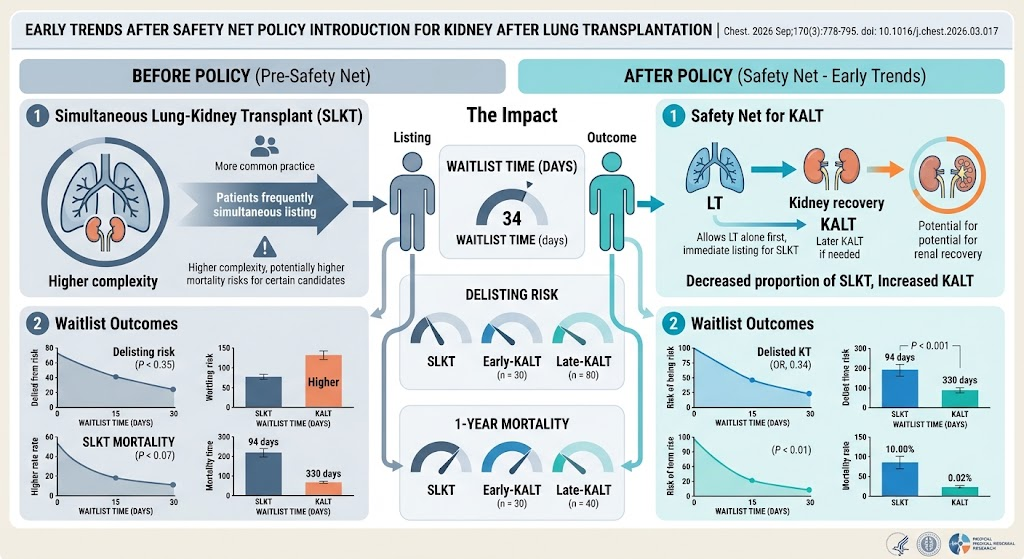
– The 2023 US safety net policy has altered practices for kidney after lung transplantation, decreasing simultaneous lung-kidney transplants (SLKT) and increasing early kidney after lung transplant (KALT) procedures.
– Early KALT is associated with shorter kidney transplant wait times and better 1-year post-transplant survival compared to SLKT.
– The safety net policy era shows reduced risk of delisting from the kidney transplant waitlist due to deterioration or death.
– Survivorship bias may influence outcomes; prospective studies are necessary to clarify long-term effects.

Study Background

MedXY registered readers

Sign in free to continue reading

Create or use your MedXY account to unlock the complete article.

This article was created using several editorial tools, including AI, as part of the process. Human editors reviewed this content before publication.

Related articles

Open language-specific specialty feeds and department pages.

Optimizing Patient Expectations and Outcomes: Understanding Days Alive and Out of Hospital After Lung TransplantationThis study evaluates days alive and out of hospital (DAOH) around lung transplantation, identifying predictors of reduced DAOH in the first post-transplant year and providing insights for tailored patient counseling and care strategies.Sep 9, 2026Efficacy and Outcomes of Short-Course Perioperative Antiviral Prophylaxis in Hepatitis C Viremic Donor Kidney TransplantationA 7-day perioperative sofosbuvir/velpatasvir prophylaxis in HCV-positive donor to HCV-negative recipient kidney transplants demonstrated sustained virologic response in over 92% of cases, with favorable 1-year graft survival and function.Aug 20, 2026Advancing Perioperative Risk Stratification: Predicting Acute Kidney Injury Following Lung TransplantationComprehensive pre- and early postoperative models predict acute kidney injury and need for renal replacement after lung transplantation, improving risk stratification and enabling targeted nephroprotection.Aug 20, 2026
Loading comments...
MedXY briefing

Get the free newsletter

Evidence-led clinical news, trends, and analysis—delivered to your inbox.

Ask MedXY AI

Most popular

Intimate Health
Five Benefits for Women Continuing Sexual Activity After Menopause
Intimate Health
Why Some Women Have a Strong Sex Drive—And Why Men Shouldn't Worry About It
Nursing & care
How often should a couple have sex?
General Surgery
Optimizing Postoperative Opioid Prescriptions After Intra-Abdominal Cancer Surgery: Comparing the 5x-Multiplier and 3-Tier Models
Intimate Health
Classic Intimacy Recommendations: How to Help Women Reach Orgasm and Enjoy Mutual Pleasure
© 2026 MedXY
Contact usAbout usPrivacy PolicyMedXY story
Lung Transplantation in Rheumatoid Arthritis-Associated Interstitial Lung Disease: Identifying Risk Factors and Survival Outcomes in a Universal Healthcare Context
This study examines lung transplantation patterns, associated risk factors, and post-transplant survival among rheumatoid arthritis-related interstitial lung disease patients in Ontario, revealing key clinical insights under a universal hea
Aug 17, 2026
Enhancing Kidney Transplant Outcomes: The Combined Role of Normothermic Regional Perfusion and Hypothermic Machine Perfusion in Donation After Circulatory Death DonorsSequential use of normothermic regional perfusion and hypothermic machine perfusion in kidney transplants from DCD donors reduces delayed graft function, highlighting enhanced organ preservation strategies.Aug 17, 2026
Pre-Transplant Left Atrial Volume Index as a Predictor of One-Year Morbidity after Kidney Transplantation: Insights and ImplicationsThis study identifies pre-transplant left atrial volume index as a potential predictor for overall one-year morbidity following kidney transplantation, highlighting its clinical relevance beyond traditional cardiac risk markers.Aug 12, 2026