Ticagrelor-Aspirin Dual Therapy After Thrombolysis in Moderate Ischemic Stroke: Insights from Infarct Patterns in the TAPIS Trial
Highlight
- TAPIS subgroup analysis evaluated ticagrelor-aspirin efficacy in moderate ischemic stroke patients treated with thrombolysis, stratified by diffusion-weighted imaging (DWI) infarction patterns.
- Multiple acute infarcts (MAIs) were associated with worse functional outcomes compared to non-MAIs, including single infarcts or DWI-negative strokes.
- Ticagrelor-aspirin showed a significant benefit in patients with MAIs for achieving excellent functional outcomes (modified Rankin Scale 0-1) at 90 days without increased symptomatic intracranial hemorrhage.
- No significant efficacy difference was observed in patients with non-MAI patterns, highlighting infarct pattern as a potential biomarker for tailored antiplatelet therapy after thrombolysis.
Study Background
Acute ischemic stroke treatment has evolved significantly with the advent of intravenous thrombolysis as a standard reperfusion therapy for eligible patients presenting within 4.5 hours of symptom onset. However, secondary prevention strategies immediately after thrombolysis, particularly the role of dual antiplatelet therapy (DAPT), remain less well defined, especially in moderate stroke severity (NIHSS 4-10) where balancing ischemic and hemorrhagic risks is critical.
Recent studies have suggested that DAPT with aspirin and ticagrelor, a potent P2Y12 receptor antagonist, may improve outcomes in patients with minor stroke or transient ischemic attack. However, its safety and efficacy shortly after thrombolysis in moderate ischemic stroke remains under investigation. Additionally, infarction patterns on diffusion-weighted imaging (DWI) might reflect different pathophysiological mechanisms and risks after stroke, potentially influencing treatment response.
Study Design
The TAPIS (Ticagrelor With Aspirin Dual Antiplatelet Therapy Combined With Intravenous Thrombolysis in Patients With Ischemic Stroke) trial was a randomized, double-blind, placebo-controlled, multicenter study conducted across 60 sites in China. It enrolled noncardioembolic acute ischemic stroke patients aged 18 to 80 years with moderate severity (NIHSS scores 4-10) who were treated with standard intravenous thrombolysis within 4.5 hours of symptom onset.
Patients were randomized within 6 hours of onset to receive early oral ticagrelor-aspirin dual therapy or placebo plus aspirin. The study’s principal focus in this subgroup analysis was to assess whether infarct patterns identified on centrally adjudicated DWI influenced the efficacy and safety of ticagrelor-aspirin compared to placebo.
Infarct classification separated patients into two groups: multiple acute infarcts (MAIs), defined as two or more acute lesions on DWI, and non-MAIs, encompassing single infarcts or DWI-negative presentations. The primary efficacy endpoint was achievement of excellent functional outcome, defined as modified Rankin Scale (mRS) score 0-1 at 90 days. Safety was primarily assessed by the occurrence of symptomatic intracranial hemorrhage (sICH).
Key Findings
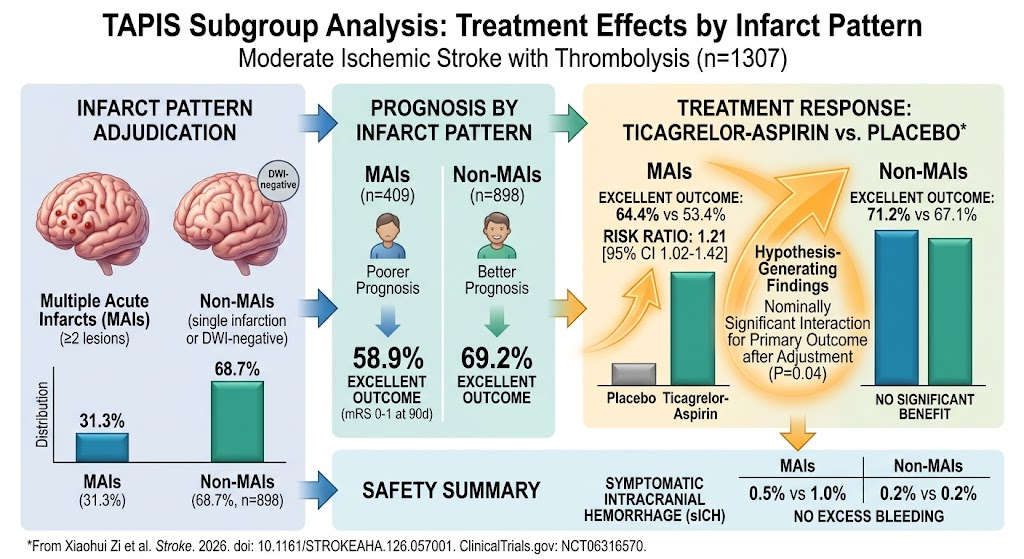
A total of 1307 patients were included in the analysis, with a median age of 65.5 years, predominantly male (71.2%), and median NIHSS score of 6.0, indicating moderate stroke severity. Approximately one-third (31.3%, n=409) showed multiple acute infarcts on DWI.
Patients with MAIs had a poorer prognosis than those with non-MAIs, achieving excellent functional outcomes in 58.9% versus 69.2%, respectively (adjusted risk ratio 0.92, 95% CI 0.84-1.00). This underscores the adverse prognostic significance of multiple infarcts, potentially related to a more diffuse or embolic mechanism.
Within the MAI subgroup, ticagrelor-aspirin significantly increased the likelihood of excellent outcomes compared to placebo (64.4% vs 53.4%; risk ratio 1.21, 95% CI 1.02-1.42). In contrast, no statistically significant benefit was observed in patients with non-MAI patterns (71.2% vs 67.1%; risk ratio 1.06, 95% CI 0.97-1.16). The interaction test between treatment and infarct pattern did not reach conventional statistical significance (P=0.18), although nominal significance emerged after adjusting for rescue use of tirofiban.
Secondary analysis of early neurological improvement also showed significant heterogeneity by infarct pattern (Pinteraction=0.02), suggesting differential early responses to treatment depending on lesion distribution.
Importantly, safety endpoints were reassuring; symptomatic intracranial hemorrhage rates were very low and comparable between ticagrelor-aspirin and placebo groups, regardless of infarct pattern. For patients with MAIs, sICH occurred in 0.5% receiving ticagrelor-aspirin versus 1.0% with placebo; among non-MAIs, rates were 0.2% across both arms.
Expert Commentary
The TAPIS subgroup analysis contributes valuable insights into the nuanced management of moderate ischemic stroke post-thrombolysis. The finding that patients with multiple infarcts derive enhanced benefit from early ticagrelor-aspirin therapy supports the concept that infarct patterning could serve as an imaging biomarker to individualize antiplatelet strategies. Multiple acute infarcts often indicate an embolic source or diffuse cerebrovascular pathology, conditions where intensified platelet inhibition may be particularly useful.
However, the absence of a statistically robust treatment-by-pattern interaction in the primary analytic framework urges cautious interpretation. The study population, although large and multicenter, was restricted geographically, and infarct pattern adjudication required advanced imaging evaluation, potentially limiting broad generalizability.
Moreover, the low rate of hemorrhagic complications suggests that early initiation of ticagrelor in selected patients after thrombolysis is safe, but these findings should be validated in larger, diverse cohorts before practice change. Ongoing and future trials incorporating advanced imaging criteria for therapeutic decision-making are warranted.
Conclusion
This subgroup analysis of the TAPIS trial implicates infarct pattern on diffusion-weighted imaging as a potential imaging biomarker guiding early dual antiplatelet therapy with ticagrelor and aspirin in moderate noncardioembolic ischemic stroke patients treated with intravenous thrombolysis. The data suggest that patients with multiple acute infarcts benefit from ticagrelor-aspirin dual therapy without increased hemorrhagic risk, associated with better functional outcomes at 90 days.
Although the interaction between treatment effect and infarct pattern did not reach full statistical significance, these hypothesis-generating results encourage further investigation. Stratifying antiplatelet therapy according to infarct pattern may optimize post-thrombolysis secondary prevention, balancing ischemic benefits and hemorrhagic risks.
Funding and Trial Registration
The TAPIS trial was a multicenter study conducted in China with funding sources not detailed in this subgroup analysis. The clinical trial is registered at ClinicalTrials.gov with identifier NCT06316570.
References
Zi X, He Y, Chen G, Wang Q, Xia X, Li J, Zhang X, Jing J, Bath PM, Turc G, Wang A, Wang Y, TAPIS Investigators. Ticagrelor-Aspirin With Thrombolysis by Infarct Patterns in Moderate Ischemic Stroke: TAPIS Subgroup Analysis. Stroke. 2026 Sep 3. PMID: 42689322.
This article was created using several editorial tools, including AI, as part of the process. Human editors reviewed this content before publication.