Introduction
Systemic sclerosis (SSc) is a complex autoimmune connective tissue disease characterized by progressive fibrosis of the skin and internal organs, vasculopathy, and immune dysregulation. Disease heterogeneity and multifactorial pathogenesis present significant challenges in effective treatment. Autoantibodies, including anti-topoisomerase-I antibodies, are closely linked to disease activity, driving inflammation and fibrosis. Targeting autoantibody production or activity represents a promising therapeutic approach. The neonatal fragment crystallisable receptor (FcRn) plays a critical role in protecting immunoglobulin G (IgG) from lysosomal degradation, thus regulating IgG half-life. Pharmacological blockade of FcRn decreases IgG autoantibody levels and has shown clinical benefit in IgG-mediated autoimmune diseases such as generalized myasthenia gravis (gMG). This article critically interprets newly published preclinical evidence evaluating FcRn blockade in a mouse model of SSc, highlighting translational implications for autoimmune fibrosing diseases.
Study Background and Unmet Medical Need
SSc affects an estimated 25,000 to 50,000 individuals in the United States alone, frequently causing significant morbidity and mortality due to organ fibrosis and vascular complications. Approved therapies, including immunosuppressants and antifibrotic agents like nintedanib, provide only partial disease control without addressing the underlying autoimmune drivers. Autoantibodies, particularly anti-topoisomerase-I (anti-TopoI) antibodies, are pathogenic contributors that promote immune activation and matrix deposition. Despite recognition of autoantibody pathogenicity, safe and effective disease-modifying treatments that simultaneously mitigate autoimmunity, inflammation, and fibrosis remain elusive. Efgartigimod, a humanized Fc fragment engineered to block FcRn, reduces IgG autoantibody levels by accelerating their clearance and is approved for IgG autoantibody-driven diseases such as gMG and chronic inflammatory demyelinating polyneuropathy. Whether FcRn blockade can impact autoimmunity and downstream fibrosis in SSc has been unexplored until recently.
Study Design and Methods
The study by Tran Manh et al. employed a well-established murine model of SSc driven by immunization with topoisomerase I (TopoI), recapitulating key autoimmune and fibrotic features observed in patients. The investigators evaluated the FcRn blockade approach using two agents: murinised efgartigimod (mEfgartigimod) and an FcRn-blocking IgG1 Fc fragment. Both prophylactic (prevention) and therapeutic (after disease establishment) treatment regimens were tested.
End points included:
– Serum immunoglobulin and autoantibody levels
– Biochemical and histological markers of dermal and pulmonary fibrosis
– Bulk RNA sequencing (RNA-Seq) to analyze gene expression changes in skin tissue
– Single-nucleus RNA sequencing (snRNA-Seq) to dissect cell-type-specific transcriptional programs
– Imaging mass cytometry (IMC) to spatially map immune and stromal cells in skin
– Multiplex cytokine/chemokine profiling using Olink technology
These multimodal approaches provided an integrated analysis of the immunological and fibrotic landscape altered by FcRn blockade.
Key Findings
Reduction of Fibrosis and Autoantibodies
Both prophylactic and therapeutic administration of mEfgartigimod significantly ameliorated dermal thickening and pulmonary fibrosis in TopoI-immunized mice. This antifibrotic effect was comparable to that observed with nintedanib, a currently approved antifibrotic therapy, indicating the potency of FcRn blockade.
Treatment caused a robust decrease in total IgG levels and presumably pathogenic anti-TopoI autoantibodies, consistent with FcRn’s role in IgG recycling.
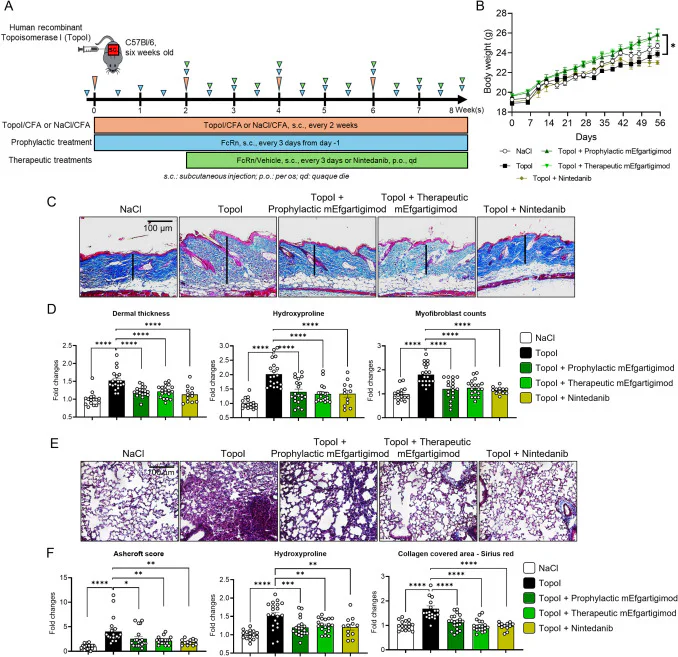
Figure 2 Prophylactic and therapeutic mEfgartigimod ameliorates dermal and pulmonary fibrosis in TopoI mice (From Tran Manh C, et al., Ann Rheum Dis, 2026)
Transcriptomic Profiles Indicate Downregulated Inflammatory and Fibrotic Pathways
Bulk RNA-Seq of skin demonstrated that FcRn blockade suppressed the expression of multiple critical inflammatory and fibrotic pathways. Notably, transcripts encoding chemokines from the C-C motif ligand family (Ccl), tumor necrosis factor (TNF) superfamily cytokines, and components of the type I interferon signaling pathway were downregulated.
These findings suggest a broad effect on immunoinflammatory cascades driving SSc pathogenesis, beyond merely reducing antibody levels.
Alteration of Immune and Stromal Cell Landscapes
IMC revealed decreased infiltration and accumulation of myofibroblasts—the main extracellular matrix-producing cells—alongside reduced numbers of classically activated macrophages, dendritic cells, and T lymphocytes. These cellular changes underpin the tissue remodeling observed with treatment.
Single-nucleus RNA-Seq provided high-resolution insight into cell-type-specific transcriptional alterations, highlighting reduced profibrotic myofibroblast populations, inflammatory macrophages resembling neutrophil-like phenotypes, and T cell subsets. The data implied altered fibroblast-macrophage crosstalk, reflecting interruption of key pathogenic cellular interactions.
Cytokine Modulation Consistent with Therapeutic Effects
Circulating levels of proinflammatory mediators such as interleukin-1 beta (Il1β) and several chemokines decreased after treatment. Conversely, antifibrotic factors including fibroblast growth factor 21 (Fgf21) and soluble programmed death ligand-2 (sPD-L2) increased, suggesting a systemic shift toward resolution of inflammation and fibrosis.
Expert Commentary
This study advances the conceptual framework that FcRn blockade can be a multitargeted therapy for systemic sclerosis by simultaneously addressing autoantibody-mediated immune activation, inflammatory cell recruitment, and fibrotic remodeling. The comparable efficacy to nintedanib on fibrosis endpoints is particularly noteworthy, as current therapies rarely achieve such multifaceted effects.
The study’s strength lies in its comprehensive mechanistic exploration, combining transcriptomics, proteomics, and spatial cell profiling to link antibody clearance to downstream molecular and cellular changes driving fibrosis. The use of a clinically relevant autoimmunity-driven SSc model enhances translational potential.
However, caveats include the reliance on a single preclinical model and murinized drug formulations; human pharmacodynamics and disease heterogeneity may diverge. Furthermore, long-term effects and safety require evaluation in human trials.
The ongoing phase 2 randomized controlled trial of efgartigimod in SSc will critically determine clinical efficacy and safety, helping establish FcRn blockade as a disease-modifying strategy for fibrosing autoimmune diseases.
Conclusion
Pharmaceutical blockade of the neonatal Fc receptor represents a promising approach to modulate autoimmunity, inflammation, and fibrosis in systemic sclerosis. The preclinical evidence demonstrates that FcRn inhibitors like efgartigimod reduce pathogenic IgG autoantibodies, downregulate inflammatory and fibrotic gene programs, and alter pathogenic immune-stromal cell crosstalk, resulting in amelioration of tissue fibrosis. These findings support further clinical development of FcRn blockers as multifunctional disease-modifying agents in SSc and potentially other autoimmune fibrotic conditions. If confirmed in ongoing human trials, this strategy may address a critical unmet need for therapies acting on the root autoimmune mechanisms driving systemic sclerosis progression.
Funding and Clinical Trials
The reported study was supported by academic and institutional funding; specific grant details were not disclosed. A randomized phase 2 clinical trial (identifier not provided) evaluating efgartigimod in systemic sclerosis patients is currently underway.
References
1. Tran Manh C, Liebel C, Rigau AR, et al. Pharmaceutical blockade of the neonatal Fc receptor (FcRn) ameliorates autoimmunity, inflammation, and fibrosis in the antitopoisomerase-I antibody-driven mouse model of systemic sclerosis. Ann Rheum Dis. 2026 Nov 10; PMID: 43009401.
2. Manetti M, Guiducci S, Ibba-Manneschi L, Matucci-Cerinic M. The Contribution of Autoantibodies to Systemic Sclerosis Pathogenesis: New Insights. Front Immunol. 2022;13:815068.
3. Howard JF Jr, Utsugisawa K, Benatar M, et al. Safety and efficacy of efgartigimod in generalized myasthenia gravis. N Engl J Med. 2021;385(9):842-853.
4. Distler O, Highland KB, Gahlemann M, et al. Nintedanib for systemic sclerosis-associated interstitial lung disease. N Engl J Med. 2019;380(26):2518-2528.