Highlight
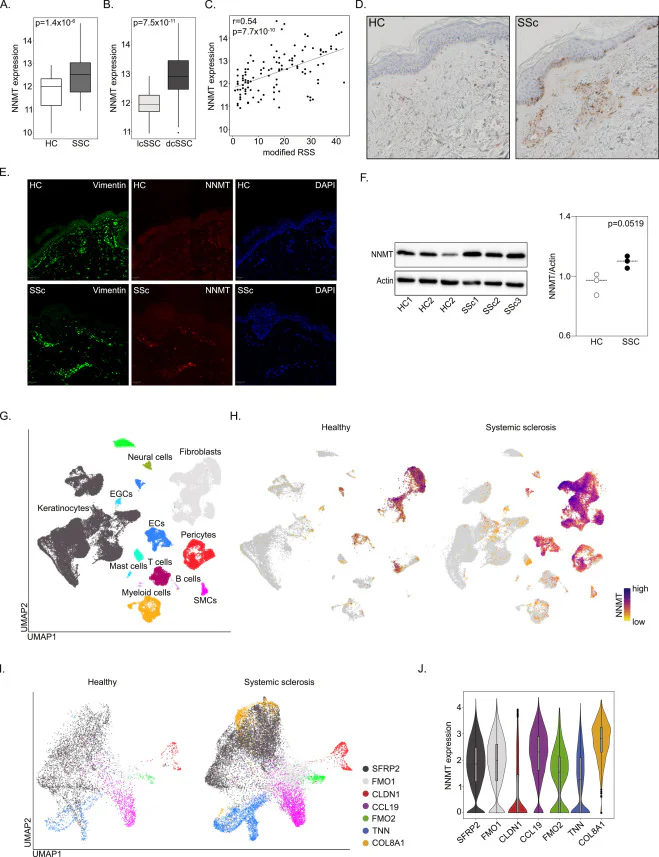
NNMT expression is significantly elevated in dermal fibroblasts within systemic sclerosis (SSc) skin lesions, especially in myofibroblast subsets driving fibrosis.
Silencing or pharmacologic inhibition of NNMT disrupts methylation balance via altering SAM/SAH ratio and histone methylation, suppressing profibrotic gene programs induced by TGFβ.
NNMT modulates a transcriptional regulatory network involving ATF4, SOX9, and SRF which promotes extracellular matrix gene expression and collagen synthesis.
Inhibition of NNMT ameliorates bleomycin-induced skin fibrosis in preclinical models, positing NNMT as a promising therapeutic target in SSc.
Study Background and Disease Burden
Systemic sclerosis (SSc) is a chronic autoimmune connective tissue disease characterized by persistent activation of dermal fibroblasts leading to excessive deposition of extracellular matrix components such as collagen. This results in progressive skin fibrosis and organ dysfunction, contributing significantly to morbidity and mortality. Current treatments are limited and largely symptomatic, with no definitive antifibrotic therapy approved. Understanding the cellular and molecular drivers that sustain the profibrotic fibroblast phenotype is crucial to developing new therapeutic strategies.
Nicotinamide N-methyltransferase (NNMT) is an S-adenosylmethionine (SAM)-dependent methyltransferase implicated in metabolic regulation and tissue remodeling. Previous studies suggest a role of NNMT in fibrotic remodeling but its function in SSc has not been fully elucidated. This study investigates whether NNMT regulates dermal fibroblast activation and fibrosis in SSc and evaluates NNMT as a target to mitigate skin fibrosis.
Study Design
The investigation integrated multi-omics data analysis and functional experiments. Researchers analyzed bulk RNA sequencing, single-cell RNA sequencing, and spatial transcriptomics datasets from human SSc skin tissue to identify NNMT expression patterns and associated fibroblast states.
Primary human dermal fibroblasts (DFs) were cultured and subjected to small interfering RNA (siRNA)-mediated NNMT knockdown or treated with pharmacological NNMT inhibitors. These treated cells underwent transcriptomic, metabolomic, epigenetic, and functional assays to delineate the impact of NNMT modulation.
Downstream transcription factors—activating transcription factor 4 (ATF4), SRY-box transcription factor 9 (SOX9), and serum response factor (SRF)—were investigated using QuantSeq 3′ RNA sequencing following targeted knockdown to clarify their involvement in the NNMT-regulated pathway.
Finally, pharmacological NNMT inhibition was evaluated in vivo in a widely accepted bleomycin-induced dermal fibrosis mouse model to assess potential therapeutic benefit.
Key Findings and Results
NNMT Overexpression in SSc Skin and Fibroblast Subsets: Multiple independent cohorts showed consistent NNMT upregulation in SSc skin biopsies. Single-cell RNA-seq and spatial transcriptomics revealed that NNMT was preferentially enriched in disease-expanded myofibroblast populations, key effectors of fibrosis.
Impact of NNMT Knockdown on Epigenetic and Metabolic Profiles: Silencing NNMT in primary human dermal fibroblasts caused a significant shift in the methionine cycle, characterized by altered SAM/S-adenosylhomocysteine (SAH) ratios. This shift affected histone methylation patterns, including marks critical for transcriptional regulation, demonstrating that NNMT influences cellular methylation potential and epigenetic landscape.
Suppression of TGFβ-Induced Profibrotic Programs: NNMT depletion attenuated transforming growth factor-beta (TGFβ)-induced transcription of genes involved in extracellular matrix production, collagen synthesis, and tissue remodeling. These data support that NNMT is a necessary cofactor for sustaining TGFβ-driven fibroblast activation.
Transcriptional Network Mediated by ATF4, SOX9, and SRF: Further molecular dissection identified that NNMT modulates a network of transcription factors including ATF4, SOX9, and SRF. Knockdown of these factors reduced extracellular matrix gene expression and collagen secretion. This network acts downstream of TGFβ and depends on NNMT’s metabolic regulation.
Pharmacological Inhibition Recapitulates NNMT Knockdown Effects and Attenuates Experimental Fibrosis: Use of small molecule inhibitors targeting NNMT in vitro simulated the effects seen with genetic knockdown, suppressing SSc-associated profibrotic fibroblast gene programs. Importantly, in a bleomycin-induced mouse model of dermal fibrosis, NNMT inhibitors significantly reduced skin thickening and collagen deposition, demonstrating translational potential in vivo.
Expert Commentary
The study compellingly links metabolic enzymes to epigenetic regulation and fibrotic signaling, uncovering a novel TGFβ-NNMT-ATF4/SOX9/SRF axis that governs dermal fibroblast activation in systemic sclerosis. The findings introduce NNMT as both a biomarker and actionable target, addressing a critical unmet need for antifibrotic therapies.
Previous research has suggested roles for altered metabolism and methylation dynamics in fibrotic diseases, but this study elucidates precise molecular mechanisms connecting NNMT activity with profibrotic transcriptional programs. The dual advantage of genetic and pharmacologic approaches enhances confidence in the validity of NNMT as a therapeutic target.
Limitations include the primarily in vitro mechanistic work that, while complemented with animal fibrosis models, will benefit from future clinical validation. Additionally, understanding the systemic effects and safety profile of long-term NNMT inhibition will be essential before clinical translation.
Conclusion
This research identifies NNMT as a crucial driver of fibroblast activation and skin fibrosis in systemic sclerosis via a metabolic-epigenetic-transcriptional regulatory network. Pharmacological targeting of NNMT effectively suppressed profibrotic programs in human cells and reduced fibrosis in vivo, spotlighting a promising therapeutic avenue to mitigate progressive tissue fibrosis in SSc.
Future clinical trials investigating NNMT inhibitors are warranted alongside expanded molecular studies to clarify the broader implications of modulating methylation metabolism in fibrotic diseases.
Funding and ClinicalTrials.gov
The study was conducted by a collaborative research group including institutions such as MedUni Vienna and supported by European research grants. Details on funding sources and clinical trial registrations were not specified in the discussed publication.
References
Tosevska A, et al. Nicotinamide N-methyltransferase drives fibroblast activation and skin fibrosis in systemic sclerosis. Ann Rheum Dis. 2026 Nov 2; PMID: 42971883.
Wynn TA. Cellular and molecular mechanisms of fibrosis. J Pathol. 2008 Jan;214(2):199-210. doi:10.1002/path.2277.
Olson LE, et al. Epigenetics and fibrosis: reprogramming fibroblasts. J Clin Invest. 2017 May 1;127(5):1803-1814.
Beyer C, et al. New insights into the pathogenesis of systemic sclerosis: focusing on fibroblast activation and fibrosis signaling. Curr Opin Rheumatol. 2021 Nov;33(6):564-572.