Highlight
This study reveals critical barriers and facilitators for pain self-management (PSM) among patients with concurrent chronic pain and opioid use disorder (OUD), including the risks of long-term opioid therapy, diminished self-efficacy in managing pain, stigma, and social determinants of health influencing care delivery.
Qualitative interviews with patients and clinicians enable the design of tailored behavioral interventions that address these unique challenges to improve treatment outcomes.
The findings support the integration of psychosocial approaches in chronic pain and OUD treatment paradigms, emphasizing individualized, patient-centered care.
Study Background
Chronic pain affects a substantial proportion of adults worldwide and is frequently complicated by co-occurring opioid use disorder (OUD) or opioid misuse (OM). This overlap poses complex clinical challenges, as treatments often focus on one condition while neglecting the other, resulting in suboptimal outcomes including continued pain, increased risk of substance misuse, and poorer quality of life.
Traditional long-term opioid therapy (LTOT) approaches have been increasingly scrutinized due to concerns about dependency, tolerance, and overdose risk. Meanwhile, behavioral interventions such as pain self-management (PSM) have garnered attention for their ability to empower patients through self-regulation techniques, potentially reducing reliance on opioids and enhancing coping strategies.
However, existing PSM programs rarely account for the unique psychosocial and clinical complexities present in individuals with both chronic pain and OUD/OM, such as stigma or social determinants of health. There is a pressing need to tailor PSM interventions for this population to improve engagement and effectiveness.
Study Design
This pragmatic clinical trial employed a qualitative research design to inform the adaptation and development of a tailored PSM intervention.
Participants included 31 patients with chronic pain and co-occurring OUD or opioid misuse, alongside 15 clinicians and healthcare staff from primary care settings in Pennsylvania and West Virginia, regions markedly affected by the opioid epidemic.
Semi-structured interviews were conducted primarily remotely, focusing on participants’ perspectives on pain, pain management strategies, barriers to treatment, and attitudes towards behavioral interventions. Interview data were transcribed verbatim and analyzed using an inductive coding framework, followed by conventional content and thematic analysis to identify key themes.
Key Findings
Patient Perspectives
Patients emphasized several challenges related to chronic pain and opioid use treatment, including:
Risks and concerns with long-term opioid therapy: Many reported fears about opioid dependence, side effects, and difficulty tapering medications.
Low pain self-efficacy: Patients often expressed a lack of confidence in their ability to manage pain without pharmacologic support, revealing an unmet need for sustained behavioral coping strategies.
Complex and sometimes strained patient-provider relationships: Difficulties arose from communication gaps, perceived judgment, and stigma related to their opioid use history, undermining trust and collaborative care.
Clinician and Staff Perspectives
Clinicians and healthcare workers identified multiple systemic and social barriers impacting effective treatment delivery:
Social determinants of health: Factors such as poverty, transportation limitations, housing instability, and limited social support were significant impediments to treatment adherence and access to care.
Stigma: Both internalized by patients and externalized by providers, stigma surrounding OUD complicated engagement and offered challenges to offering empathetic, comprehensive care.
Training and resource gaps: Staff recognized the need for improved training on behavioral pain management tailored to patients with OUD and more integrated care models.
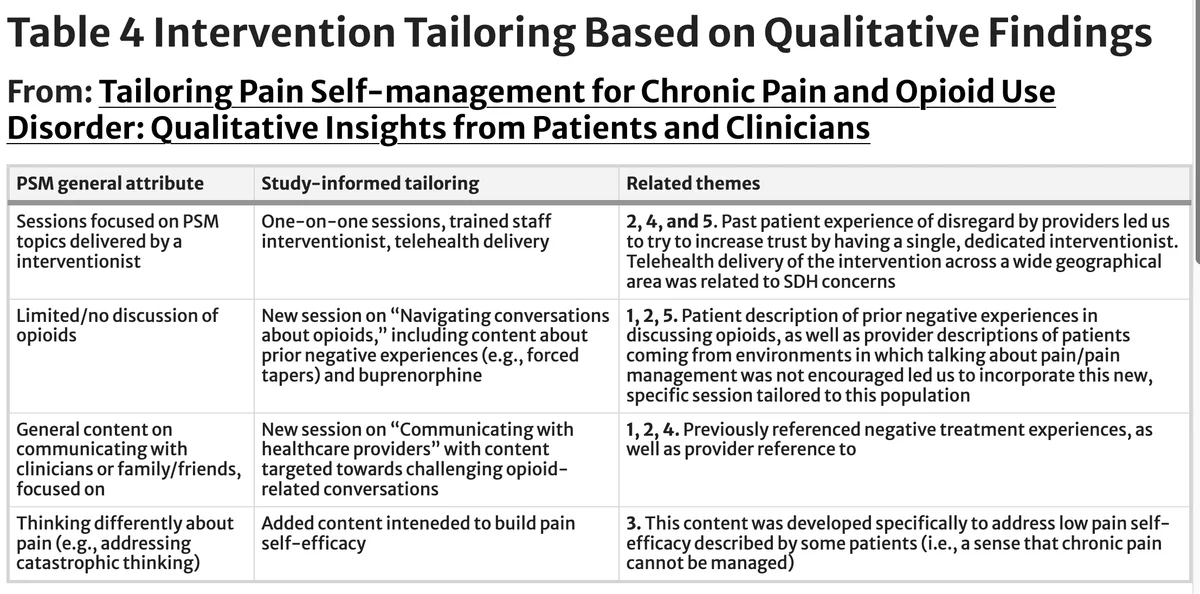
Implications for Tailoring Pain Self-Management
The findings provide a framework to design a PSM intervention that is patient-centered and contextually relevant, highlighting the importance of:
Incorporating education on opioid risks balanced with strategies to build patient self-efficacy.
Addressing stigma explicitly within the intervention to foster positive patient-provider relationships.
Considering social determinants in intervention delivery, including flexible scheduling, transportation support, and linkage to social services.
Engaging multidisciplinary teams with behavioral health expertise to support comprehensive care.
Expert Commentary
This study aligns with a growing body of evidence advocating for integrated behavioral interventions that address both pain and substance use disorders simultaneously. As noted in recent clinical guidelines, a multidisciplinary approach incorporating psychosocial therapies is essential to improve outcomes for patients with complex pain and opioid use profiles.
Nevertheless, the qualitative nature of the study limits generalizability; further research is required to evaluate the effectiveness and scalability of the tailored PSM intervention in diverse clinical settings.
Importantly, the identified role of social determinants and stigma underscores the necessity for health systems to adopt structural interventions that transcend purely clinical solutions.
Conclusion
This qualitative study offers invaluable insights into the lived experiences of patients with chronic pain and OUD as well as the perspectives of frontline clinicians. By elucidating barriers and facilitators to behavioral pain self-management, this work informs the development of tailored interventions that address opioid-related risks, enhance patient self-efficacy, and mitigate stigma.
Future deployment of such tailored PSM interventions has the potential to improve treatment adherence, reduce opioid reliance, and optimize functional outcomes in this vulnerable population, ultimately contributing to more integrated and compassionate chronic pain and addiction care.
Funding and ClinicalTrials.gov
The publication did not specify the sources of funding or clinical trial registration information.
References
Evington EJ, Winstanley EL, Salay M, de Abril Cameron F, Alexander L, Nash S, Choo LY, Edwards KA, Emerson R, Debi P, Merlin JS, Hamm M. Tailoring Pain Self‑management for Chronic Pain and Opioid Use Disorder: Qualitative Insights from Patients and Clinicians. J Gen Intern Med. 2026 Oct 26. doi: 10.1007/s11606-026-10927-0. Epub ahead of print. PMID: 42934354.