Highlight
• The Unbroken Integrative Psycho-Trauma Care Model enables delivery of trauma-informed mental health services at scale within a civilian hospital during ongoing conflict.
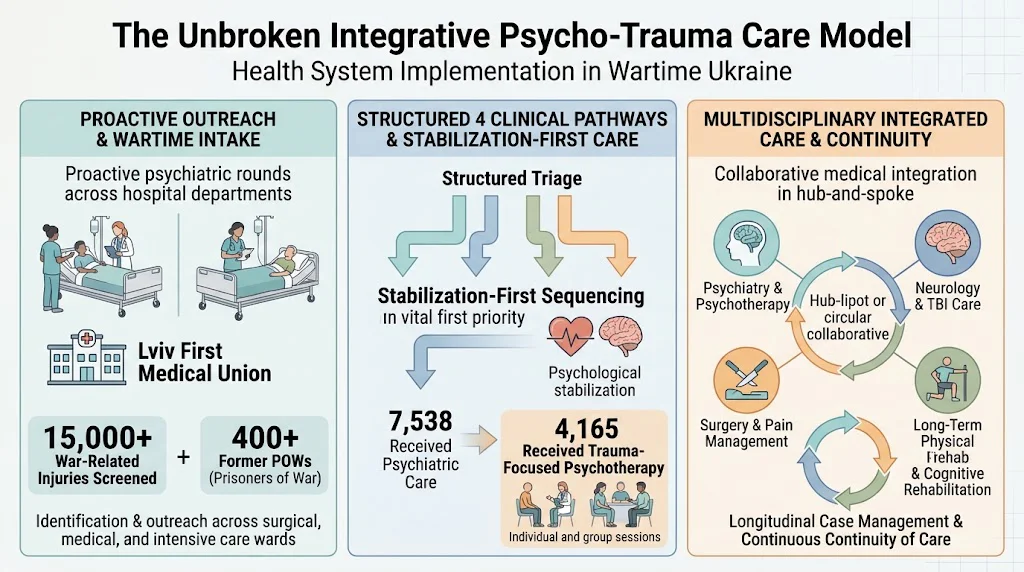
• Over 15,000 war-related injury patients and 7,538 individuals received trauma-focused psychiatric care from February 2022 to December 2025 in Lviv, Ukraine.
• The model employs proactive psychiatric outreach with structured triage into clinical pathways, stabilization-first sequencing, and longitudinal multidisciplinary case management.
• Integration of neurological, surgical, rehabilitation, and psychiatric services facilitated early trauma distress recognition and continuity of care under resource-constrained conflict conditions.
Study Background
The war in Ukraine has created an unprecedented psychological trauma burden among both military personnel and civilians. High rates of posttraumatic stress disorder (PTSD), traumatic brain injury (TBI), severe physical injury, and psychiatric sequelae from captivity in former prisoners of war present complex challenges for healthcare delivery. Wartime contexts impose significant limitations on health systems, including limited resources, disrupted infrastructure, and ongoing security threats. The civilian hospital system becomes a vital platform for delivering trauma-informed mental health care at scale. However, there has been limited guidance on how to pragmatically organize multidisciplinary services to manage overlapping medical and psychiatric conditions in a dynamic conflict environment.
Study Design and Implementation
The Unbroken Integrative Psycho-Trauma Care Model was implemented in the Lviv First Medical Union, located in Western Ukraine. This civilian hospital system faced large volumes of war-injured patients and individuals with complex mental health needs. The model was introduced starting from the onset of the full-scale invasion on February 24, 2022, and is ongoing through December 31, 2025, aiming to provide longitudinal, coordinated care.
The key design features included:
Proactive psychiatric rounds across medical and surgical departments to identify patients with trauma-related distress early.
Structured triage system categorizing patients into four distinct clinical pathways based on urgency and complexity.
Stabilization-first sequencing, prioritizing acute medical and neurological stabilization before initiating trauma-focused psychotherapies.
Multidisciplinary coordination integrating psychiatry with neurology, surgery, rehabilitation, and case management teams.
Longitudinal case management to ensure continuous follow-up and adaptive therapy in a high-turnover, resource-limited setting.
Key Findings and Results
Between February 24, 2022, and December 31, 2025:
The Lviv First Medical Union treated over 15,000 individuals with war-related injuries.
More than 400 former prisoners of war, a population at particularly high risk for psychiatric sequelae, were cared for under this model.
A total of 7,538 unique patients received psychiatric evaluation and treatment through the Unbroken Model.
Of these, 4,165 patients received trauma-focused psychotherapy, adapted to the wartime clinical environment.
The presence of proactive psychiatric rounds ensured early identification of trauma-related distress, facilitating prompt psychological intervention rather than delayed referral after medical discharge. The structured triage pathways allowed prioritization based on clinical severity and resource availability, ensuring effective utilization of constrained staff and infrastructure.
By sequencing stabilization of physical and neurological injuries before commencing psychological therapies, the model aligned with best practices in managing overlapping conditions such as traumatic brain injury and PTSD, boosting treatment tolerance and outcomes. The multidisciplinary case management approach promoted seamless communication across specialties, enhancing patient-centered continuity of care critical in a complex conflict setting where frequent transfers and interruptions were common.
Expert Commentary
The Unbroken Model represents a pragmatic and innovative example of trauma-informed mental health service delivery under extreme conditions. Its major advancement lies not only in clinical techniques but in the systemic organization of care pathways that accommodate overlapping injury types and fluctuating resource constraints.
Similar models could be adapted in other conflict zones or postconflict settings with high burdens of trauma and limited centralized mental health infrastructure. The multidisciplinary coordination featured here aligns with current global mental health recommendations for integrated care models, particularly where neurological and physical trauma coexist with psychiatric disorders.
Limitations include the challenges inherent in data collection and research amid active conflict and reliance on a single civilian hospital site, which may impact generalizability. Further investigations could compare outcomes with traditional care delivery or evaluate cost-effectiveness to inform broader implementation.
Conclusion
In conclusion, the Unbroken Integrative Psycho-Trauma Care Model offers a scalable, multidisciplinary framework for delivering trauma-informed mental health care within civilian hospitals during ongoing wartime conflict. It demonstrates that coordinated outreach, triage-driven clinical pathways, integration of multidisciplinary specialties, and stabilization-first sequencing are feasible and effective strategies for managing complex trauma populations in resource-constrained, high-demand environments.
This model holds promise for wider application in conflict-affected regions globally, addressing critical gaps in trauma care systems where traditional psychiatric services may be fragmented or overwhelmed. Continued dissemination of this approach alongside rigorous evaluation will be crucial to improving mental health recovery for war-affected populations.
Reference
Berezyuk O, Rubinstein D, Duek O, Amen S, Samchuk O, Krynytska-Berezyuk U, Filts O, Svirchuk M, Herych H, Paolini L, Patsalides Hofmann B, Bluvshtein M, Umarbekov A, Philip NS, Harpaz-Rotem I. The Unbroken Integrative Psycho-Trauma Care Model: Health System Implementation in Wartime Ukraine. JAMA Psychiatry. 2026 Oct 28. doi: 10.1001/jamapsychiatry.2026.3438. Epub ahead of print. PMID: 42949753.