Tailoring Misoprostol Dosing for Labor Induction: The Influence of BMI and Administration Route
Highlight
This study identifies that higher body mass index (BMI) in pregnant patients is associated with an increased requirement for misoprostol doses to achieve active labor during labor induction. Notably, buccal administration of misoprostol demands more doses than vaginal dosing, particularly in patients with obesity. These findings emphasize the need for individualized dosing strategies in obese populations undergoing labor induction.
Study Background
Induction of labor is a common obstetric intervention intended to initiate uterine contractions before spontaneous labor. Misoprostol, a prostaglandin E1 analogue, is widely used for cervical ripening and labor induction due to its efficacy and ease of administration. With the rising global prevalence of obesity among pregnant women, understanding how body mass index influences labor induction outcomes is critical. Obesity is known to complicate labor management owing to factors such as altered pharmacokinetics, comorbidities like diabetes mellitus and hypertensive disorders, and increased cesarean delivery rates. However, optimal strategies for misoprostol dosing in obese patients remain underexplored, especially when comparing different routes of administration, such as vaginal and buccal.
Study Design
This investigation was a secondary analysis of the Induction with MisoPROsotol: Oral mucosa versus Vaginal Epithelium study (NCT02408315), a triple-blinded, placebo-controlled randomized controlled trial. The cohort comprised 299 term pregnant patients undergoing labor induction, categorized by BMI into nonobese (≤29 kg/m2), obese (30-40 kg/m2), and morbidly obese (≥41 kg/m2) groups. Participants were randomized to receive either vaginal or buccal misoprostol. The primary endpoint for this analysis was the number of misoprostol doses required to achieve active labor, defined as cervical dilation of at least 6 cm. Statistical comparisons included Wilcoxon signed-rank tests and chi-squared or Fisher exact tests, supplemented by generalized linear models adjusting for ethnicity, race, dosing route, and labor induction indication. Statistical significance was set at P<.05.
Key Findings
The distribution of participants across BMI categories was 21% nonobese, 55% obese, and 23% morbidly obese.
Baseline characteristics such as age, race, gestational age, parity, initial Bishop score, and dosing route did not significantly differ across BMI groups. However, a higher proportion of non-Hispanic ethnicity was observed in obese categories (P=.02). Additionally, labor induction indications related to diabetes mellitus and hypertensive disorders were significantly higher in obese and morbidly obese groups (P=.03), implicating associated comorbid conditions in this population.
Univariate analysis revealed that in the buccal dosing group, obese and morbidly obese patients required significantly more doses to achieve active labor compared to nonobese patients (2.1 vs 2.8 vs 2.9 doses; P=.01). Conversely, no statistically significant dose difference was observed among BMI groups for vaginal dosing (1.9 vs 2.1 vs 2.3 doses; P=.21).
Rates of vaginal delivery within 24 hours, cesarean delivery, and cesarean for fetal distress showed no significant variation across different BMI categories or dosing routes.
Multivariate analysis adjusting for race/ethnicity and labor induction indication demonstrated that buccal dosing independently required 24% more doses to achieve active labor than vaginal dosing (P<.005). Furthermore, obesity was independently associated with an increased requirement for doses regardless of dosing route: 24% more expected doses for BMI 30-40 kg/m2 (P<.047) and 28% more for BMI ≥41 kg/m2 (P<.05).
Expert Commentary
This study underscores the pharmacodynamic challenges in inducing labor among obese patients, suggesting that misoprostol efficacy is diminished or delayed in this population. The finding that buccal administration necessitates more dosing than vaginal administration aligns with known differences in mucosal drug absorption and local prostaglandin bioavailability. Given that vaginal dosing more effectively reaches cervical and uterine tissues directly, it may explain the relatively lower dose requirement.
Clinicians should appreciate that BMI impacts not only labor course but also medication response, warranting consideration of dosing strategy adjustments. However, the absence of differences in cesarean rates indicates that increased dosing does not correlate with adverse delivery mode outcomes. The study’s strengths include a robust RCT design and rigorous adjustment for confounding factors. Limitations include the secondary analysis approach, limiting causative assertions, and lack of pharmacokinetic data to explain mechanistic bases for dose variation.
Conclusion
Obesity significantly increases the number of misoprostol doses needed to achieve active labor irrespective of the route of administration. Buccal misoprostol dosing, while convenient, requires more doses than vaginal dosing, particularly in patients with elevated BMI. These insights advocate for individualized induction protocols, potentially favoring vaginal dosing and adjusted dosing schedules in obese populations to optimize labor induction efficacy. Further research is warranted to refine dosing guidelines and elucidate the underlying pharmacological mechanisms in obesity.
Funding and ClinicalTrials.gov
This study was a secondary analysis derived from the randomized trial registered as NCT02408315. Funding sources and conflicts of interest were declared in the original study publication.
Reference
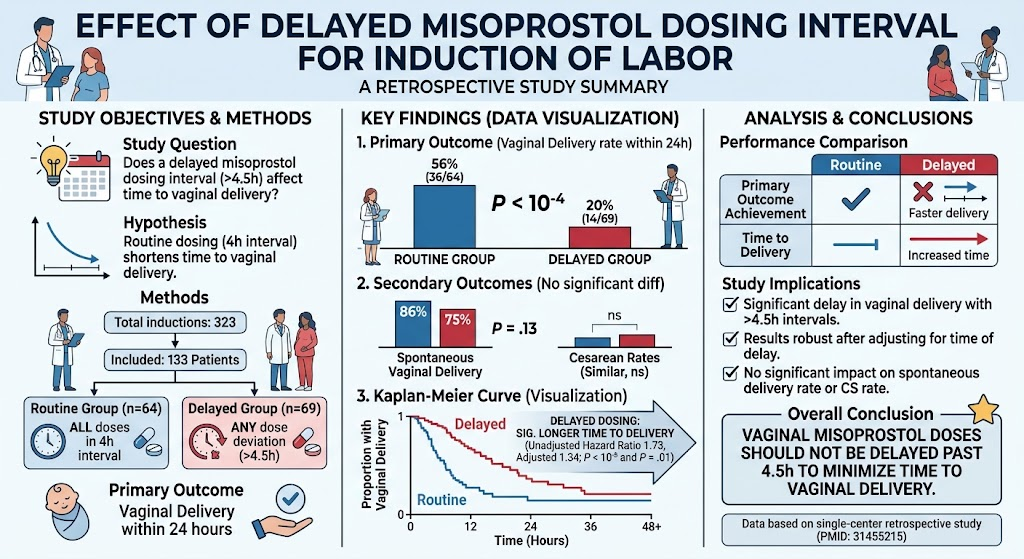
Harman Crowell EH, Crowell AM, Theiler RN. Effect of delayed misoprostol dosing interval for induction of labor: a retrospective study. BMC Pregnancy Childbirth. 2019 Aug 27;19(1):309. doi: 10.1186/s12884-019-2454-9. PMID: 31455215; PMCID: PMC6712846.
This article was created using several editorial tools, including AI, as part of the process. Human editors reviewed this content before publication.