We use cookies

Our website uses essential cookies and, with your consent, additional cookies to measure performance and improve our services. Cookie Policy.

You can change your choice at any time.

MMedXYNews
HomeVideos
MedXY AI/MedXY News/Section: Clinical Updates

Smartphone Acquisition at Age 13 and Its Impact on Adolescent Depression, Obesity, and Sleep: A Cohort Evidence Synthesis
MedXY Editorial Team•Aug 16, 2026•Clinical Updates
obesitydepressionadolescent healthsmartphone usesleep

Highlights

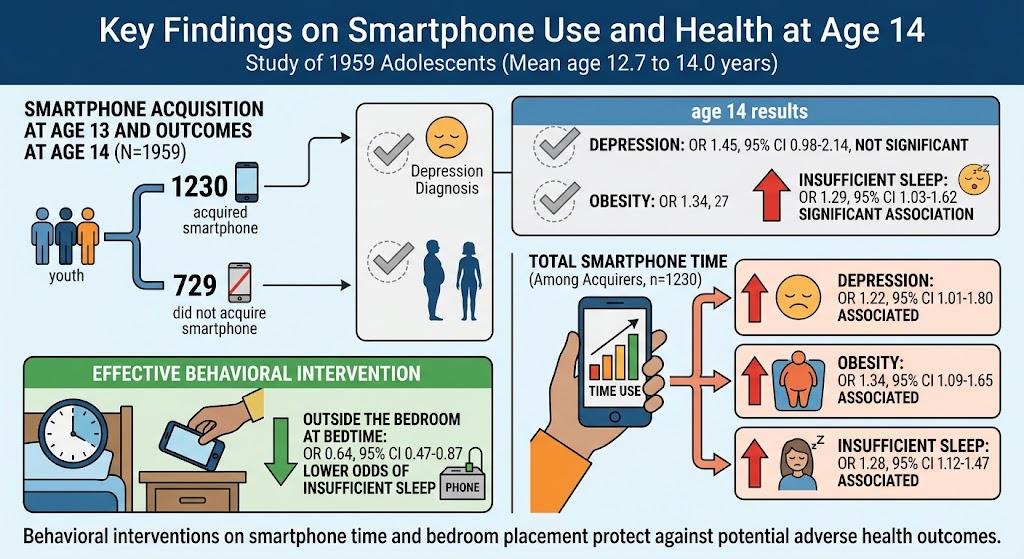
  • Smartphone acquisition at 13 years is linked to insufficient sleep at 14 years but not significantly to depression or obesity.
  • Higher smartphone use duration among adolescents with smartphones increases risk for depression, obesity, and insufficient sleep.
  • Behavioral interventions such as limiting smartphone time and removing devices from bedrooms at night significantly reduce sleep insufficiency risk.
  • Findings inform caregiver guidelines and public health policy, supporting delayed smartphone acquisition and moderated use.

Background

MedXY registered readers

Sign in free to continue reading

Create or use your MedXY account to unlock the complete article.

This article was created using several editorial tools, including AI, as part of the process. Human editors reviewed this content before publication.

Related articles

Open language-specific specialty feeds and department pages.

Bariatric Surgery and Risk of Obesity-Related Cancer by Age and Sex: A Comprehensive ReviewThis review synthesizes evidence from large cohort studies and meta-analyses highlighting bariatric surgery’s association with reduced risks of many obesity-related cancers, consistent across age and sex. Mechanistic insights and implOct 19, 2026Impact of CYP2D6 and CYP2C19 Genetic Variations on Venlafaxine Treatment Outcomes: Insights from Norwegian and UK CohortsThis article reviews a large retrospective study revealing significant associations between CYP2D6 and CYP2C19 genotypes and venlafaxine treatment failure, highlighting the potential for genotype-guided personalized antidepressant therapy.Oct 17, 2026Survodutide Once Weekly in Adults with Obesity and Type 2 Diabetes: A Contemporary Review of Evidence and Clinical ImplicationsSurvodutide, a dual glucagon and GLP-1 receptor agonist, demonstrates significant weight loss and glycemic improvements in adults with obesity and type 2 diabetes, offering promise as a novel therapeutic agent with favorable efficacy and saOct 17, 2026
Loading comments...
MedXY briefing

Get the free newsletter

Evidence-led clinical news, trends, and analysis—delivered to your inbox.

Ask MedXY AI

Most popular

Intimate Health
Five Benefits for Women Continuing Sexual Activity After Menopause
Intimate Health
Why Some Women Have a Strong Sex Drive—And Why Men Shouldn't Worry About It
Nursing & care
How often should a couple have sex?
Cardiology
Precision Medicine for Long QT Syndrome Type 2: Lumacaftor Corrects Trafficking Defects and Shortens QT Interval
General Surgery
Optimizing Postoperative Opioid Prescriptions After Intra-Abdominal Cancer Surgery: Comparing the 5x-Multiplier and 3-Tier Models
© 2026 MedXY
Contact usAbout usPrivacy PolicyMedXY story
Retatrutide: A Breakthrough Triple Agonist for Obesity and Type 2 Diabetes Management
Retatrutide, a triple agonist targeting GIP, GLP-1, and glucagon receptors, significantly reduces bodyweight and improves glycemic control in adults with obesity and type 2 diabetes, showing promising efficacy and a manageable safety profil
Oct 15, 2026
Obesity and Kidney Transplantation: Weighing Risks and Outcomes from a Swiss Single-Center StudyThis Swiss retrospective study reveals that while obesity in kidney transplant recipients increases early surgical complications and delayed graft function, it does not affect long-term patient or graft survival, suggesting obesity alone shOct 14, 2026
Linking Disease-Specific Gains to Long-Term Quality of Life in Functional RhinoplastyFunctional rhinoplasty improves nasal obstruction symptoms and these disease-specific improvements correlate with reductions in anxiety, depression, and pain/discomfort, influencing long-term global quality of life.Oct 9, 2026