We use cookies

Our website uses essential cookies and, with your consent, additional cookies to measure performance and improve our services. Cookie Policy.

You can change your choice at any time.

MMedXYNews
HomeVideos
MedXY AI/MedXY News/Section: Neurology

Synergistic Impact of Age and Nerve Degeneration on Bell’s Palsy Recovery: Clinical Implications
MedXY Editorial Team•Sep 13, 2026•Neurology
ageBell's palsyNerve degenerationprognosis

Highlight

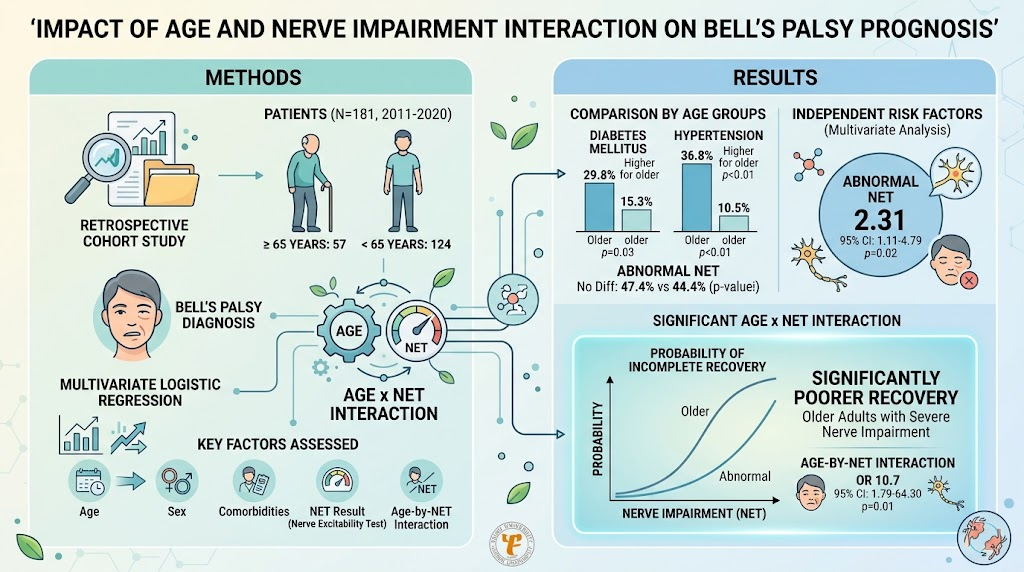
  • Severe nerve degeneration, assessed by the Nerve Excitability Test (NET), is a strong independent predictor of poor prognosis in Bell’s palsy.
  • The interaction between aging and nerve impairment significantly exacerbates recovery outcomes in older adults (≥65 years).
  • Older patients exhibit higher rates of comorbidities like diabetes and hypertension, though these alone are not the main drivers of prognosis.
  • Early and aggressive intervention is crucial in older patients with severe nerve injury due to diminished nerve regenerative capacity.

Study Background and Disease Burden

MedXY registered readers

Sign in free to continue reading

Create or use your MedXY account to unlock the complete article.

This article was created using several editorial tools, including AI, as part of the process. Human editors reviewed this content before publication.

Related articles

Open language-specific specialty feeds and department pages.

Molecular Stratification of Early-Stage Vulvar Squamous Cell Carcinoma: Prognostic Impact of HPV and TP53 StatusThis study highlights how HPV and TP53 molecular subtyping in stage I vulvar squamous cell carcinoma delineates survival outcomes and recurrence risks, supporting its role in personalized management strategies.Sep 19, 2026Cardiac Sarcoidosis: Nationwide Insights into Diagnosis, Management, and Outcomes from the MYSTICS RegistryThe MYSTICS Registry provides robust data on cardiac sarcoidosis, highlighting diagnostic challenges, treatment patterns, and prognostic differences among phenotypes, emphasizing tailored management strategies to improve patient outcomes.Sep 17, 2026Enhancing Prognosis in Bell Palsy: Electrodiagnostic Testing Beyond House-Brackmann GradeElectrodiagnostic tests, notably electroneuronography and electromyography, significantly improve prognosis prediction for Bell palsy recovery, including patients with moderate paralysis (H-B grade IV). These findings support broader use toSep 13, 2026
Loading comments...
MedXY briefing

Get the free newsletter

Evidence-led clinical news, trends, and analysis—delivered to your inbox.

Ask MedXY AI

Most popular

Intimate Health
Five Benefits for Women Continuing Sexual Activity After Menopause
Intimate Health
Why Some Women Have a Strong Sex Drive—And Why Men Shouldn't Worry About It
Nursing & care
How often should a couple have sex?
Intimate Health
Classic Intimacy Recommendations: How to Help Women Reach Orgasm and Enjoy Mutual Pleasure
Intimate Health
What Makes a Woman "Physiologically Addicted" Is Never Money, But These Two Relationship Qualities
© 2026 MedXY
Contact usAbout usPrivacy PolicyMedXY story
Decoding CPEB3-Regulated Alternative Polyadenylation: A New Genetic Lens on Hepatocellular Carcinoma Prognosis
This article explores how genetic variants affect CPEB3-mediated alternative polyadenylation in hepatocellular carcinoma, revealing potential prognostic markers and therapeutic targets to improve patient survival.
Sep 5, 2026
From Pressure Metrics to Personalized Prognosis: Transforming Risk Assessment in Advanced Chronic Liver DiseaseA shift from static portal pressure thresholds to dynamic, non-invasive risk prediction models offers improved prognostic accuracy for decompensation in advanced chronic liver disease, enabling personalized patient management and better cliAug 31, 2026
MRI-Derived EOAD-Signature Atrophy as a Prognostic Biomarker in Early-Onset Mild Cognitive ImpairmentBaseline cortical atrophy within an EOAD-specific brain signature predicts progression from mild cognitive impairment to dementia, providing a valuable MRI biomarker for individualized prognosis in early-onset Alzheimer disease.Aug 28, 2026