We use cookies

Our website uses essential cookies and, with your consent, additional cookies to measure performance and improve our services. Cookie Policy.

You can change your choice at any time.

MMedXYNews
HomeVideos
MedXY AI/MedXY News/Section: news

Supraglottic Botulinum Toxin Injection Improves Symptoms of Laryngeal Sensory Dysfunction
MedXY Editorial Team•Sep 28, 2026•news
Độc tố botulinumVagal HypersensitivityLaryngeal Sensory Dysfunction

Introduction

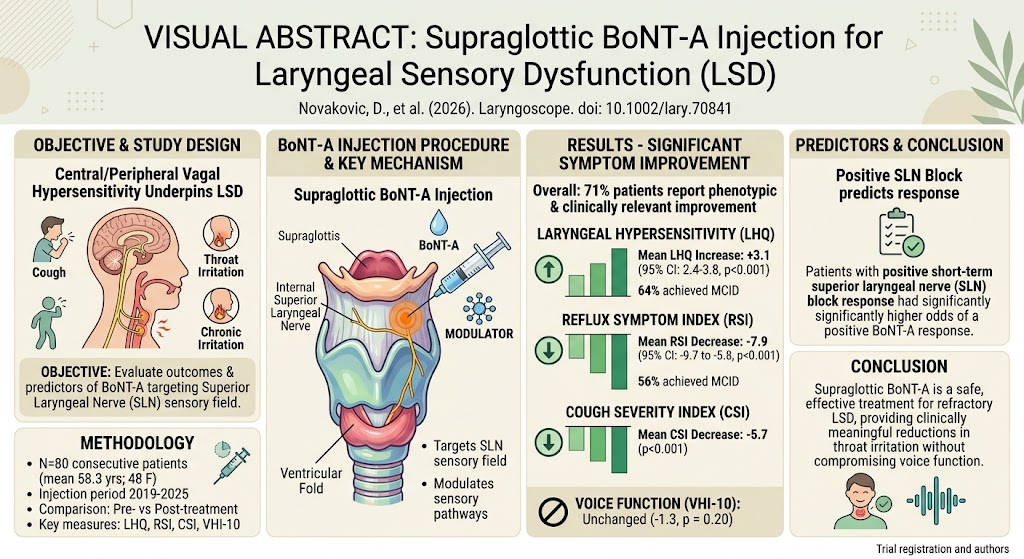
Laryngeal sensory dysfunction (LSD) is a condition characterized by abnormal hypersensitivity of the laryngeal mucosa, often leading to persistent throat irritation, chronic cough, and throat clearing. This sensory disturbance is predominantly driven by central and peripheral hypersensitivity of the vagus nerve, particularly the superior laryngeal nerve (SLN), which plays a key role in laryngeal sensation. Patients suffering from LSD frequently experience a reduced quality of life due to the chronic and refractory nature of their symptoms.

Traditional management of LSD includes medical and behavioral therapies such as proton pump inhibitors, neuromodulators, speech therapy, and lifestyle modifications. However, a subset of patients remain refractory to these treatments, warranting exploration of alternative therapeutic strategies.

MedXY registered readers

Sign in free to continue reading

Create or use your MedXY account to unlock the complete article.

This article was created using several editorial tools, including AI, as part of the process. Human editors reviewed this content before publication.

Related articles

Open language-specific specialty feeds and department pages.

PREBOTPilot Trial: Botulinum Toxin Injection Into the Sphincter of Oddi Fails to Prevent Pancreatic Fistula After Distal PancreatectomyA randomized controlled trial showed that preoperative botulinum toxin injection into the sphincter of Oddi does not reduce the incidence of clinically relevant postoperative pancreatic fistula following distal pancreatectomy.Oct 18, 2026Intraoperative Botulinum Toxin Injection to Reduce Postoperative Sialocele After Parotidectomy: A Retrospective Cohort AnalysisThis study suggests intraoperative botulinum toxin may reduce sialocele formation after parotidectomy, though larger prospective trials are needed to confirm efficacy and guide clinical use.Sep 15, 2026Evaluating Automated Acoustic Metrics for Monitoring Botulinum Toxin Treatment in Adductor Laryngeal DystoniaThis article reviews the utility of pitch strength and percent vocal creak as automated acoustic biomarkers to assess treatment response in adductor laryngeal dystonia, highlighting their correlations with traditional measures yet limited gAug 11, 2026
Loading comments...
MedXY briefing

Get the free newsletter

Evidence-led clinical news, trends, and analysis—delivered to your inbox.

Ask MedXY AI

Most popular

Intimate Health
Five Benefits for Women Continuing Sexual Activity After Menopause
Intimate Health
Why Some Women Have a Strong Sex Drive—And Why Men Shouldn't Worry About It
Nursing & care
How often should a couple have sex?
Cardiology
Precision Medicine for Long QT Syndrome Type 2: Lumacaftor Corrects Trafficking Defects and Shortens QT Interval
General Surgery
Optimizing Postoperative Opioid Prescriptions After Intra-Abdominal Cancer Surgery: Comparing the 5x-Multiplier and 3-Tier Models
© 2026 MedXY
Contact usAbout usPrivacy PolicyMedXY story
Beyond the Bloat: Addressing the Neuropsychiatric Burden of Retrograde Cricopharyngeus Dysfunction through Targeted Botulinum Toxin Intervention
This review analyzes the high prevalence of anxiety and depression in patients with Retrograde Cricopharyngeus Dysfunction (RCPD) and evaluates the significant, sustained mental health improvements following cricopharyngeal botulinum toxin
Mar 13, 2026