PREBOTPilot Trial: Botulinum Toxin Injection Into the Sphincter of Oddi Fails to Prevent Pancreatic Fistula After Distal Pancreatectomy
Highlight
Preoperative endoscopic injection of botulinum toxin (BTX) into the sphincter of Oddi (SO) was safe and feasible in patients undergoing distal pancreatectomy (DP).
BTX injection did not reduce the rate of clinically relevant postoperative pancreatic fistula (POPF) grades B/C or 30-day mortality compared to control.
The PREBOTPilot randomized controlled trial was prematurely terminated due to futility after interim analysis.
Findings do not support routine use of SO BTX injection for POPF prevention following DP.
Study Background
Postoperative pancreatic fistula (POPF) remains one of the most common and serious complications after distal pancreatectomy (DP), occurring in up to 30% of patients. POPF can lead to prolonged hospitalization, significant morbidity including secondary hemorrhage, infection, and sometimes mortality. Preventive strategies for POPF are thus a critical unmet clinical need in pancreatic surgery.
The sphincter of Oddi (SO) regulates the outflow of pancreatic juice into the duodenum. Pharmacological relaxation of the SO via botulinum toxin (BTX) injection has been proposed to facilitate pancreatic drainage and potentially reduce the pressure gradient at the anastomotic or transection site, thereby minimizing the risk of fistula formation. Early observational reports suggested this approach as a promising technique to prevent POPF after DP; however, rigorous randomized evidence was lacking.
Study Design
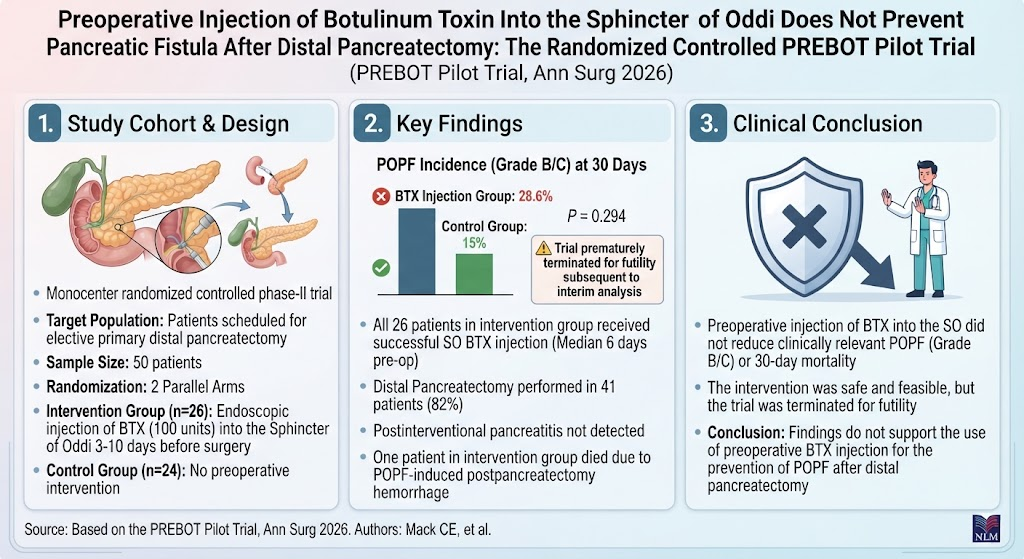
The PREBOTPilot trial was a monocenter, phase-II, randomized controlled, open-label study conducted between March 2020 and August 2023. Eligible adult patients scheduled for elective primary distal pancreatectomy, regardless of underlying pathology, were randomized in a 1:1 ratio to receive preoperative endoscopic BTX injection into the SO or no preoperative intervention (control).
Patients randomized to the intervention received 100 units of BTX injected endoscopically into the SO 3 to 10 days before surgery. The control group did not receive any sphincter-directed preoperative treatment. The primary endpoint was a composite of clinically relevant POPF grades B and C and/or death from any cause within 30 days after DP. Secondary endpoints included safety, feasibility, postoperative complications, and mortality rates.
Key Findings
Fifty patients were enrolled, with 26 in the intervention group and 24 controls. All intervention patients underwent successful SO BTX injection at a median of 6 days (interquartile range 5-8) before surgery. No cases of postinterventional pancreatitis or injection-related adverse events were observed.
Distal pancreatectomy was eventually performed on 41 patients (82%) across both arms. The primary outcome—clinically relevant POPF (grade B/C)—occurred in 6 of 21 patients (28.6%) in the BTX group versus 3 of 20 patients (15%) in the control group, a difference that was not statistically significant (P=0.294). One death, attributable to POPF-induced postpancreatectomy hemorrhage, occurred in the intervention arm.
Given the absence of any trend toward benefit and considering the event rates, the trial’s data monitoring committee recommended premature termination for futility prior to full recruitment (planned inclusion of 60 patients). The intervention was thus deemed safe and feasible but ineffective in reducing the incidence or severity of POPF.
Expert Commentary
The rationale for SO BTX injection centered on the hypothesis that pharmacologically induced sphincter relaxation would improve pancreatic juice outflow and reduce intraductal pressure, thereby decreasing the mechanical forces contributing to POPF after DP. However, the PREBOTPilot trial’s findings challenge this mechanistic conjecture in the clinical setting.
Several factors may explain the negative results. The degree and duration of sphincter relaxation induced by BTX may have been insufficient or transient relative to the critical window of postoperative pancreatic juice flow. Additionally, POPF pathophysiology is multifactorial, involving not only intraductal pressure but also pancreatic texture, duct size, surgical technique, and patient comorbidities, which BTX injection cannot address. Importantly, the trial confirmed the safety of preoperative BTX injection, with no procedure-related pancreatitis, supporting the feasibility of this approach for investigational purposes.
Previous smaller studies and case series had suggested potential benefits, but the lack of randomized data limited clinical adoption. This rigorous, controlled trial thus provides pivotal evidence that SO BTX injection should not be integrated into routine practice for fistula prevention. Future research may explore other pharmacological target strategies or optimized surgical techniques.
Conclusion
The PREBOTPilot randomized controlled trial demonstrated that preoperative endoscopic injection of botulinum toxin into the sphincter of Oddi did not reduce rates of clinically relevant postoperative pancreatic fistula or 30-day mortality after distal pancreatectomy. Although safe and feasible, this intervention does not confer clinical benefit in POPF prevention and should not be adopted as standard care. These findings underscore the complexity of POPF pathogenesis and emphasize the need for continued research into multifactorial prevention strategies.
Funding and Trial Registration
The study was conducted at a single center in Germany. Details on funding sources or trial registration numbers were not specified in the source publication. The trial was conducted in accordance with ethical standards for clinical research.
References
1. Mack CE, Klotz R, Klaiber U, et al. Preoperative Injection of Botulinum Toxin Into the Sphincter of Oddi Does Not Prevent Pancreatic Fistula After Distal Pancreatectomy: The Randomized Controlled PREBOTPilot Trial. Ann Surg. 2026 Oct 15. PMID: 42875865.
2. Bassi C, Marchegiani G, Dervenis C, et al. The 2016 update of the International Study Group (ISGPS) definition and grading of postoperative pancreatic fistula: 11 years after. Surgery. 2017;161(3):584-591.
3. Hackert T, Büchler MW. Surgical treatment of pancreatic cancer: Minimally invasive approaches, intraoperative radiation therapy, and future directions. J Gastrointest Surg. 2017;21(1):54-58.
4. Diener MK, Seiler CM, Rossion I, et al. Efficacy of techniques to reduce delayed gastric emptying after pancreaticoduodenectomy: A systematic review and meta-analysis. Ann Surg. 2017;266(3):356-365.
This article was created using several editorial tools, including AI, as part of the process. Human editors reviewed this content before publication.