Spiritual Distress Before Elective Surgery: Understanding Its Impact on Patient Experience and Outcomes
Highlight
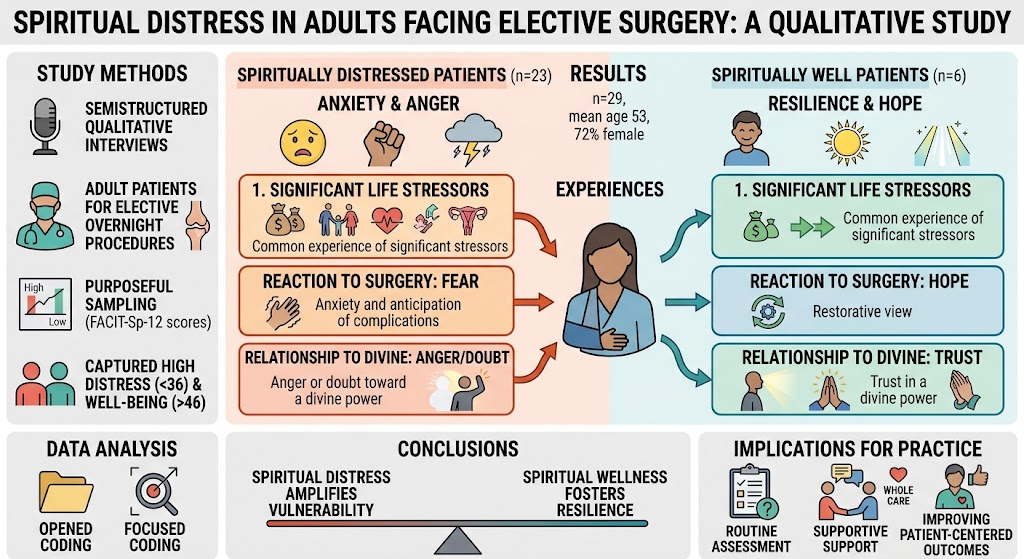
This qualitative study explores spiritual distress among adults facing elective surgery, revealing three key themes: common life stressors, divergent preoperative emotional responses based on spiritual well-being, and patients’ varying perceptions of the divine. The findings highlight the clinical importance of assessing spiritual well-being to enhance holistic preoperative care and patient resilience.
Study Background
Spiritual distress, characterized by difficulties in achieving connectedness with self, others, or a transcendent entity, is a recognized psychosocial challenge often observed in patients undergoing major health crises such as cancer or palliative care settings. Despite increasing awareness of spirituality’s role in holistic health, its impact remains understudied in surgical populations undergoing elective procedures. Surgery, even when planned, poses significant psychological and existential challenges, potentially affecting recovery and overall outcomes. Understanding the role of spiritual distress in the surgical context is crucial to tailoring patient-centered care and optimizing perioperative support.
Study Design
This qualitative investigation employed semistructured interviews with adult patients scheduled for elective surgical procedures requiring overnight admission, including bariatric, orthopedic, hernia, and vascular surgeries. Participants (n=29; mean age 53 years; 72% female) were purposively selected based on scores from the Functional Assessment of Chronic Illness Therapy-Spiritual Well-Being 12 (FACIT-Sp-12), targeting two groups: those with high spiritual distress (scores <36) and those with high spiritual well-being (scores >46). Interviews explored patients’ perceptions of surgery, their spiritual or religious identities, and the interplay between their health and spirituality. Data were analyzed using an iterative process of open and focused coding to identify emergent themes.
Key Findings
The majority of participants (23 out of 29) were categorized as spiritually distressed, with 6 participants demonstrating spiritual well-being. Analysis revealed three primary themes that differentiated the experience of spiritually distressed versus spiritually well patients in their preoperative period:
- Common Experience of Significant Life Stressors: Across both groups, participants reported encountering numerous stressors unrelated to surgery, including chronic health challenges, personal losses, and socioeconomic pressures. These common stressors formed an important context for their surgical experience.
- Surgery Begets Fear and Hope: Patients with spiritual distress predominantly expressed anxiety, fear of complications, and anticipatory dread about the surgical process and potential outcomes. Conversely, participants with spiritual well-being generally viewed surgery with hope, perceiving it as an opportunity for restoration and healing.
- Making Sense of the Divine: Spiritual distress was frequently accompanied by anger, doubt, or a sense of abandonment by a higher power or divine entity, reflecting existential struggle. In contrast, spiritually well patients articulated a sense of trust and surrender, drawing comfort from their faith or spiritual beliefs during the preoperative period.
These contrasting perspectives underscore that spiritual distress amplifies vulnerability to fear and anxiety, whereas spiritual well-being fosters resilience and adaptive coping in anticipation of surgery.
Expert Commentary
This study addresses a critical gap in surgical care by illuminating the nuanced role of spirituality in shaping the patient experience. Traditionally, clinical focus has emphasized biomedical and physical aspects of surgical readiness, often overlooking psychosocial and spiritual dimensions that can profoundly influence outcomes. Recognizing spiritual distress as a distinct and measurable patient experience allows for targeted interventions to mitigate anxiety and improve preparation for surgery.
One limitation is the relatively small sample size and the predominance of female participants, which may influence generalizability. Additionally, the mixed surgical populations, while representing common elective procedures, introduce heterogeneity in patient experiences. Future research should explore quantitatively how spiritual distress impacts postoperative recovery metrics such as pain, complications, and length of hospital stay.
From a mechanistic standpoint, spiritual well-being may buffer stress-related neuroendocrine responses, thereby modulating immune function and tissue healing, although empirical data in surgical populations remain limited.
Conclusion
Spirituality significantly informs adults’ preoperative experience during elective surgery, with spiritual distress intensifying vulnerability to negative emotions and spiritual wellness promoting resilience and positive outlook. Routine assessment of spiritual well-being could be integrated into preoperative evaluation protocols to identify patients at risk of spiritual distress and provide supportive interventions such as counseling, spiritual care consultations, or mindfulness-based approaches. Such holistic care models have the potential to enhance patient-centered outcomes, reduce perioperative anxiety, and improve overall surgical recovery.
Implementing spiritual distress screening and support aligns with current trends toward whole-person care in surgical practice, bridging physical, psychological, and existential domains to optimize health outcomes.
Funding and ClinicalTrials.gov
The original study did not indicate specific funding sources or clinical trial registration. Future trials to evaluate interventions targeting spiritual distress in surgical patients are warranted.
References
- Makar KG, Thomas MR, Worden AM, Varner-Perez SE, Matthias MS, Torke AM. A qualitative study of Spiritual distress in adults facing elective surgery. Surgery. 2026 Aug 3;199:110499. PMID: 42632276.
- Puchalski CM, et al. Spirituality, illness, and healing: an integrative approach. Ann Fam Med. 2014;12(2):197-204.
- Koenig HG. Religion, spirituality, and health: The research and clinical implications. Int Sch Res Notices. 2012;2012:278730.
- Balboni TA, et al. Spirituality and medical care: enhancing patient-centered care through religious and spiritual support. Am J Hosp Palliat Care. 2013;30(2):135-143.
This article was created using several editorial tools, including AI, as part of the process. Human editors reviewed this content before publication.