Highlight
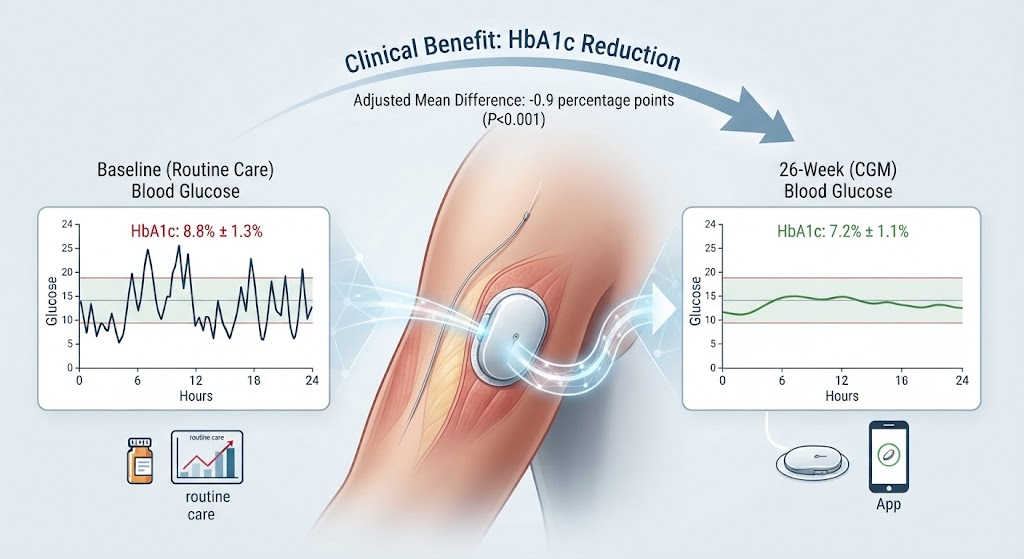
Continuous glucose monitoring (CGM) significantly lowers HbA1c levels in non-insulin-treated type 2 diabetes, with a 0.9% greater reduction compared to routine care over 26 weeks. CGM use improves time spent in optimal glucose range (70-180 mg/dL) by 21 percentage points and reduces hyperglycemia risk without increasing hypoglycemia. These results support CGM use in broader diabetes management beyond insulin-treated populations.
Study Background
Type 2 diabetes mellitus (T2DM) is a prevalent chronic metabolic disorder characterized by impaired glucose regulation and progressive beta-cell dysfunction. Effective glycemic management reduces the risk of microvascular and macrovascular complications. Continuous glucose monitoring has transformed diabetes management by providing real-time glycemic data, enabling improved treatment adjustments and lifestyle decisions. While CGM’s benefits in type 1 diabetes and insulin-treated type 2 diabetes are well established, its role in patients with T2DM managed without insulin remains underexplored. Given that a substantial proportion of individuals with T2DM are managed with oral agents or lifestyle alone, innovative tools to optimize glycemic control in this population are highly needed to curb diabetes-related complications and improve quality of life.
Study Design
The CONNECT trial was a 26-week, randomized controlled trial conducted at 22 primary care practices across the United States. Adults aged 21 to 84 years with type 2 diabetes treated without insulin were enrolled and randomly assigned to two parallel groups: continuous glucose monitoring (CGM) versus routine care (control). The primary endpoint was glycated hemoglobin (HbA1c) at 26 weeks, reflecting average blood glucose over approximately three months. Secondary endpoints assessed CGM-derived metrics, including time spent within the target glucose range (70-180 mg/dL) and hypo- and hyperglycemia durations. Hierarchical testing was applied to control for type I error across secondary outcomes. Importantly, the trial was pragmatic, operating in primary care environments, aiming to reflect real-world applicability.
Key Findings
The study randomized 283 participants (145 CGM, 138 control) with baseline mean HbA1c of approximately 8.8%. At 26 weeks, the CGM group exhibited a clinically significant decrease in HbA1c from 8.8% to 7.2%, while routine care participants reduced from 8.7% to 8.0%. The adjusted mean difference was -0.9 percentage points (95% CI, -1.1 to -0.6; P<0.001), underscoring a robust effect size favoring CGM.
CGM metrics revealed that the CGM group spent 21 percentage points more time per day in the 70-180 mg/dL glucose range compared to controls (95% CI, 16 to 26; P<0.001), indicating improved glycemic stability. Hypoglycemia events were rare, with the CGM group demonstrating lower percentages of time below 54 mg/dL and below 70 mg/dL compared to routine care; differences met noninferiority and superiority criteria (P<0.005). Crucially, no severe hypoglycemia episodes were reported during the trial.
This trial confirms safety alongside efficacy, showing that CGM use in non-insulin-treated T2DM reduces hyperglycemia and improves overall glycemic patterns without increasing hypoglycemic risk.
Expert Commentary
The CONNECT trial provides compelling evidence that the utility of CGM extends beyond insulin-treated diabetes populations, bringing real-world benefits to primary care settings. The magnitude of HbA1c reduction observed (approx. 0.9%) rivals that of many oral diabetes medications, suggesting that CGM can function as a potent adjunct to standard therapeutic regimens through enhanced self-monitoring and feedback.
Potential mechanisms include greater patient engagement, behavioral modifications from immediate data feedback, and more informed clinical decision-making by providers. Importantly, the trial did not simply demonstrate statistical significance but clinically meaningful improvement, which may translate into reduced risk of long-term complications.
Limitations include the 26-week follow-up period, which does not elucidate long-term sustainability of glycemic benefits or clinical outcomes. Also, while primary care settings reflect broad applicability, individual variability in adherence to CGM technology could influence effectiveness. Future studies should explore cost-effectiveness, patient-reported outcomes, and integration strategies in diverse healthcare systems.
Conclusion
The CONNECT trial marks a paradigm shift by establishing CGM as an effective tool to improve glycemic control in adults with type 2 diabetes managed without insulin in primary care. CGM use led to greater HbA1c reduction and improved time in target glucose range, with no increase in hypoglycemia risk. These findings support expanding CGM indications to a wider T2DM population, potentially leading to better long-term outcomes and enhanced patient empowerment.
Funding and Trial Registration
This trial was funded by Dexcom. It is registered under ClinicalTrials.gov identifier NCT06601166.
References
Oser TK, Martens T, Ruedy KJ, et al. Continuous Glucose Monitoring in Non-Insulin-Treated Type 2 Diabetes. N Engl J Med. 2026 Oct 14. PMID: 42878622. Available at https://pubmed.ncbi.nlm.nih.gov/42878622/