Highlight
Development of a shared T classification system based on invasion depth for biliary tract cancers at the cystic duct junction.
Identification that traditional site-based classifications (perihilar, distal, cystic duct cancers) inadequately stratify survival for tumors involving the cystic duct junction.
Depth-based staging (T1–T4) shows superior prognostic stratification with better discrimination of patient survival outcomes.
Proposal to group these tumors collectively as junctional cholangiocarcinoma (JCC) to improve clinical management consistency.
Study Background
Biliary tract cancers (BTCs) encompass a heterogeneous group of malignancies arising along the bile duct system. Among these, tumors localized around the cystic duct junction—a critical anatomical crossroads between the intrahepatic and extrahepatic biliary tree—pose unique diagnostic and treatment challenges. This region harbors distinct cancer entities such as perihilar cholangiocarcinoma (PCC), distal cholangiocarcinoma (DCC), and cystic duct carcinoma (CDC), each traditionally staged by separate tumor classification systems per AJCC guidelines. These tumor site-centric systems risk inconsistent prognostic accuracy and impede therapeutic decision-making, particularly for tumors invading this junctional zone, which may defy clear anatomical categorization.
Given the clinical conundrum and prognostic uncertainty surrounding junctional tumors, ongoing efforts seek a unified classification that reliably stratifies patient outcomes and guides treatment. The depth of tumor invasion, a histopathologic hallmark reflecting biological aggressiveness, offers a promising alternative or adjunct to anatomical staging. This study addresses a significant unmet need by proposing and evaluating a novel invasion depth-based T classification system specifically for biliary tract cancers at the cystic duct junction.
Study Design
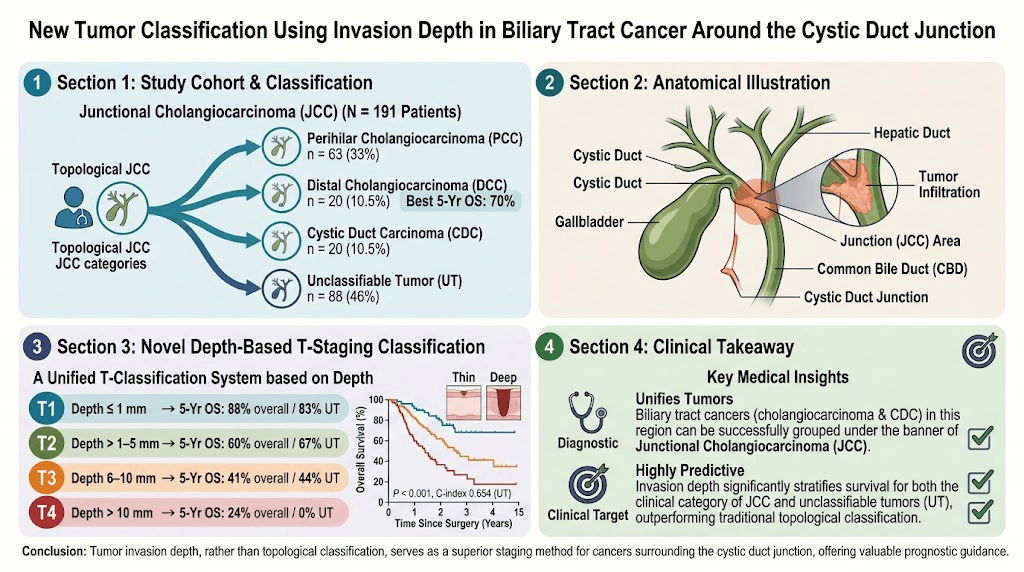
This retrospective cohort study enrolled patients treated from 2011 to 2019 diagnosed with biliary tract cancers clinically invading the cystic duct junction, termed junctional cholangiocarcinoma (JCC). Based on topologic predominance, tumors were initially classified into four groups: PCC, DCC, CDC, or unclassifiable tumor (UT) when the origin could not be distinctly assigned.
Clinical and pathological data, including traditional AJCC T staging specific to PCC, DCC, and CDC, were collected. The investigators introduced a novel depth-based T classification subdividing tumors by invasion depth measured in millimeters: T1 (≤1 mm), T2 (>1–5 mm), T3 (6–10 mm), and T4 (>10 mm). The primary endpoint was overall survival, and the performance of traditional anatomical T classifications was compared against the new depth-based system using concordance indices (C-index) and survival curves.
Key Findings
Among 191 patients with JCC, 33% were classifiable as PCC (63), DCC (20), or CDC (20), whereas nearly half (46%, 88 patients) were UT. Distinct survival differences emerged: DCC patients showed a favorable 5-year survival (70%) contrasting sharply with PCC (36%), CDC (29%), and UT patients (48%). Despite this, when UT patients were retrospectively staged using the PCC, DCC, and CDC AJCC T systems, all showed only modest survival stratification (C-index around 0.56–0.61), indicating limited discriminatory power.
Crucially, the depth-based T classification provided superior prognostic stratification in both the UT subgroup and the entire JCC cohort. In the UT group, 5-year survival rates dramatically decreased from 83% (T1) to 0% (T4) with statistical significance (P < 0.001, C-index 0.654). Similarly, in the full JCC cohort, survival rates declined from 88% (T1) to 24% (T4) (P < 0.001, C-index 0.632). The depth-based staging surpassed the anatomical site-specific systems in predictive accuracy, demonstrating its robustness across heterogeneous tumor topologies.
Expert Commentary
This study offers a compelling paradigm shift in the classification of biliary tract cancers near the cystic duct junction. The findings underscore the limitations inherent in etiologically strict anatomical classifications for tumors that anatomically straddle multiple bile duct segments. By leveraging a histopathologic measure of tumor invasion depth, the authors established a unified, biologically relevant staging criterion that improves survival prediction.
This shared depth-based classification could harmonize clinical decision-making and facilitate more tailored treatment strategies. For example, patients with early invasion depths (T1 or T2) might benefit from less extensive surgery or be candidates for adjuvant therapy trials, while those with deep invasion (T4) may require more aggressive approaches or palliative care emphasis.
Nevertheless, the study’s retrospective design and single-institution cohort may limit generalizability. Future multicenter prospective validation is necessary to confirm these findings and integrate invasion depth into standardized staging manuals. Moreover, mechanistic studies correlating invasion depth with molecular tumor features could enhance understanding of its prognostic power.
Conclusion
The novel tumor invasion depth-based T classification represents a major advance in the staging of biliary tract cancers involving the cystic duct junction. It outperforms traditional topological classifications in stratifying survival and provides a unified framework encompassing perihilar, distal, and cystic duct tumors under the shared umbrella of junctional cholangiocarcinoma. Incorporating this depth-based system into clinical practice promises improved prognostic precision and may inform personalized therapeutic strategies for this challenging cancer subset.
Funding and Clinical Trials
The study was conducted at the institutions affiliated with Ushida Y and colleagues; no specific funding disclosures were noted. The research does not reference ongoing clinical trials.
References
1. Ushida Y, Watanabe N, Kawakatsu S, et al. New Tumor Classification Using Invasion Depth in Biliary Tract Cancer Around the Cystic Duct Junction. Ann Surg. 2025;284(4):796-803. doi:10.1097/SLA.0000000000005653
2. Blechacz B, Gores GJ. Cholangiocarcinoma: Advances in Pathogenesis, Diagnosis, and Treatment. Hepatology. 2008;48(1):308-321.
3. Edge SB, Compton CC. The American Joint Committee on Cancer: The 7th Edition of the AJCC Cancer Staging Manual and the Future of TNM. Ann Surg Oncol. 2010;17(6):1471-1474.
4. DeOliveira ML, Cunningham SC, Cameron JL, et al. Cholangiocarcinoma: thirty-one-year experience with 564 patients at a single institution. Ann Surg. 2007;245(5):755-762.