Rethinking Race/Ethnicity in Cardiovascular Risk Assessment: The Race-Free MESA Risk Score
Highlight
1. The original MESA risk score includes race/ethnicity as a predictor for coronary heart disease risk alongside coronary artery calcium and traditional cardiovascular risk factors.
2. A newly developed race-free MESA risk score eliminates race/ethnicity but retains several novel interaction terms, maintaining predictive performance.
3. The race-free score shows comparable discrimination and calibration to the original, with no significant difference in predictive accuracy.
4. This suggests that race/ethnicity may be excluded from risk models without loss of clinical utility, addressing concerns about race-based risk stratification.
Study Background
Cardiovascular disease remains a leading cause of morbidity and mortality globally, necessitating precise risk stratification tools for prevention and management. The Multi-Ethnic Study of Atherosclerosis (MESA) risk score is widely used to estimate the 10-year risk of coronary heart disease (CHD). A key feature of the original MESA score was the inclusion of coronary artery calcium (CAC) scoring alongside traditional cardiovascular risk factors and race/ethnicity categories (White, Hispanic/Latino, Black, Chinese). However, the use of race/ethnicity in clinical algorithms has raised ethical and methodological concerns, including potential reinforcement of health disparities and limited biological basis of racial categories.
Study Design
This study reanalyzed data from the MESA cohort, which enrolls community-based adults aged 45 to 84 years without prevalent cardiovascular disease. The authors developed a race-free MESA risk model by adopting the original two-step regression approach: first applying least absolute shrinkage and selection operator (LASSO) regression for variable selection, followed by ridge regression to reduce overfitting. Importantly, race/ethnicity variables and any interaction terms involving them were excluded as candidate predictors, allowing evaluation of model performance without racial classification.
Key Findings
The race-free MESA risk score retained some interaction terms that were not part of the original score, indicating that other variables and their interactions may compensate for the predictive contribution previously attributed to race/ethnicity.
Performance metrics showed that the area under the receiver operating characteristic curve (AUC) for the race-free model was 0.820 (95% CI, 0.801-0.840), very close to that of the original model. The difference in AUC was 0.0032 (95% CI, -0.0008 to 0.0073), not statistically significant, supporting comparable discrimination between models.
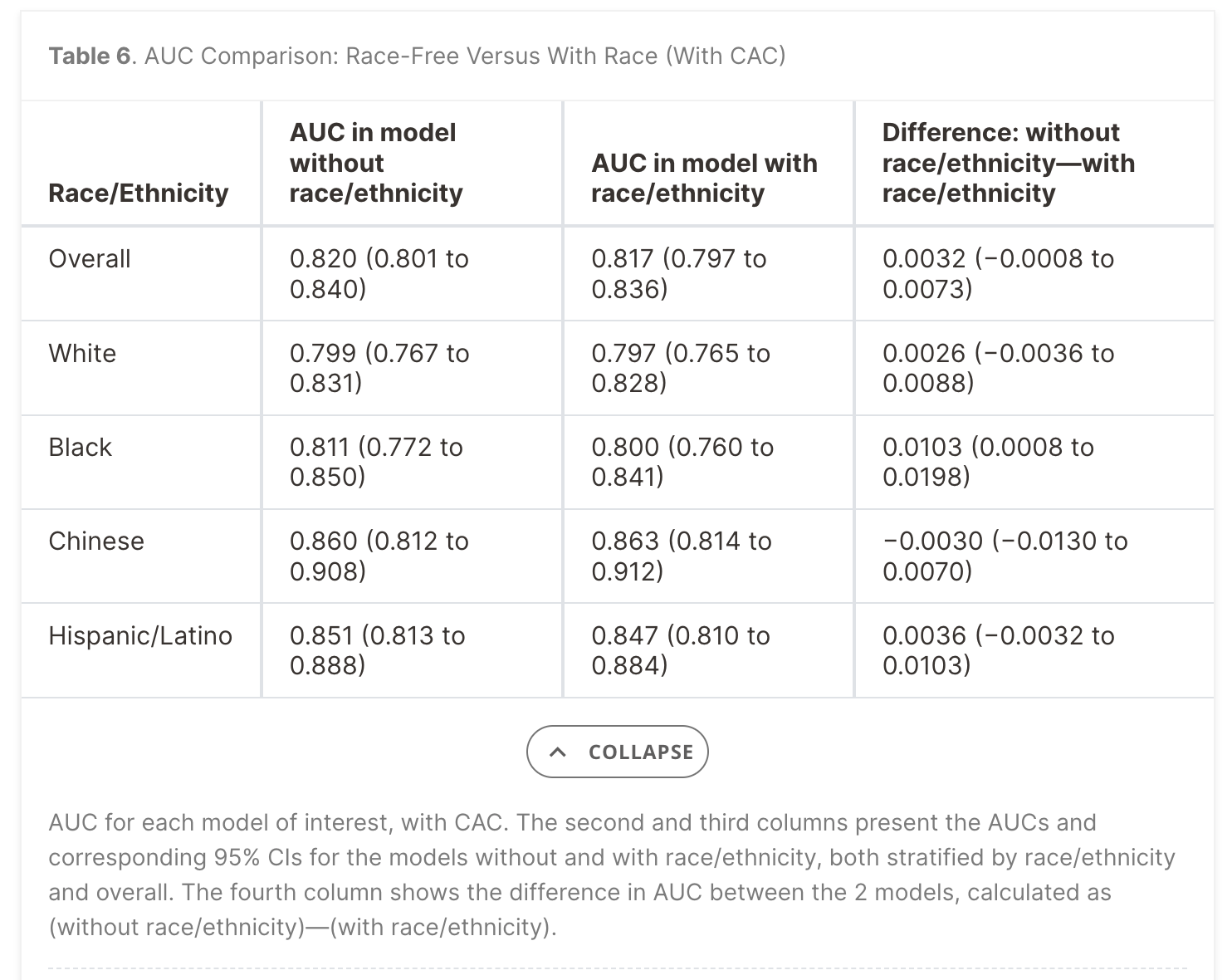
The discrimination slope, a measure of risk stratification, was slightly improved in the race-free score (0.101) compared to the original (0.0937), suggesting enhanced separation between events and nonevents.
Both models demonstrated good calibration, indicating accurate prediction of observed event rates across risk strata.
Expert Commentary
The findings underscore the potential to remove race/ethnicity from cardiovascular risk prediction algorithms without compromising clinical accuracy. This aligns with evolving recommendations discouraging routine use of race in clinical algorithms due to concerns about perpetuating disparities and the social construct nature of race.
The maintenance of predictive accuracy after excluding race suggests that the underlying clinical and imaging variables, along with nuanced interactions, can adequately capture relevant risk factors typically correlated with race/ethnic categories.
However, limitations include the focus on four specific racial/ethnic groups from the original MESA cohort and potential differences in phenotypic risk heterogeneity not fully captured in nonracial variables. Further validation in diverse external populations is warranted.
Conclusion
This study provides important evidence supporting a race-free MESA coronary heart disease risk score with similar predictive performance to the original model. Removing race/ethnicity from prediction models may promote equity in cardiovascular risk assessment and guide clinical decision-making without reinforcing race-based categorizations.
Future research should focus on external validation, assessment of clinical impact in diverse populations, and exploration of alternative social and environmental determinants of cardiovascular risk to enhance individualized prediction.
Funding and ClinicalTrials.gov
The study was supported by data from the Multi-Ethnic Study of Atherosclerosis cohort. Specific funding sources for this secondary analysis were not detailed. ClinicalTrials.gov registration details for the original MESA cohort are available (NCT00005487).
References
White Q, Hansen S, Murphy BS, Johnson C, DeFilippis A, Post W, McClelland R. Reevaluating the Use of Race/Ethnicity in the MESA Risk Score. J Am Heart Assoc. 2026 Jul 7;15(13):e047013. doi: 10.1161/JAHA.125.047013. Epub 2026 Jul 3. PMID: 42396766.
This article was created using several editorial tools, including AI, as part of the process. Human editors reviewed this content before publication.