Highlight
Primary care providers (PCPs) who completed a targeted behavioral health training fellowship demonstrate significantly lower mental health stigma compared to non-alumni.
Stigma reduction was specifically noted in attitudes, disclosure, and help-seeking behavior domains.
Socioeconomic disadvantage of practice location showed no significant association with stigma levels, suggesting stigma among PCPs is primarily influenced by training rather than practice environment.
Behavioral health training programs may be a critical tool to advance equitable and high-quality mental health care in primary care settings.
Study Background
Mental health disorders represent a substantial global disease burden, often first encountered in primary care settings. However, stigma among healthcare providers remains a key barrier to timely diagnosis, treatment initiation, and ongoing management of patients with behavioral health conditions. Primary care providers (PCPs), including physicians, nurse practitioners, and physician assistants, can play a pivotal role in integrated mental health care if stigma-related barriers are mitigated. Educational interventions aimed at reducing such stigma have been proposed as an essential component to enhance access to and quality of mental health services in primary care, but real-world evidence quantifying the impact of structured training on clinician attitudes remains limited.
Study Design
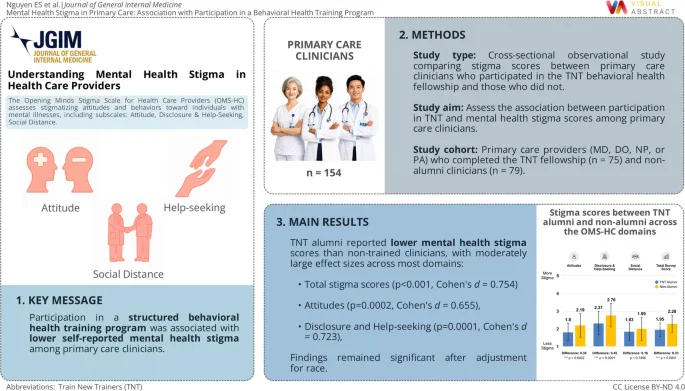
This cross-sectional observational study, conducted in 2024 across diverse urban, suburban, and rural settings in the USA, assessed 154 licensed PCPs comprising MDs, DOs, nurse practitioners, and physician assistants. The cohort included 75 alumni of the Train New Trainers Primary Care Psychiatry Fellowship—a year-long continuing education program specifically designed to enhance primary care behavioral health expertise—and 79 non-alumni PCPs without similar formal behavioral health training. The primary exposure was participation in the fellowship, while the secondary exposure was the socioeconomic disadvantage of the PCP practice location, measured by the Area Deprivation Index (ADI).
Mental health stigma was quantitatively measured using the Opening Minds Stigma Scale for Health Care Providers (OMS-HC), a validated 15-item instrument subdivided into three subscales: attitudes towards mental illness, disclosure and help-seeking comfort, and social distance preferences. Lower scores correspond to less stigma. The study evaluated differences between fellowship alumni and non-alumni and explored correlations of stigma levels with local socioeconomic factors.
Key Findings
The principal finding was that PCPs who completed the Train New Trainers fellowship exhibited significantly lower overall stigma scores compared to non-alumni peers (p < 0.0001). The fellowship alumni reported notably less agreement with stigmatizing attitudes toward mental illness (p = 0.0002) and a more accepting perspective regarding disclosure and help-seeking (p = 0.0001). Differences in social distance subscale scores were less pronounced but trended favorably among alumni.
Interestingly, analysis revealed no statistically significant differences in stigma levels based on the socioeconomic disadvantage of practice locations measured by ADI, indicating that PCP stigma might be relatively independent of the economic context of communities served.
These results suggest that targeted educational interventions, such as the Train New Trainers Primary Care Psychiatry Fellowship, are effective in modifying PCP attitudes and potentially enhancing clinical engagement with patients who have behavioral health disorders.
Expert Commentary
The study provides robust cross-sectional evidence associating structured behavioral health training with reduced stigma among primary care clinicians. This is a critical insight because stigma reduction is recognized as a precursor to improved mental health care delivery, including better screening, diagnosis, patient rapport, and adherence to treatment.
However, the cross-sectional design limits causal inferences; it remains plausible that clinicians predisposed to more favorable mental health attitudes may self-select into such fellowship programs. Longitudinal or randomized controlled trials are warranted to firmly establish causality.
Moreover, the lack of association between practice location disadvantage and stigma challenges assumptions that socioeconomic hardships might translate into higher clinician stigma. This finding may reflect the homogenizing influence of professional culture or training deficiencies that are universal rather than context dependent.
Integrating behavioral health training into primary care curricula and continuing medical education frameworks might serve as a scalable approach to mitigate stigma and enhance mental health care accessibility, especially in underserved areas. The program’s curriculum content, mentorship models, and delivery mode warrant further investigation to optimize effectiveness and replication.
Conclusion
This study highlights the potential of dedicated behavioral health training programs in significantly reducing mental health stigma among primary care providers. Given the integral role of PCPs in managing common mental health conditions, embedding such training within primary care workforce development could be a pivotal strategy to improve patient outcomes and equity in mental health services.
Further prospective research is recommended to confirm these findings, evaluate long-term impact on clinical behaviors and patient outcomes, and explore implementation models across diverse healthcare settings.
Funding and ClinicalTrials.gov
The original publication did not specify funding sources or clinical trial registration.
References
1. Nguyen ES, Barry DR, Stehli A, et al. Mental Health Stigma in Primary Care: Association with Participation in a Behavioral Health Training Program. J Gen Intern Med. 2026 Nov 3. PMID: 42977886. https://pubmed.ncbi.nlm.nih.gov/42977886/
2. Thornicroft G, Mehta N, Clement S, et al. Evidence for effective interventions to reduce mental-health-related stigma and discrimination. Lancet. 2016;387(10023):1123-1132.
3. Corrigan PW, Druss BG, Perlick DA. The Impact of Mental Illness Stigma on Seeking and Participating in Mental Health Care. Psychol Sci Public Interest. 2014;15(2):37-70.
4. Mate K, Dover M, Nosek A, et al. Improving behavioral health care by teaching primary care clinicians stigma reduction strategies. Am J Psychiatry. 2020;177(4):305-314.