Highlight
Retrorectus placement of absorbable polyglactin mesh lowers postoperative bulge rates after DIEP flap breast reconstruction.
Hernia risk is influenced by patient age, prior open abdominal surgery, and perforator dissection patterns.
A validated, individualized nomogram was developed to estimate hernia risk with and without mesh use, supporting personalized surgical planning.
Study Background
Deep Inferior Epigastric Perforator (DIEP) flap breast reconstruction is widely regarded for its preservation of abdominal muscle integrity compared to other autologous options, thus reducing donor-site morbidity. However, complications such as abdominal hernias and bulges remain clinically relevant concerns, potentially impacting patient satisfaction and functional outcomes. Bulge reflects a non-hernia abdominal wall laxity or weakness presenting as a visible contour deformity, whereas hernias describe fascial defects with visceral protrusion requiring more invasive management.
Current approaches seeking to mitigate donor-site complications include reinforcing the abdominal wall with mesh implants. While synthetic non-absorbable meshes have demonstrated efficacy, their use confers risks of chronic foreign body reaction, infection, and cost burden. Absorbable meshes such as polyglactin may offer a low-cost, biocompatible alternative, with potential to strengthen the abdominal wall during critical healing phases and be resorbed thereafter.
This study investigates the impact of retrorectus placement of absorbable polyglactin mesh on the rates of postoperative hernia and bulge after DIEP flap harvest. Moreover, it addresses a clinical need for personalized risk stratification by developing and validating a nomogram to estimate individual hernia risk with and without mesh reinforcement, facilitating tailored clinical decision-making.
Study Design
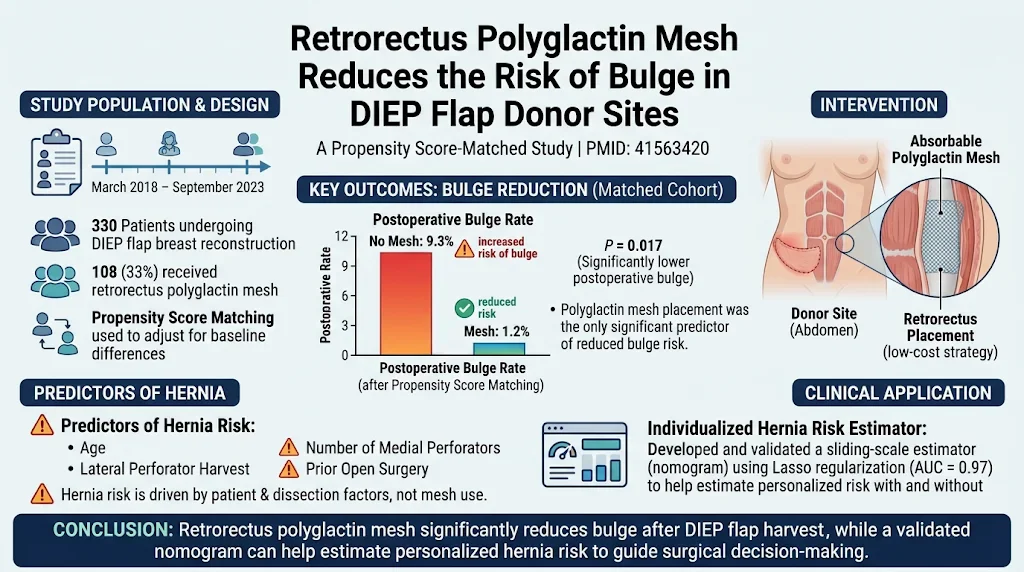
The authors conducted a retrospective cohort study at a single center involving 330 patients who underwent DIEP flap breast reconstruction between March 2018 and September 2023. The study compared outcomes between patients receiving retrorectus polyglactin mesh placement (n=108, 33%) and those without mesh reinforcement.
Key donor site outcomes assessed included the occurrence of hernias and bulges confirmed clinically and/or radiographically. To reduce confounding from baseline differences, propensity score matching was applied, creating well-balanced cohorts for comparative analysis. Multivariable logistic regression identified independent predictors of hernia and bulge. A logistic model with Lasso regularization was developed to estimate individualized hernia risk, culminating in a user-friendly nomogram for clinical use.
Key Findings
After propensity score matching, retrorectus retrogressive placement of absorbable polyglactin mesh significantly reduced postoperative abdominal bulge incidence compared to the no-mesh group (1.2% vs 9.3%, P=0.017), indicating a substantial benefit in abdominal wall contour preservation.
Regarding hernia risk, multivariable analysis revealed that older age, lateral perforator harvest, and the number of medial perforators harvested independently increased the likelihood of hernia formation. Notably, mesh placement did not significantly reduce hernia rates in this cohort, highlighting the multifactorial complexity of hernia pathogenesis beyond mechanical reinforcement alone.
The predictive logistic regression model incorporating these clinical variables demonstrated excellent discrimination (area under the curve = 0.97) and was used to construct a nomogram. This tool allows clinicians to estimate personalized hernia risk probabilities with and without mesh reinforcement, aiding in nuanced surgical planning and preoperative counseling.
Expert Commentary
The study offers compelling evidence supporting the use of absorbable polyglactin mesh placed in the retrorectus plane to mitigate postoperative bulge, a complication often underappreciated yet significantly affecting patient quality of life post DIEP flap reconstruction. The mesh likely reinforces the abdominal wall during critical healing, thereby preserving muscular and fascial contour without introducing permanent synthetic material.
Interestingly, while mesh was protective against bulge, it was not a significant predictor for hernia risk reduction in multivariate models. This dissociation suggests divergent pathophysiological mechanisms underlying hernias and bulges, with hernia risk more closely related to patient factors (age), prior surgical history (open operations), and technical factors (perforator dissection patterns).
The incorporation of rigorous statistical techniques such as propensity-score matching and Lasso-regularized logistic regression enhances confidence in the findings by minimizing confounding and overfitting biases. The resultant nomogram is especially valuable in clinical practice, providing a data-driven framework for individualized risk assessment, moving away from one-size-fits-all surgical decisions.
Limitations to consider include the retrospective design and single-center setting, which may affect generalizability. Also, longer-term follow-up may be necessary to capture late-onset donor site complications. Future prospective randomized controlled trials are warranted to further validate absorbable mesh benefits and refine risk models.
Conclusion
The use of retrorectus absorbable polyglactin mesh during DIEP flap breast reconstruction significantly reduces postoperative bulge incidence, improving donor-site abdominal contour and morbidity. Hernia risk is primarily influenced by patient age, prior open abdominal surgery, and perforator dissection but not directly mitigated by mesh placement. The study’s development and validation of a robust nomogram allow clinicians to estimate individualized hernia risk with or without mesh support, enhancing personalized surgical planning.
These findings advocate for consideration of absorbable mesh reinforcement as a low-cost, biocompatible strategy to reduce donor-site bulge and pave the way for risk-tailored approaches to optimize patient outcomes following autologous breast reconstruction.
Funding and Clinical Trial Information
The study was conducted under institutional funding at the authors’ center. No external funding sources or clinical trial registrations were reported.
References
Elmorsi R, Camacho L, Rogan D, et al. Retrorectus Polyglactin Mesh Reduces the Risk of Bulge in DIEP Flap Donor Sites: A Propensity Score-Matched Study. Plast Reconstr Surg. 2026;158(5):746e-754e. PMID: 41563420.
Selber JC, Renz N. Complications in DIEP flap breast reconstruction. Semin Plast Surg. 2010;24(2):129-137.
McCarthy CM, Mehrara BJ, Riedel E, et al. Prospective analysis of abdominal wall function after free TRAM flap breast reconstruction. Plast Reconstr Surg. 2002;109(2):569-574.
Jahangiri A, Bell T, Mercan E, et al. Risk factors for bulge formation after abdominal free flap breast reconstruction. J Plast Reconstr Aesthet Surg. 2017;70(8):1012-1018.