Highlight
• The J-scar mammaplasty is a versatile oncoplastic technique suitable for a wide range of breast sizes and tumor locations, particularly lateral quadrants.
• In a series of 157 patients, this method demonstrated a low overall complication rate of 7%.
• High patient and surgeon satisfaction was recorded at least 12 months postoperatively.
• The procedure integrates oncological safety with strong aesthetic outcomes, reaffirming its value in breast-conserving surgery.
Study Background
Oncoplastic breast surgery has emerged as a vital approach that balances oncological safety with enhanced aesthetic outcomes following breast-conserving surgery. Traditional lumpectomy or quadrantectomy methods, while effective for tumor excision, often present challenges related to symmetry, breast shape, and patient satisfaction. Oncoplastic techniques, by combining cancer surgery principles with plastic surgery reconstruction concepts, address these limitations. The philosophy prioritizes wide excision with tumor-free margins alongside reshaping techniques to maintain or restore breast contour and symmetry.
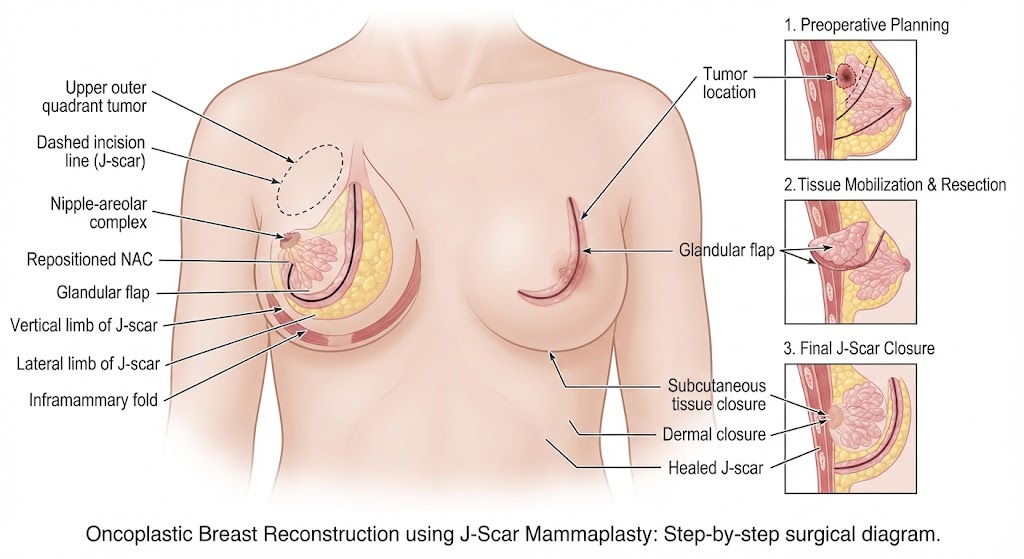
Among various oncoplastic maneuvers, level 2 procedures—those involving up to 20% breast volume resection—require reconstructive strategies that minimize deformity and optimize cosmesis. The J-mammaplasty, a relatively underreported technique in oncoplastic literature, has been refined and utilized over 20 years at the authors’ institution. This method involves a J-shaped scar pattern that facilitates tumor removal and simultaneous breast reshaping, particularly effective in patients with large breasts and ptosis.
Study Design
A retrospective cohort study was conducted involving 157 female patients undergoing level 2 oncoplastic breast surgery utilizing J-scar mammaplasty over a 3-year span. All patients had breast cancer amenable to quadrantectomy and were selected without restrictions on breast size or tumor quadrant location. Preoperative data collection included patient demographics, breast morphology, and photographic documentation. Intraoperative records detailed tumor size, location, and extent of tissue excision, along with procedural specifics of the J-scar technique.
Postoperative follow-up included regular clinical assessments for complications, defined as hematoma, infection, wound dehiscence, fat necrosis, or delayed healing. Patient and surgeon satisfaction surveys were administered no earlier than 12 months post-surgery to assess both aesthetic and functional outcomes. The study did not employ a comparator group but focused on descriptive outcomes and complication rates.
Key Findings
The J-type oncoplastic mammaplasty was found to be applicable across a broad patient population with variable breast sizes (including significantly large breasts) and third-degree ptosis, highlighting its versatility. Tumor location varied, with lateral quadrants being the most frequent site.
The overall complication rate reported was 7%, notably lower than the historically cited rates of up to 16% in other oncoplastic procedures. Complications were predominantly minor and manageable without compromising oncologic or aesthetic outcomes. No significant delays in adjuvant therapy due to surgical complications were recorded.
Assessment of patient and surgeon satisfaction showed high concordance, with most reporting excellent or good results in terms of breast symmetry, contour, and scarring. The J-scar pattern proved advantageous in camouflaging incision lines within natural breast folds, contributing to favorable cosmetic impressions.
Expert Commentary
The study reinforces the pivotal role of innovative oncoplastic techniques like the J-mammaplasty in expanding options for breast conservation, especially in patients with larger and ptotic breasts, who traditionally present reconstructive challenges. Its adaptability to varied tumor locations enhances surgical planning flexibility while preserving oncological safety.
Limitations include the lack of a control group and the single-institution design, which may affect generalizability. Furthermore, the level 4 evidence reflects observational experience rather than randomized controlled data. Future comparative studies could validate these findings and define precise patient selection criteria. Mechanistically, the design of the J-shaped scar optimizes tissue rearrangement without excessive glandular undermining, potentially reducing complication risks.
Conclusion
The J-scar mammaplasty represents a refined, effective, and safe oncoplastic technique that can be confidently employed in level 2 breast-conserving surgeries. It ensures oncologic safety with an acceptable complication profile and superior aesthetic outcomes, promoting high patient satisfaction. This study’s extensive institutional experience advocates for broader consideration of J-type mammaplasty as a standard reconstructive option in suitable patients.
Funding and Clinical Trials
This study did not report external funding sources or clinical trial registration.
References
1. Bianchi A, Visconti G, Barone Adesi L, Scardina L, Sanchez MA, Di Leone A, Franceschini G, Salgarello M. Oncoplastic Breast Reconstruction With J-Scar Mammaplasty: Outcomes and Versatility of an Innovative Technique. Aesthet Surg J. 2026 Oct 15;46(11):1228-1235. doi: 10.1093/asj/sjag148. PMID: 42446182.
2. Losken A, Dugal CS, Styblo TM, Carlson GW. A reconstructive algorithm for oncoplastic surgery. Ann Plast Surg. 2010;64(3): 251-258.
3. Silverstein MJ, Savalia N. Oncoplastic breast surgery. Surg Clin North Am. 2013;93(2):389-407.
4. Hieken TJ, Boughey JC. Oncoplastic techniques in breast conserving surgery. Surg Oncol Clin N Am. 2020;29(3):427-442.