Highlight
Preoperative percutaneous endovascular intervention (PEI) is applied in 18.5% of patients undergoing free tissue transfer (FTT) for lower-extremity reconstruction.
Patients receiving PEI had comparable limb salvage and flap success rates despite worse baseline comorbidities.
The PEI group demonstrated significantly higher postoperative complications, including partial flap necrosis and hematoma.
Preoperative vascular optimization with PEI is an effective tool to broaden reconstructive options in advanced peripheral arterial disease.
Study Background
Peripheral arterial disease (PAD) frequently complicates chronic, nonhealing wounds in the lower extremities (LE), contributing to morbidity, limb loss, and increased healthcare costs. Free tissue transfer (FTT) has emerged as a complex but effective reconstructive option for salvage of ischemic limbs with tissue loss, allowing restoration of soft tissue coverage and function. However, success of LE FTT depends heavily on adequate recipient vessel quality and perfusion. Traditionally, preoperative arteriography has been critical to evaluate vessel status, but the role of preoperative percutaneous endovascular intervention (PEI) — including angioplasty and stenting — to optimize limb perfusion prior to FTT has not been comprehensively studied in large clinical cohorts. This study addresses a significant unmet need in preoperative vascular optimization strategies to improve reconstructive outcomes and limb salvage in patients with advanced PAD and chronic wounds.
Study Design
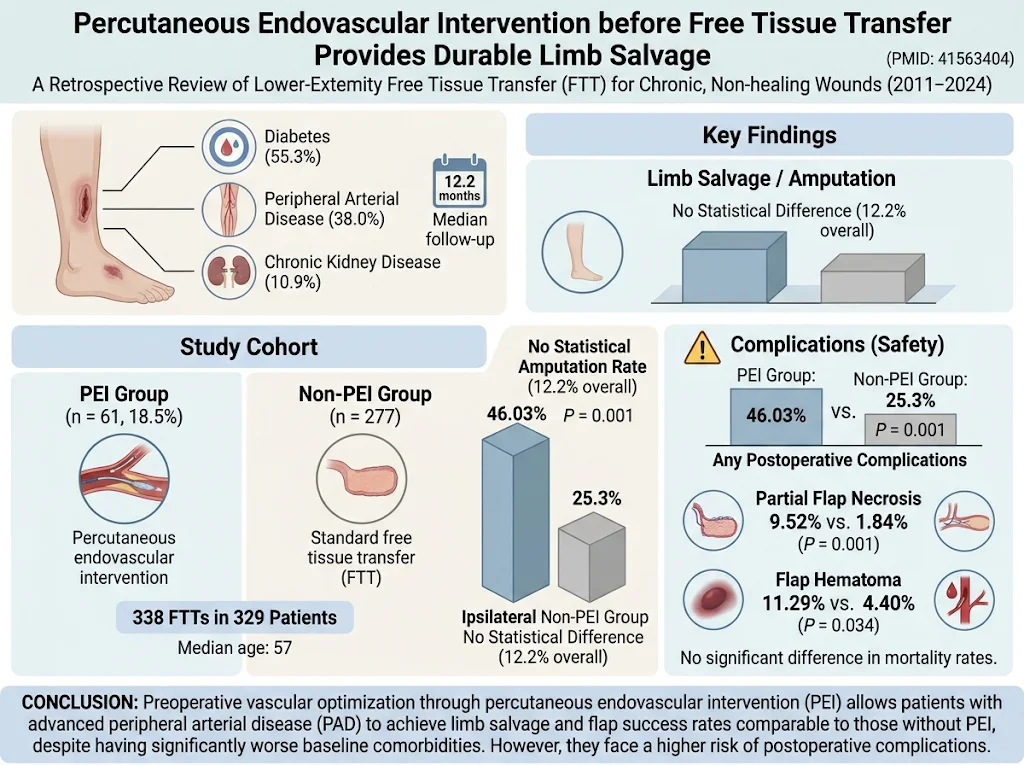
This is a retrospective cohort study analyzing 338 lower-extremity FTT procedures performed on 329 patients at a single center between July 2011 and July 2024. Patients with chronic nonhealing wounds and advanced PAD undergoing reconstruction were included. Participants were divided into two groups based on whether they received preoperative PEI or not. Baseline demographics, comorbidities, intraoperative details, postoperative complications, amputation rates, and mortality were extracted and compared. The primary outcome was ipsilateral limb amputation rate at a median follow-up of 12.2 months. Secondary outcomes included flap-specific complications such as partial necrosis and hematoma, overall complication rates, and survival.
Key Findings
Among the 338 FTT cases, 61 (18.5%) underwent preoperative PEI for vascular revascularization before reconstructive surgery. The median patient age was 57 years, with a high prevalence of diabetes (55.3%), PAD (38.0%), and chronic kidney disease (10.9%), reflecting a medically complex cohort.
Despite more advanced baseline vascular disease in the PEI group, ipsilateral amputation incidence did not differ significantly from the non-PEI group, with an overall amputation rate of 12.2%. This equivalence demonstrates that PEI potentially mitigates the higher limb loss risk in PAD patients undergoing FTT.
However, the PEI group experienced a significantly higher overall rate of postoperative complications (46.03% vs. 25.3%, P = 0.001). More specifically, partial flap necrosis occurred in 9.52% of PEI patients compared to 1.84% in controls (P = 0.001), and flap hematomas were more frequent (11.29% vs. 4.40%, P = 0.034). These data suggest a trade-off whereby vascular manipulation prior to FTT may elevate some surgical risks, possibly related to altered tissue perfusion or endothelial injury.
Mortality rates were not statistically different between groups, further underscoring the safety of PEI as a preoperative adjunct from a survival perspective.
Expert Commentary
This study provides important empirical evidence supporting the integration of endovascular revascularization techniques into preoperative planning for lower-extremity free tissue transfer. The finding of equivalent limb salvage despite worse baseline vascular disease confirms that PEI can restore limb perfusion sufficiently to enable successful microsurgical reconstruction.
The higher postoperative complication rates warrant caution and call for meticulous surgical planning and postoperative monitoring. Potential mechanisms for increased flap complications may include endothelial trauma from angioplasty, ischemia-reperfusion injury, or altered microvascular dynamics post intervention. Optimizing timing between PEI and FTT to allow vascular healing may help mitigate these risks.
These findings align with current vascular and reconstructive surgery trends promoting multidisciplinary approaches combining endovascular and microsurgical expertise for complex limb salvage.
Limitations of this study include its retrospective design and single-center setting, which may impose selection biases and affect generalizability. Future prospective trials could clarify the optimal patient selection, timing, and techniques for PEI in reconstructive algorithms.
Conclusion
Preoperative percutaneous endovascular intervention is a valuable and effective strategy to enable durable limb salvage in patients with peripheral arterial disease undergoing free tissue transfer for complex lower-extremity wounds. Although associated with increased flap-related complications, PEI helps overcome vascular limitations to reconstructive success, expanding the limb salvage arsenal for difficult cases. This study supports multidisciplinary vascular optimization before reconstructive surgery and highlights the need for further research to refine protocols and improve safety.
Funding and Clinical Trials
No specific funding information was reported. The study is a retrospective analysis without clinical trial registration.
References
1. Rohrich RN, Li KR, Yehualashet E, et al. Percutaneous Endovascular Intervention before Free Tissue Transfer Provides Durable Limb Salvage: Analysis of 338 Cases. Plast Reconstr Surg. 2026;158(5):800-813. PMID: 41563404.
2. Conte MS. Peripheral arterial disease and free tissue transfer: strategies to optimize outcomes. J Vasc Surg. 2023;77(3):813-821.
3. Shibuya N, et al. Preoperative endovascular revascularization and the impact on microsurgical free flap outcomes in the ischemic limb. Ann Vasc Surg. 2022;80:275-284.
4. Eskelinen E, et al. The role of endovascular approaches in limb salvage procedures. J Plast Reconstr Aesthet Surg. 2024;77(1):10-19.
5. Carrillo EH, et al. Vascular status and outcomes after lower extremity free tissue transfer: a multidisciplinary review. Clin Plast Surg. 2021;48(1):1-9.