Highlight
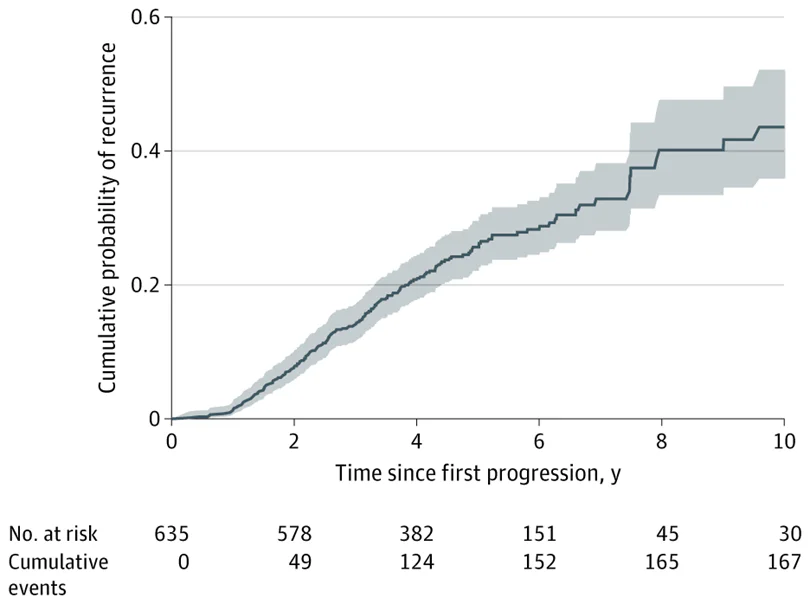
Recurrent visual field progression after initial glaucoma progression is common, with a 43.5% cumulative risk at 10 years.
Faster visual field deterioration prior to first progression, higher post-event intraocular pressure (IOP), less advanced initial damage, and older age are independently associated with recurrence.
Each 10% greater IOP reduction after initial progression significantly lowers recurrence risk.
Results highlight the importance of individualized IOP management and intensified monitoring strategies targeting high-risk patients.
Study Background
Glaucoma remains a leading cause of irreversible blindness worldwide, characterized by progressive optic neuropathy and corresponding visual field loss. Management strategies primarily aim to slow or halt progression by lowering intraocular pressure (IOP). The detection of a confirmed progression event in visual field testing, such as through Guided Progression Analysis (GPA), usually triggers intensification of IOP-lowering treatment. However, recurrent progression episodes following this initial event are poorly understood. Identifying factors which predispose patients to recurrent visual field deterioration can improve risk stratification, tailor monitoring intervals, and guide timely interventions to preserve vision.
Study Design
This large cohort study utilized data from the Bascom Palmer Ophthalmic Registry, comprising patients undergoing routine ophthalmic care from 1998 to 2025 at a single tertiary academic center. Inclusion criteria focused on eyes with open-angle glaucoma or suspected glaucoma. A total of 7,457 eyes from 5,086 patients were followed for a mean duration of 12.4 years (SD 4.6). The primary endpoints were (1) the cumulative incidence of recurrent visual field progression after an initial GPA likely-progression event and (2) hazard ratios for clinical and demographic factors associated with recurrence.
Visual field progression was defined objectively by GPA criteria. Post-progression IOP measures and mean deviation (MD) slopes before and after progression were calculated to evaluate disease dynamics. Multivariable Cox proportional hazards models controlled for confounding variables including age, baseline disease severity, ethnicity, and treatment parameters.
Key Findings
Among the 1,951 eyes (26.2%) with an initial GPA likely progression, 635 eyes had sufficient follow-up and IOP data for recurrent progression analysis. Recurrent progression developed in 167 eyes (26.3%) during follow-up.
Kaplan-Meier analysis revealed a 13.8% cumulative recurrence probability at 3 years and 43.5% at 10 years, emphasizing the substantial risk of ongoing disease worsening even after initial progression detection.
Multivariable analysis identified several independent risk factors:
Faster mean deviation (MD) loss before the first progression event increased recurrence risk significantly (Hazard Ratio [HR] 1.73 per 1 dB/year faster loss, 95% CI 1.39–2.15).
Higher mean IOP following the initial progression event conferred elevated risk (HR 1.09 per 1 mm Hg, 95% CI 1.05–1.13), underscoring the pivotal role of post-event IOP control.
Less negative (better) MD at the time of first progression was paradoxically associated with higher recurrence (HR 1.08 per 1 dB less negative, 95% CI 1.04–1.12), suggesting eyes with milder baseline damage may be more vulnerable to persistent decline.
Older patient age was also a predictor of recurrence (HR 1.11 per 5-year increment, 95% CI 1.03–1.19).
Notably, each 10% greater reduction in IOP after the first progression event was associated with an 11% reduction in recurrence risk (HR 0.89; 95% CI 0.83–0.94), highlighting IOP lowering’s protective effect.
Subgroup analysis revealed that eyes with pre-event MD slopes faster than -1.0 dB/year had a much higher recurrence rate (42.7%) compared to eyes with slower progression (23.4%), reflecting disease acceleration as a strong adverse prognostic factor.
The racial and ethnic distribution suggested broad applicability across diverse populations, although the study did not find race as an independent recurrence predictor after adjustment.
Expert Commentary
This study by Malek et al. offers valuable insights into the natural history of glaucoma after initial visual field progression. The finding that nearly half of eyes experience recurrent progression within a decade despite clinical intervention underscores glaucoma’s often relentless course. Importantly, the association between post-progression IOP and recurrence validates continued aggressive IOP management as essential even after progression events.
The paradoxical higher risk in eyes with less advanced damage at first progression challenges clinicians to maintain vigilance in early-stage disease rather than assuming stability once damage appears mild. Older age as a risk factor merits consideration when defining follow-up intervals.
Study limitations include its single-center design and potential selection bias from patients with adequate follow-up and IOP data. Nevertheless, the large sample size and extensive longitudinal data strengthen generalizability to routine clinical practice.
Clinicians should consider incorporating pre-progression rate of visual field loss, precise post-event IOP metrics, and age into risk stratification models. Further studies might investigate whether adjunctive neuroprotective therapies benefit high-risk patients beyond intensified IOP lowering.
Conclusion
Recurrent visual field progression after confirmed initial deterioration in glaucoma is frequent and clinically significant. Risk factors such as faster baseline visual field loss, higher post-event IOP, milder initial damage, and older age identify patients who may benefit most from intensified monitoring and aggressive IOP reduction strategies. These findings reinforce the paradigm of individualized, dynamic glaucoma management informed by close structural and functional surveillance to prevent vision loss.
Reference
Malek DA, da Costa DR, Scherer R, Medeiros FA. Incidence and Risk Factors of Recurrent Visual Field Progression in Glaucoma. JAMA Ophthalmol. 2026 Oct 22:e264609. doi: 10.1001/jamaophthalmol.2026.4609. Epub ahead of print. PMID: 42911573; PMCID: PMC13691913.