Highlight
This study evaluates the impact of restructuring a traditional ophthalmology resident clinic into an urgent eye clinic model, focusing on health equity and resident education. Key findings include decreased sociodemographic disparities in patient insurance and race profiles, increased proportion of high-acuity cases seen by residents, and significantly higher resident cataract surgery volumes post-transition.
Study Background
Ophthalmology residency programs in the United States commonly utilize two models for clinical training: a traditional resident clinic with separate faculty practice and a universal practice-based training model. In the traditional model, the resident clinic often serves a more socially disadvantaged patient population, while faculty clinics typically serve patients with private insurance. This division may contribute to health disparities and impacts the educational experience by limiting resident exposure primarily to lower-acuity cases.
Improving resident education by increasing procedural experience and exposure to complex cases is vital for training competent ophthalmologists. Concurrently, ensuring equitable access to eye care for socioeconomically disadvantaged groups remains a public health challenge. However, empirical data comparing the clinical and educational impacts of these models remain limited.
Study Design
This cross-sectional study was conducted at the University of Rochester Flaum Eye Institute. Patient data were retrospectively analyzed across two periods: before the transition (July 1, 2017, to June 30, 2019) and after the transition (July 1, 2022, to June 30, 2024). Four cohorts were defined for comparison: resident clinic (2017-2019), faculty practice (2017-2019), urgent eye clinic (2022-2024), and universal practice (2022-2024).
The main intervention was the conversion of the traditional resident clinic to an urgent eye clinic in July 2022, followed by patient reassignment to a unified universal practice model. Outcomes measured included sociodemographic characteristics (insurance payor and self-identified race), disease acuity levels, and graduating resident procedural volumes, with a focus on primary cataract surgery.
Key Findings
The study analyzed a total of 118,459 unique patient visits: 6,819 from the resident clinic (2017-2019), 61,847 from faculty practice (2017-2019), 5,124 from the urgent eye clinic (2022-2024), and 79,001 from the universal practice (2022-2024). The mean patient age was 47 years, and 55% were female.
Patient Sociodemographic Characteristics: Before the transition, resident clinic patients were significantly more likely to use Medicaid (62.1%) compared to faculty practice patients (19.4%; absolute difference 32.0%, 95% CI 30.9%-33.1%, P<.001). Additionally, higher proportions of resident clinic patients identified as Asian, Black or African American, multiracial, Native American or Alaska Native, or other races (51.9%) versus faculty practice (23.6%; difference 28.3%, 95% CI 27.1%-29.5%, P<.001).
After the transition, the urgent eye clinic and universal practice cohorts had similar proportions of Medicaid users (26.8% vs 27.8%; difference 0.4%, 95% CI -0.7% to 1.6%, P=.42) and patients identifying as minority racial groups (29.6% vs 26.8%; difference 2.8%, 95% CI 1.5%-4.1%, P<.001). This indicates a reduction in sociodemographic disparities previously observed between resident and faculty clinics.
Disease Acuity: The urgent eye clinic saw a significantly greater proportion of high-acuity cases (37.6%) compared with the resident clinic (20.9%; difference 16.7%, 95% CI 15.0%-18.4%, P<.001). This shift enhances resident exposure to more complex, urgent ophthalmic conditions.
Resident Procedural Volume: Graduating resident primary cataract surgery cases increased substantially following the clinic transformation, with a median of 228 cases post-transition compared to 148 cases pre-transition (difference 80 cases, 95% CI 49 to 122, P<.001). This suggests an improved surgical training experience with higher hands-on procedural opportunities.
Expert Commentary
This study provides compelling evidence that restructuring resident clinical training from a traditional clinic to an urgent eye clinic integrated within a universal practice can simultaneously advance health equity and resident education. By blending patient populations and clinic functions, it reduces segregation based on insurance type and race and bridges the gap in healthcare access for vulnerable populations.
Increased exposure to urgent, high-acuity diseases enriches resident clinical training, fostering better preparedness for independent practice. Furthermore, enhanced surgical volumes, particularly in cataract surgery, address a well-recognized educational metric correlated with competency and confidence.
However, as a single academic center study, results may vary across institutions depending on demographic and operational differences. Longitudinal follow-up and patient outcome analyses would deepen understanding of the clinical impact. Future research should explore resident educational satisfaction and patient-reported outcomes in these models.
Conclusions
The transition from a traditional resident clinic to an urgent eye clinic within a universal practice setting at the University of Rochester was associated with reduced sociodemographic disparities in patient populations and increased resident exposure to high-acuity ophthalmic conditions. Critically, it led to a marked increase in resident cataract surgery volumes, enhancing procedural training.
These findings support reconsideration of resident clinic models nationwide, advocating integration of urgent care and universal practice frameworks to improve health equity while augmenting resident educational experiences. This approach could serve as a valuable paradigm for restructuring ophthalmology residency programs to address both patient care disparities and training adequacy.
Funding and Clinical Trial Registration
No specific funding was disclosed. The study was a retrospective cross-sectional analysis and did not require clinical trial registration.
References
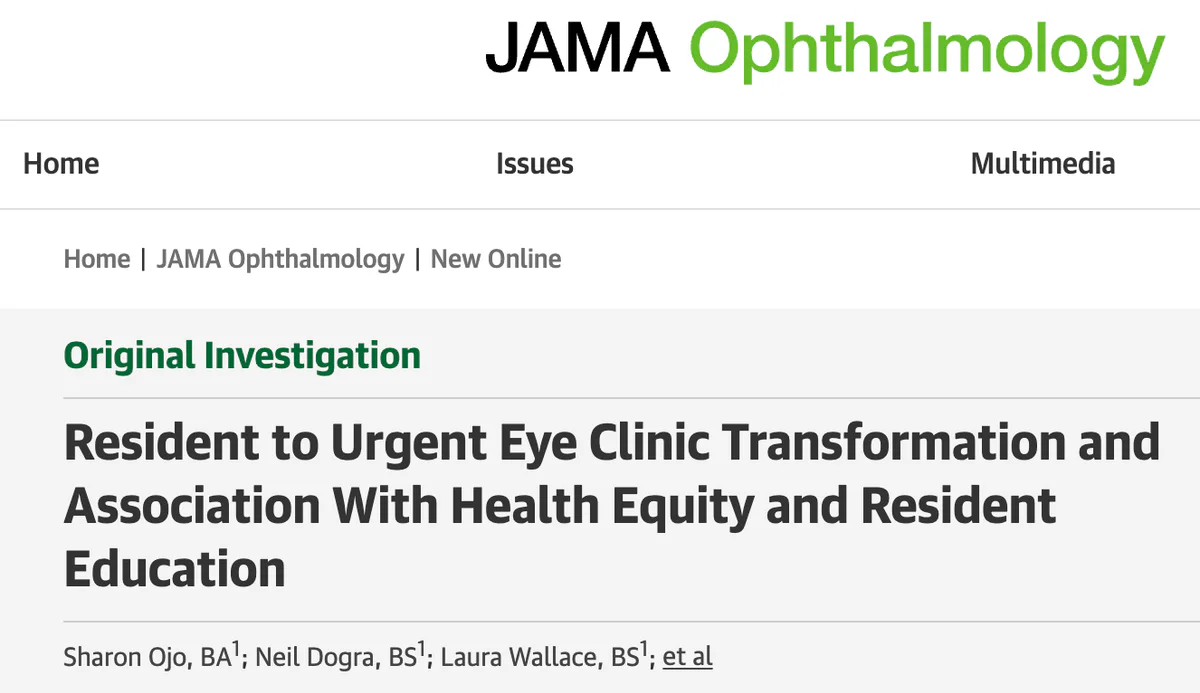
Ojo S, Dogra N, Wallace L, DiLoreto DA, Wozniak RAF, Hu WF. Resident to Urgent Eye Clinic Transformation and Association With Health Equity and Resident Education. JAMA Ophthalmol. 2026 Oct 22. doi:10.1001/jamaophthalmol.2026.42911612. PMID: 42911612.
Additional relevant literature includes recent reviews on ophthalmology resident training models and healthcare disparities:
American Academy of Ophthalmology. Ophthalmology Residency Curriculum and Training Guidelines. 2023.
Quillen DA, Harper RA, Haik BG. Resident surgical experience in ophthalmology: A national survey. Ophthalmology. 2021;128(2):198-205.
Zamora JJ, Basler L. Addressing health disparities in ophthalmology: A call to action. Ophthalmology Clinics of North America. 2022;35(3):361-371.