We use cookies

Our website uses essential cookies and, with your consent, additional cookies to measure performance and improve our services. Cookie Policy.

You can change your choice at any time.

MMedXYNews
HomeVideos
MedXY AI/MedXY News/Section: Clinical Updates

Racial and Ethnic Disparities in Treatment Initiation and Survival Among Patients With Endometrial Cancer: Socioeconomic Modifiers and Clinical Implications
MedXY Editorial Team•Oct 10, 2026•Clinical Updates
Endometrial Cancerracial disparitiessocioeconomic statussurvivaltreatment initiation

Highlights

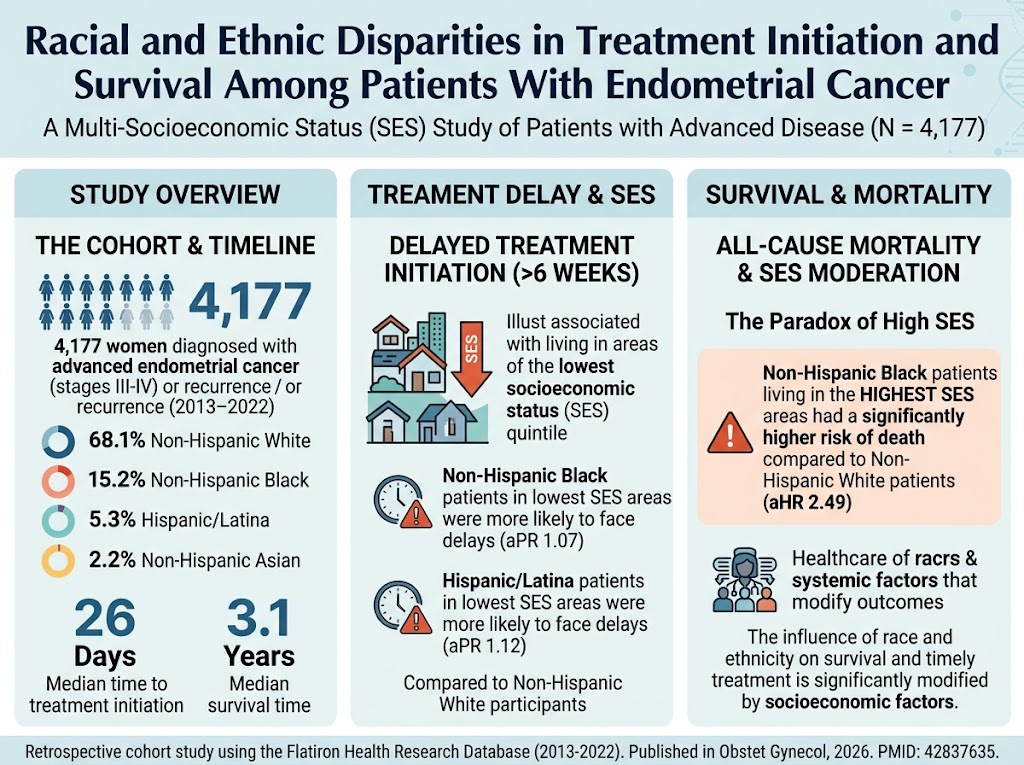
  • Persistent racial and ethnic disparities are evident in treatment initiation delays and survival outcomes among women with advanced endometrial cancer.
  • Socioeconomic status (SES) significantly modifies these disparities, with low SES exacerbating delays in treatment particularly among non-Hispanic Black and Hispanic/Latina women.
  • An inverse SES effect was observed whereby non-Hispanic Black women in high SES areas exhibited higher all-cause mortality despite adjusting for clinical factors.
  • Social determinants of health play a critical role, indicating the need for multifaceted interventions addressing both clinical and socioeconomic barriers.

Background

MedXY registered readers

Sign in free to continue reading

Create or use your MedXY account to unlock the complete article.

This article was created using several editorial tools, including AI, as part of the process. Human editors reviewed this content before publication.

Related articles

Open language-specific specialty feeds and department pages.

Plasma Phosphorylated Tau 217 Percentage by Race and Ethnicity in Preclinical Alzheimer Disease: Implications for Screening and Biomarker UtilityThis review synthesizes evidence on racial and ethnic differences in plasma phosphorylated tau 217 (%p-tau217) in preclinical Alzheimer disease, highlighting implications for diagnostic screening and biomarker validity across diverse populaOct 17, 2026Baseline Lung Allograft Dysfunction After Bilateral Lung Transplantation: Determinants and Long-Term Pulmonary OutcomesBaseline lung allograft dysfunction (BLAD) affects over 60% of bilateral lung transplant recipients, associates with increased mortality, and influences long-term lung function trajectories. Risk factors include higher BMI, prolonged ICU stOct 16, 2026Facilitated vs Self-Guided Advance Care Planning in Black and White Older Adults: Insights from the EQUAL ACP Randomized TrialThe EQUAL ACP trial compared facilitated and self-guided advance care planning in Black and White older adults with serious illnesses, revealing no significant difference in overall ACP completion but greater facilitated approach efficacy aOct 14, 2026
Loading comments...
MedXY briefing

Get the free newsletter

Evidence-led clinical news, trends, and analysis—delivered to your inbox.

Ask MedXY AI

Most popular

Intimate Health
Five Benefits for Women Continuing Sexual Activity After Menopause
Intimate Health
Why Some Women Have a Strong Sex Drive—And Why Men Shouldn't Worry About It
Nursing & care
How often should a couple have sex?
Cardiology
Precision Medicine for Long QT Syndrome Type 2: Lumacaftor Corrects Trafficking Defects and Shortens QT Interval
General Surgery
Optimizing Postoperative Opioid Prescriptions After Intra-Abdominal Cancer Surgery: Comparing the 5x-Multiplier and 3-Tier Models
© 2026 MedXY
Contact usAbout usPrivacy PolicyMedXY story
Impact of Primary Melanoma Stage on Survival Outcomes in Advanced Disease: Insights from the Spanish Melanoma Registry GEM1801Systemic relapse after stage I melanoma, though rare, portends higher tumor burden and poorer survival compared with relapse after stage II/III disease, as evidenced by data from 365 metastatic melanoma patients in the Spanish Melanoma RegiOct 13, 2026
Racial and Ethnic Disparities in Physical Impairment Among ICU Survivors: Implications for Post-Hospital CareNon-Hispanic Black and Hispanic ICU survivors exhibit higher rates of physical impairment at discharge and increased healthcare utilization within one year, highlighting critical racial and ethnic disparities in post-ICU recovery.Oct 13, 2026
Gut Microbiota and Idiopathic Pulmonary Fibrosis: Associations with Disease Severity and Survival OutcomesEmerging evidence reveals gut microbiota profiles correlate with disease severity and survival in idiopathic pulmonary fibrosis, highlighting potential microbial biomarkers and treatment modifiers.Oct 11, 2026