Highlights
Polygenic risk scores (PRS) robustly stratify lifetime glaucoma risk, with hazard ratios exceeding 3-fold for top percentiles compared to middle ranges.
Glaucoma PRS outperform family history in risk prediction and independently contribute to disease stratification.
High PRS associates with earlier onset and more aggressive disease requiring accelerated escalation of treatments, including medications, laser, and surgery.
Integration of PRS with environmental and clinical data, including machine learning-derived imaging features, enhances incident glaucoma risk prediction.
Background
Glaucoma is the leading cause of irreversible blindness worldwide, characterized by progressive optic neuropathy often linked to elevated intraocular pressure (IOP) and retinal ganglion cell loss. Early asymptomatic nature underpins the challenge of timely diagnosis, with many patients remaining undetected until advanced damage has occurred. Accurate risk stratification is essential for targeted screening and personalized management to prevent vision loss.
The advent of polygenic risk scores (PRS)—aggregating the effects of numerous genetic variants—offers a promising avenue for genomic-informed glaucoma risk prediction. While family history has traditionally guided risk assessment, its imprecision and variability limit clinical utility. Recent large-scale biobank studies have facilitated comprehensive evaluation of glaucoma PRS performance across ancestries and clinical phenotypes.
Key Content
Benchmarking Glaucoma PRS and Risk Stratification
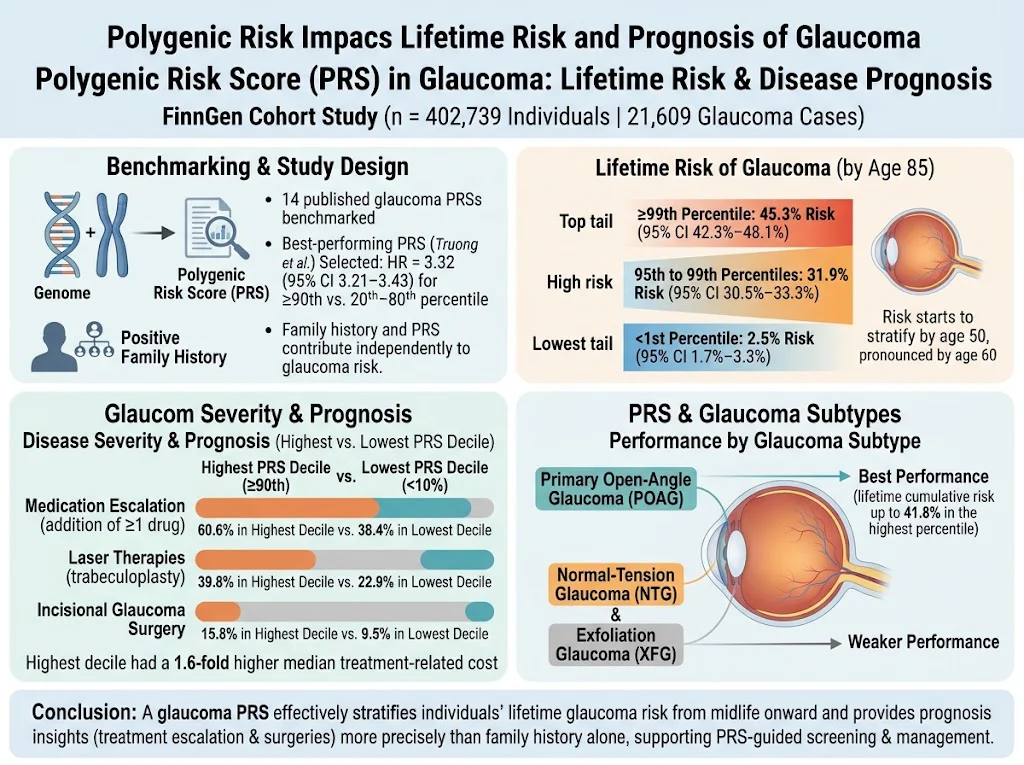
A pivotal cohort study within the FinnGen biobank (Tusa et al., 2026) encompassing over 400,000 individuals and 21,609 glaucoma cases benchmarked 14 published glaucoma PRSs. The best-performing PRS achieved a hazard ratio (HR) of 3.32 for glaucoma risk comparing individuals in the ≥90th percentile to those in the 20th–80th percentile. Lifetime risk analysis showed stark gradations: individuals below the first percentile of PRS had a 2.5% risk by age 85, escalating to 32% in the 95th–99th percentile, and 45% among those above the 99th percentile. This stratifies risk with substantial discrimination beyond family history alone, which modestly attenuated PRS effect by approximately 4%. Importantly, PRS predicted not only risk but corroborated clinical progression markers.
Extension to Prognosis and Treatment Needs
Individuals in the highest PRS decile demonstrated significantly higher needs for glaucoma care escalation over 20 years: medication escalation (60.6% vs. 38.4%), laser therapies (39.8% vs. 22.9%), and incisional surgery (15.8% vs. 9.5%) compared to the lowest decile. Complementary findings from multi-ancestry cohorts (e.g., Mass General Brigham and Mount Sinai biobanks) supported associations between elevated PRS and faster visual field progression and increased treatment burden (Odds Ratio ~1.2–1.3 per SD increase in PRS). Taiwanese population data also confirmed PRS correlation with disease severity and more rapid retinal nerve fiber layer thinning, indicating cross-ethnic validity.
PRS Integration with Clinical and Environmental Factors
UK Biobank studies exemplify enhanced glaucoma risk prediction by combining genetic PRS with deep learning-derived imaging features, ocular measurements (IOP, vertical cup-to-disc ratio—VCDR), and lifestyle data. Machine learning frameworks (XGBoost) achieved an impressive area under the curve (~0.93) for 10-year incident primary open-angle glaucoma prediction. SHAP (Shapley Additive Explanations) analyses identified PRS, retinal imaging scores, IOP, and age as top contributors.
Moreover, environmental exposures such as residential greenspace have been associated with incident glaucoma risk reductions, although interactive effects with genetic predisposition appear limited. Conversely, long-term air pollution exposure synergizes additively with high genetic risk to increase glaucoma incidence.
Ethnic, Racial, and Genetic Architecture Considerations
While PRS demonstrate robust predictive power, ethnic and racial disparities persist in glaucoma prevalence and IOP, partly influenced by social determinants and yet incompletely explained by genetics alone. Studies show higher mean IOP and glaucoma reporting in Black individuals relative to White counterparts despite adjustment for PRS, warranting further exploration into gene-environment interactions.
Juvenile open-angle glaucoma shares a polygenic continuum with adult POAG, validating PRS applicability across age spectra. In contrast, primary congenital glaucoma displays a distinct genetic architecture dominated by rare Mendelian variants (e.g., MYOC), underscoring the need for integrated rare variant and polygenic analyses. Incorporation of MYOC p.Gln368Ter variants improves risk stratification for carriers without compromising the polygenic predictive framework.
Polygenic Risk Scores and Biomarkers of Glaucoma Pathophysiology
PRS for related endophenotypes, including IOP and VCDR, explain substantive proportions of phenotypic variance (up to 22% for VCDR in some cohorts). These biomarker-linked PRSs enable identification of individuals at risk who may not exhibit elevated IOP, emphasizing the importance of integrating multiple risk axes.
Clinical Implementation Challenges and Psychosocial Impact
PRS-guided screening offers promise for early glaucoma identification and tailored management yet necessitates addressing psychosocial impacts. The INSiGHT study is prospectively investigating the psychological effects of PRS disclosure, evaluating anxiety, distress, and behavioral modifications, crucial for responsible clinical translation.
Recent retrospective analyses validate use of diagnostic codes (ICD) to construct glaucoma PRS in large electronic health record linked biobanks with comparable predictive performance to manual record review, facilitating cost-effective large-scale genetic risk studies.
Expert Commentary
Emerging evidence unequivocally positions glaucoma PRS as a potent tool for stratifying lifetime risk and predicting disease progression. Its independence and additive value over family history marks a substantial advance in personalized ophthalmic risk assessment. Nevertheless, clinical utility will hinge on integration with phenotypic, environmental, and lifestyle data to contextualize risk within comprehensive models.
Mechanistically, PRS encapsulate cumulative small-effect variants influencing trabecular meshwork function, retinal ganglion cell survival, extracellular matrix remodeling, and IOP regulation pathways. Dissecting these biological underpinnings may inform novel therapeutic targets and preventive strategies.
Limitations include ethnic disparities in GWAS training datasets leading to reduced PRS accuracy in non-European ancestries, necessitating dedicated efforts to diversify genomic data. Additionally, rare variant effects (e.g., MYOC pathogenic mutations) require complementary sequencing approaches for full risk characterization. The psychological impact of risk disclosure must be carefully balanced with clinical benefit.
Guidelines currently recognize glaucoma PRS research but await prospective trial evidence and cost-effectiveness analyses before recommending routine clinical use. Implementation studies such as the GRADE study (Australia) will provide critical validation data.
Conclusion
Polygenic risk scoring has matured into a highly informative, independent predictor of lifetime glaucoma risk and prognosis, providing refined stratification beyond classical family history. High PRS correlates with earlier disease onset, more aggressive progression, and greater treatment needs, informing personalized surveillance and intervention strategies. Multimodal approaches integrating PRS, imaging, environmental factors, and clinical metrics demonstrate excellent predictive accuracy for incident glaucoma.
Future research must address PRS refinement across diverse populations, conjoint rare variant and polygenic risk models, psychosocial impacts of genetic testing, and pragmatic clinical implementation frameworks. Cost-effectiveness and health economic evaluations will underpin policy adoption.
Harnessing glaucoma PRS heralds a new era of genomic precision medicine in ophthalmology, with the potential to transform early detection, prognostic counseling, and individualized glaucoma care.
References
Tusa ES, Tamlander M, Ripatti S, et al; FinnGen Research Project. Polygenic Risk Impacts Lifetime Risk and Prognosis of Glaucoma. Ophthalmology. 2026;133(11):1308-1317. doi:10.1016/j.ophtha.2026.06.003. PMID: 42276423.
Gharahkhani P, et al. Primary Open Angle Glaucoma Polygenic Risk Score is Associated with Disease Progression. Ophthalmol Glaucoma. 2026 May-Jun;S2589-4196(26)00093-1.
Torkamani A, et al. Predictive Power of Polygenic Risk Scores for Intraocular Pressure or Vertical Cup-Disc Ratio. JAMA Ophthalmol. 2025 Jan 1;143(1):15-22.
Burton LC, et al. Artificial Intelligence-Driven Multimodal Prediction of 10-Year Incident Glaucoma Integrating Genetic and Deep Learning-Derived Imaging Features. Ophthalmol Sci. 2026;6(8):101292.
Ramdas WD, et al. Evaluation of Practical Approaches for Including MYOC Variants Alongside Common Variants for Genetics-Based Risk Stratification for Glaucoma. Am J Ophthalmol. 2025 Jun;274:232-240.
Hudson C, et al. Genetic Risk Assessment of Degenerative Eye Disease (GRADE): study protocol of a prospective assessment of polygenic risk scores to predict diagnosis of glaucoma and age-related macular degeneration. BMC Ophthalmol. 2023 Oct 24;23(1):431.
Choi JA, et al. Joint effects of air pollution and genetic susceptibility on incident primary open-angle glaucoma. Sci Total Environ. 2024 Oct 10;946:173935.
Jonas JB, et al. Glaucoma in the UK Biobank: A Comparison of Diagnostic-Based versus Treatment-Based Definitions. Ophthalmology. 2026 Nov;133(11):1320-1333.
Pham TQ, et al. Residential Greenspace and Domestic Gardens, Genetic Predisposition, and Incident Glaucoma: A Prospective Cohort Study. Geohealth. 2026 Jun;10(6):e2025GH001367.