We use cookies

Our website uses essential cookies and, with your consent, additional cookies to measure performance and improve our services. Cookie Policy.

You can change your choice at any time.

MMedXYNews
HomeVideos
MedXY AI/MedXY News/Section: Cardiology

Plasma Biomarkers CPVL and PIGR Predict Anthracycline-Induced Cardiotoxicity in Hematologic Cancer Patients
MedXY Editorial Team•Aug 29, 2026•Cardiology
Hematologic MalignanciesPIGRCPVLanthracycline cardiotoxicityimmune response

Highlight

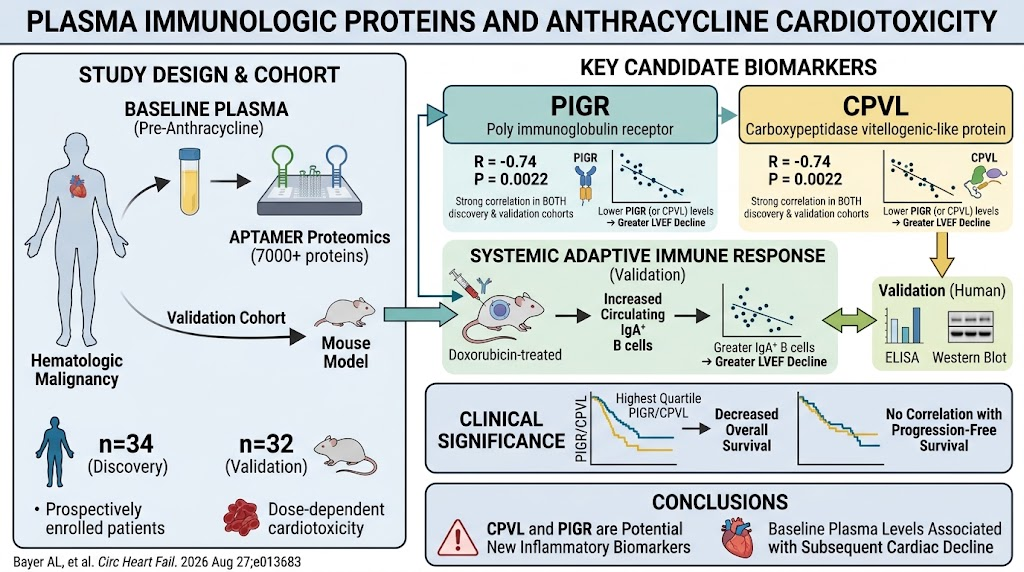
This study identified two plasma proteins, carboxypeptidase vitellogenic-like protein (CPVL) and poly immunoglobulin receptor (PIGR), whose baseline levels before anthracycline chemotherapy correlate strongly with the development of systolic dysfunction in patients with hematologic malignancies. Validation in both an independent patient cohort and a murine doxorubicin cardiotoxicity model supports their role as predictive biomarkers. Moreover, increased IgA+ B cells linked to PIGR suggest an immune-adaptive mechanism underlying cardiotoxicity. Elevated CPVL and PIGR levels predicted poorer overall survival, emphasizing clinical relevance.

Study Background

MedXY registered readers

Sign in free to continue reading

Create or use your MedXY account to unlock the complete article.

This article was created using several editorial tools, including AI, as part of the process. Human editors reviewed this content before publication.

Related articles

Open language-specific specialty feeds and department pages.

Cardiovascular Risks of CAR-T Therapy in Older Adults: Insights from US Medicare DataAmong older adults receiving CAR-T therapy, 5.8% experienced major adverse cardiovascular events (MACE), associated with increased mortality. Pre-existing cardiac conditions heightened risk, underscoring the need for cardiovascular monitoriSep 19, 2026Evolving Epidemiology and Survival Trends in Myeloproliferative Neoplasms: Insights from SEER 2000-2021Analysis of SEER data from 2000-2021 reveals incidence, survival trends, and demographic disparities in US patients with myeloproliferative neoplasms, highlighting improved outcomes particularly in primary myelofibrosis and areas for furtheSep 13, 2026Rogocekib Demonstrates Clinical Activity as a First-in-Class CLK Inhibitor in Relapsed or Refractory AML and MDSThis Phase 1 study evaluates rogocekib, a novel CDC2-like kinase inhibitor, in patients with relapsed or refractory hematologic malignancies, reporting manageable safety and significant complete remission rates in AML and MDS cohorts, signaJan 20, 2026Sự viêm vi mạch bẩm sinh sớm và kích hoạt nội mô xác định đặc điểm miễn dịch chủng khác sau ghép tim lợn sang người
Loading comments...
MedXY briefing

Get the free newsletter

Evidence-led clinical news, trends, and analysis—delivered to your inbox.

Ask MedXY AI

Most popular

Intimate Health
Five Benefits for Women Continuing Sexual Activity After Menopause
Intimate Health
Why Some Women Have a Strong Sex Drive—And Why Men Shouldn't Worry About It
Nursing & care
How often should a couple have sex?
Intimate Health
Classic Intimacy Recommendations: How to Help Women Reach Orgasm and Enjoy Mutual Pleasure
Intimate Health
What Makes a Woman "Physiologically Addicted" Is Never Money, But These Two Relationship Qualities
© 2026 MedXY
Contact usAbout usPrivacy PolicyMedXY story
Phân tích đa chế độ của hai quả tim lợn đã được chỉnh sửa gen 10 gen được ghép vào người đã chết não cho thấy sự viêm vi mạch bẩm sinh sớm với kích hoạt nội mô và hồ sơ phân tử phù hợp với tổn thương do kháng thể mặc dù không có C4d trong m
Dec 3, 2025
Early Innate Microvascular Inflammation and Endothelial Activation Define the Xenoimmune Signature After Pig-to-Human Heart TransplantationMultimodal analysis of two 10-gene–edited pig hearts transplanted into brain-dead human recipients revealed early innate microvascular inflammation with endothelial activation and a molecular profile consistent with antibody-mediated injuryDec 2, 2025
Atorvastatin Preserves Aortic Elasticity During Anthracycline Chemotherapy: Secondary Analysis of STOP‑CAIn a secondary analysis of the randomized STOP‑CA trial, atorvastatin 40 mg daily attenuated anthracycline‑associated increases in aortic stiffness measured by CMR pulse wave velocity, suggesting vascular protection and a potential strategyNov 25, 2025