pFIB Scores for Pediatric MASLD Fibrosis Linked to Risk of Youth-Onset Type 2 Diabetes in Children with Obesity
A study published in Diabetologia reports that pediatric liver fibrosis risk scores (pFIB), originally developed to assess fibrosis risk in metabolic dysfunction-associated steatotic liver disease (MASLD), are associated with an elevated risk of youth-onset type 2 diabetes in children with obesity. The findings suggest that integrating hepatic and metabolic markers could improve early identification of adolescents at highest short-term risk.
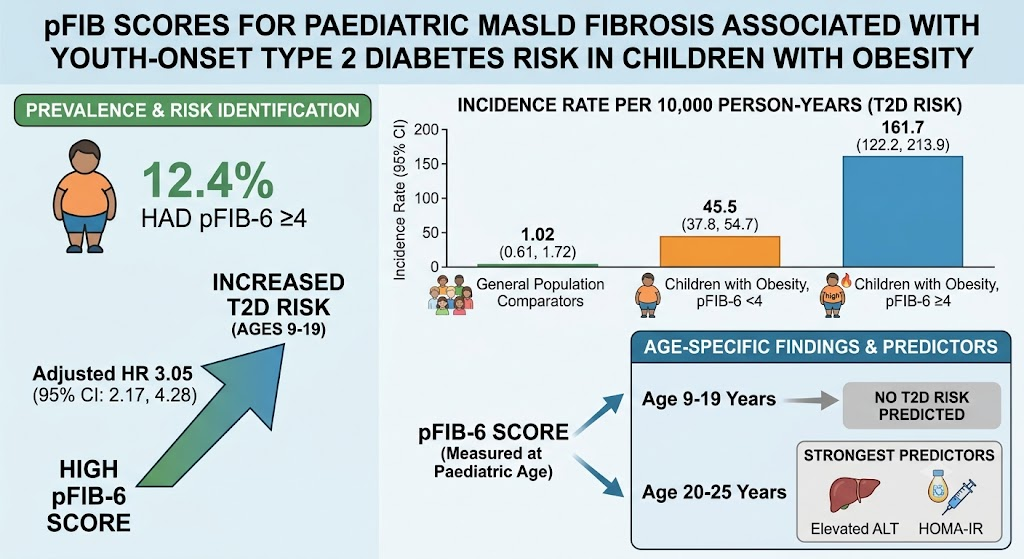
Children with obesity and a pFIB-6 score ≥4 had a threefold higher risk of developing type 2 diabetes during adolescence (adjusted HR 3.05; 95% CI 2.17–4.28).
Incidence rates per 10,000 person-years: 1.02 in general-population comparators, 45.5 in obesity with low pFIB-6, and 161.7 in obesity with high pFIB-6.
Neither pFIB-c nor pFIB-6 predicted type 2 diabetes risk at ages 20–25 years, indicating a short-term risk window.
Elevated alanine aminotransferase (ALT) and HOMA-IR were the strongest individual score components associated with diabetes risk.
Study Snapshot
Design: Retrospective cohort study using the Swedish Childhood Obesity Treatment Register (BORIS) linked to national registers.
Population: 4,856 children with obesity (mean age 12.0 years) and 23,758 general-population comparators.
Exposure: pFIB-c and pFIB-6 scores calculated at baseline.
Primary Outcome: Incident type 2 diabetes ascertained through national registers.
Analysis: Cox regression and flexible parametric survival models adjusted for confounders.
Key Result: pFIB-6 ≥4 associated with adjusted HR 3.05 (95% CI 2.17–4.28) for type 2 diabetes during ages 9–19 years.
Limitations: Observational design; single time-point score; possible residual confounding; limited generalizability.
Why This Study Matters
Youth-onset type 2 diabetes is an aggressive form of metabolic disease with earlier complications and shorter time to insulin dependence than adult-onset diabetes. Identifying children with obesity who are at the highest short-term risk could enable targeted monitoring and early intervention. Currently, clinicians lack simple, validated tools to stratify risk within this large population. The pFIB scores, which combine age, BMI, waist circumference, ALT, and HOMA-IR (pFIB-6 also includes albumin), offer a liver-focused risk assessment that may also capture systemic metabolic risk.
How the Study Was Conducted
Investigators used the Swedish Childhood Obesity Treatment Register (BORIS) for years 2005–2020, including 4,856 children with obesity and 23,758 age- and sex-matched general-population comparators. The pFIB-c and pFIB-6 scores were calculated at baseline. Incident type 2 diabetes was identified through linkage to national prescription, hospital, and cause-of-death registries. Time-to-event analyses used Cox regression with adjustment for age, sex, and other covariates. Flexible parametric survival models were also fitted. In a separate independent cohort, the authors examined the association between pFIB-6 and adipose tissue insulin resistance.
What the Researchers Found
Among children with obesity, 12.4% had a pFIB-6 score of 4 or higher. During follow-up (ages 9–19 years), a high pFIB-6 score was associated with an adjusted hazard ratio of 3.05 (95% CI 2.17–4.28) for developing type 2 diabetes. The incidence rate per 10,000 person-years was 1.02 in general-population comparators, 45.5 in children with obesity and a pFIB-6 below 4, and 161.7 when the pFIB-6 was 4 or higher. However, neither pFIB-c nor pFIB-6 measured at pediatric age predicted type 2 diabetes risk at ages 20–25 years. Among individual components of the scores, elevated ALT and HOMA-IR were most strongly associated with diabetes risk. In an independent cohort, higher pFIB-6 scores correlated with greater adipose tissue insulin resistance, suggesting a mechanistic link.
What the Findings May Mean
The results indicate that a liver-derived composite score can identify a subgroup of adolescents with obesity who face a sharply elevated short-term risk of type 2 diabetes. The finding that prediction was limited to ages 9–19 years, not into early adulthood, suggests that the risk captured by pFIB may be dynamic and requires reassessment over time. The strong contribution of ALT and HOMA-IR aligns with known pathways linking hepatic steatosis, insulin resistance, and beta-cell dysfunction. The association with adipose tissue insulin resistance in a separate cohort provides biological plausibility. The authors emphasize that these are observational findings and that pFIB scores are not yet validated for diabetes prediction in routine care.
Strengths and Limitations
Strengths include the large, nationwide cohort with long-term linkage to high-quality registers, minimizing loss to follow-up and ascertainment bias. The study design allows for clear temporality, and the use of established score cutoffs enhances reproducibility. Limitations include the observational nature, which cannot exclude residual confounding (e.g., by lifestyle factors, family history, or genetics). The pFIB scores were calculated from a single time point, and changes over time were not captured. The cohort is predominantly of European ancestry, limiting generalizability to other ethnic groups. Additionally, the absence of prediction beyond adolescence suggests that the score may not be useful for long-term risk stratification without repeated measurement.
Implications for Practice and Research
If validated in other populations, pFIB scores could serve as a simple, non-invasive tool to prioritize children with obesity for closer metabolic follow-up, lifestyle interventions, or emerging pharmacotherapies. The results also highlight the importance of liver health as a marker of systemic metabolic risk in pediatric obesity. Future studies should assess whether using pFIB scores in a screening pathway leads to improved clinical outcomes, and whether repeated measurements enhance long-term prediction. The authors caution that the scores were not designed for diabetes prediction and should not replace clinical judgment.
References
Lefere S, Putri RR, Danielsson P, et al. pFIB scores for paediatric MASLD fibrosis are associated with risk of youth-onset type 2 diabetes in children with obesity. Diabetologia. 2026 Jul 22. PMID: 42486926. PubMed
This article was created using several editorial tools, including AI, as part of the process. Human editors reviewed this content before publication.