Highlight
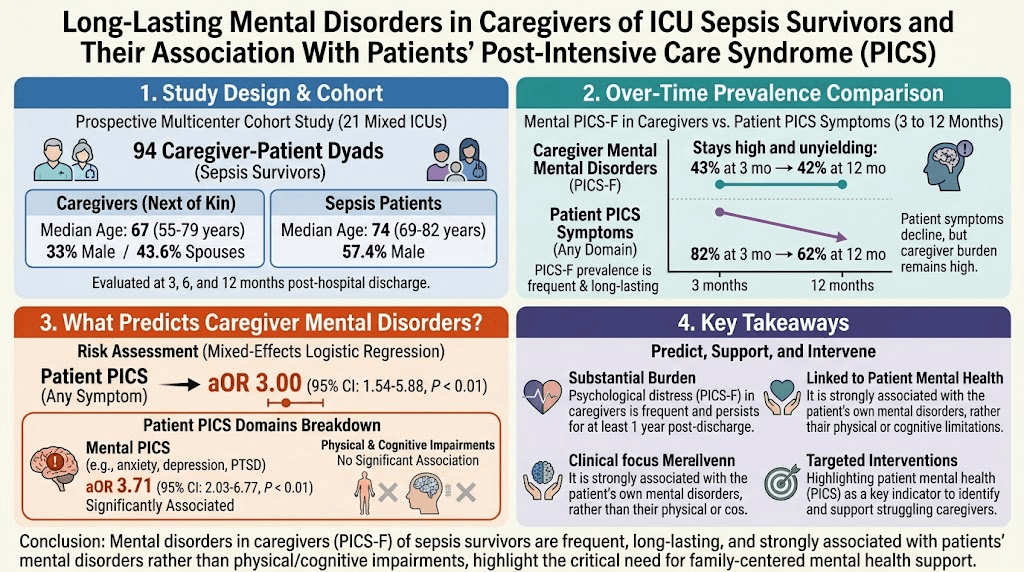
This prospective multicenter cohort study investigated the prevalence and persistence of mental health disorders in caregivers of ICU sepsis survivors over one year post-discharge. It demonstrated that nearly 43% of caregivers exhibited mental post-intensive care syndrome-family (PICS-F) symptoms consistently from 3 to 12 months. Critically, caregiver mental health was strongly associated with patients’ mental PICS domain rather than physical or cognitive impairments.
Study Background
Sepsis is a life-threatening condition frequently treated in intensive care units (ICUs). Survivors often experience a constellation of physical, cognitive, and mental health impairments collectively termed post-intensive care syndrome (PICS). As patients grapple with these challenges, their caregivers—often immediate family members—face significant psychological stress. Mental health difficulties in caregivers, described as PICS-family (PICS-F), can be substantial, yet remain understudied, especially in the context of sepsis survivors. Understanding the long-term mental health burden on caregivers and its relationship to patients’ PICS domains is crucial for comprehensive post-ICU care strategies.
Study Design
This prospective observational study was conducted across 21 mixed ICUs and included 94 caregiver-patient dyads, where patients were diagnosed with sepsis between November 2020 and April 2022. Caregivers, defined as the next of kin, and patients were assessed via telephone and mail at 3, 6, and 12 months after hospital discharge. The primary outcome was the prevalence of caregiver mental disorders indicative of PICS-F.
Mixed-effects logistic regression was employed to evaluate associations between caregiver PICS-F and patient PICS, focusing on the mental, physical, and cognitive domains in patients. Patient median age was 74 years, and caregivers had a median age of 67 years; approximately 44% of caregivers were spouses.
Key Findings
Mental PICS-F remained prevalent and unrelenting, with 43% of caregivers affected at 3 months and 42% still affected at 12 months post-discharge. In contrast, the prevalence of PICS symptoms in patients declined from 82% at 3 months to 62% at 12 months, indicating some recovery or adaptation over time.
Statistical analysis demonstrated that the presence of PICS symptoms in patients was significantly associated with caregiver mental disorders. The adjusted odds ratio (OR) for caregiver PICS-F with any patient PICS was 3.00 (95% confidence interval [CI], 1.54–5.88; p < 0.01). Further domain-specific analysis revealed that only the mental health domain of patient PICS was significantly linked to PICS-F, with an OR of 3.71 (95% CI, 2.03–6.77; p < 0.01). Physical and cognitive impairments in patients did not significantly predict caregiver mental health disorders.
This evidence highlights a specific and robust relationship between patients’ mental health impairments post-sepsis and persistent caregiver psychological distress.
Expert Commentary
This study addresses an important gap by elucidating the enduring mental health burden on caregivers of ICU sepsis survivors. The longitudinal design and multicenter setting enhance the generalizability of these findings. By linking caregiver distress specifically to patient mental health impairments instead of physical disability or cognitive decline, the study emphasizes the nuanced psycho-social mechanisms that underpin caregiver strain.
Potential limitations include reliance on telephone and mail assessments, which may under- or overestimate symptom severity, and the lack of detailed psychiatric evaluation. Moreover, confounding factors such as prior caregiver mental health history and socio-economic status were not extensively analyzed.
Nonetheless, these findings align with emerging literature emphasizing the concept of PICS-F as a major healthcare concern. They underscore the need for integrated mental health screening and interventions targeting both patients and their families during post-ICU recovery pathways.
Conclusion
The mental health of caregivers for ICU sepsis survivors is frequently compromised, with symptoms often persisting for at least a year after hospital discharge. Since caregiver psychological distress is most strongly associated with patients’ mental health impairments, clinicians and healthcare systems should prioritize mental health evaluations and support for both groups. Future research should focus on developing and validating targeted interventions that address this dyadic relationship to improve outcomes holistically.
Funding and ClinicalTrials.gov
Details regarding funding sources and trial registration were not specified in the study abstract.
References
Shirasaki K et al. Long-Lasting Mental Disorders in Caregivers of ICU Sepsis Survivors and Their Association With Patients’ Post-Intensive Care Syndrome: A Prospective Multicenter Cohort Study. Crit Care Med. 2026 Oct 14. PMID: 42872916.