Introduction and Context
Penicillin allergy labels are common: nearly 10% of people worldwide carry one. Yet when tested, roughly 95% of labeled individuals are not truly allergic. Most labels are applied in childhood and persist for decades in electronic health records, driving use of broader‑spectrum antibiotics, increasing costs, and contributing to adverse outcomes including higher rates of surgical site infections and multidrug‑resistant organism infections.
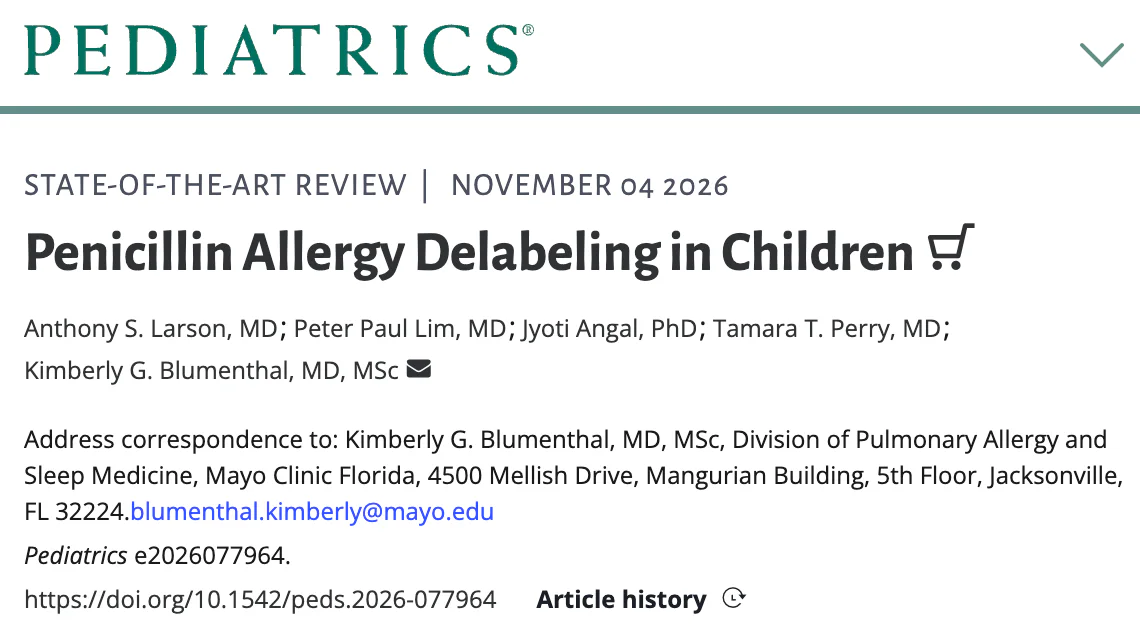
In November 2026, Pediatrics published an evidence‑based guidance titled “Penicillin Allergy Delabeling in Children” (Larson AS, Lim PP, Angal J, Perry TT, Blumenthal KG; Pediatrics. 2026 Nov 4. PMID: 42976931). The statement synthesizes pediatric‑specific data and issues a prioritized set of recommendations intended for pediatricians, family physicians, emergency medicine clinicians, hospitalists, and pediatric allergists. The guidance aligns with the broader movement in antimicrobial stewardship to reduce inappropriate allergy labeling and to expand safe, accessible delabeling strategies outside specialty clinics.
Why this guidance matters now
– Most penicillin allergy labels are assigned in childhood but are rarely reassessed.
– Accumulating pediatric data show that simple, clinic‑based approaches (notably direct oral amoxicillin challenge for low‑risk presentations) are safe and effective.
– Delabeling is an actionable, high‑impact intervention for antibiotic stewardship at the population level.
– Recent policy interest—federal proposals to require penicillin allergy evaluation for certain patient groups—brings delabeling into general practice.
New Guideline Highlights
The Pediatrics guidance emphasizes three central messages:
1. Routine, proactive identification of penicillin‑allergy labels in children is recommended. Clinical teams should systematically screen records (well visits, preoperative assessments, hospital admissions) and ask families about the original reaction.
2. Use history‑based risk stratification to separate low‑risk labels from possible immediate (IgE‑mediated) or severe delayed reactions. Low‑risk children should be offered point‑of‑care delabeling via direct oral amoxicillin challenge without prior skin testing.
3. High‑risk features (anaphylaxis, wheeze/respiratory compromise, angioedema, severe cutaneous adverse reactions such as Stevens‑Johnson syndrome/toxic epidermal necrolysis [SJS/TEN], organ involvement, or unclear history) require specialist evaluation and/or allergy testing before delabeling.
Key takeaways for clinicians
– Screen frequently and document the original reaction details (timing, symptoms, treatments given, age at reaction).
– Offer direct oral amoxicillin challenge in low‑risk children (typically a single supervised dose with observation) as a first‑line delabeling method.
– Reserve skin testing and specialist referral for children with histories consistent with immediate IgE‑mediated allergy or severe delayed reactions.
Updated Recommendations and Key Changes
What is new or emphasized compared with prior practice guidance:
– Stronger endorsement of direct oral challenge as safe and effective in children judged low‑risk on history alone. Earlier paradigms often favored skin testing prior to challenge; the 2026 guidance supports skipping routine skin testing in low‑risk pediatric patients.
– A push to integrate delabeling into routine pediatric workflows (well visits, preoperative evaluations, inpatient admission processes), rather than leaving all evaluation to allergists.
– Pragmatic recommendations for resource‑limited settings, supporting primary‑care–based challenges when staff are trained and emergency protocols are in place.
– Clearer operational guidance on observation periods, documentation templates, and family counseling language to support reliable, billable clinical practice.
Why these changes? The recommendation update reflects:
– Growing pediatric safety data showing rare immediate reactions during supervised direct oral challenge in low‑risk children.
– Evidence that many children’s labels are historical (e.g., rashes while on antibiotics for viral illnesses) and unlikely to represent true hypersensitivity.
– The public health need to curb unnecessary use of broad‑spectrum antibiotics in childhood.
Topic‑by‑Topic Recommendations
Recommendation summary (high level)
– Screen and reassess
– Strong recommendation: Routinely ask about penicillin allergy at well‑child visits, hospital admission, and preoperative assessments.
– Risk stratify by history
– Strong recommendation: Use structured questions to identify low‑risk presentations (isolated non‑urticarial rash >24 hours after dosing, gastrointestinal upset, vague family history, or reactions occurring in infancy that were not associated with systemic features).
– Direct oral amoxicillin challenge
– Strong recommendation for low‑risk children: Offer a supervised single‑dose oral amoxicillin challenge with observation (commonly 60–120 minutes) and delabel if tolerated.
– Skin testing and specialist referral
– Recommendation: Reserve penicillin skin testing and/or allergist referral for children with histories of immediate hypersensitivity (e.g., anaphylaxis, hives with respiratory compromise) or history suggestive of severe delayed reactions (SJS/TEN, drug‑reaction with eosinophilia and systemic symptoms [DRESS], blistering).
– Documentation and communication
– Strong recommendation: If challenge is negative, immediately remove the allergy entry from the permanent problem list or clearly change it to “tested — not allergic,” and provide written information to families and to other clinicians.
– Observation, emergency readiness, and training
– Recommendation: Challenges should occur where staff and medications to manage anaphylaxis are available. For low‑risk children, challenges may take place in primary care offices if staff are trained and observation protocols (and epinephrine) are in place.
Details and practical protocols
1. Screening and history elements (core questions)
– Age at time of reaction.
– Specific antibiotic taken (penicillin, amoxicillin, ampicillin, a β‑lactam?).
– Time from drug exposure to first symptoms (minutes, hours, days).
– Symptoms and course (hives, swelling, respiratory symptoms, syncope, isolated rash, gastrointestinal symptoms, mucosal involvement, blistering).
– Treatments given (epinephrine, steroids, hospitalization).
– Any subsequent antibiotic exposures and reactions.
2. Defining low, moderate, and high risk (guideline framework)
– Low risk: maculopapular rash without mucosal or systemic features, itching without hives, gastrointestinal upset, family‑reported or vague history, distant history in infancy with no recurrence — these are eligible for direct oral challenge.
– Moderate risk: urticaria or hives without systemic compromise or with unclear timing — consider skin testing or challenge depending on context; shared decision‑making recommended.
– High risk: anaphylaxis, respiratory distress, hypotension, angioedema, severe cutaneous adverse reactions (SJS/TEN, DRESS), organ involvement — refer to allergy/immunology and avoid routine challenge.
3. Direct oral amoxicillin challenge protocol (typical approach recommended)
– Pre‑challenge: confirm assent and informed consent; ensure emergency equipment and trained personnel available.
– Dose: weight‑appropriate therapeutic dose (often a single full therapeutic dose based on weight; some centers use 1–2 divided doses for very young children).
– Observation: at least 60 minutes for immediate reactions; many centers extend to 2 hours. In select settings, extended observation up to 24–48 hours with instructions for delayed reactions may be provided.
– Documentation: if tolerated, remove allergy label and update problem list; provide a written statement to the family and primary care team.
4. Skin testing
– Use reserved for intermediate/high‑risk cases or unclear history. The guideline notes that skin testing is imperfect and can be time‑consuming; in low‑risk cases it adds little value.
5. Special populations
– Infants and toddlers: Most labels originate in early childhood; the guidance supports early reassessment and delabeling when history is compatible with low risk.
– Immunocompromised children: Delabeling remains valuable; however, shared decision‑making is recommended and certain settings (e.g., transplant candidates) may require allergist involvement.
– Hospitalized children: Inpatients without high‑risk features may undergo supervised challenge in hospital if logistics permit; preoperative delabeling is encouraged to improve perioperative antibiotic selection.
Recommendation Grades (practical summary)
– Strong recommendation: Routine screening and history‑based risk stratification; direct oral challenge for low‑risk children; clear documentation and communication after negative challenge.
– Conditional recommendation: Skin testing for moderate‑risk presentations; primary‑care–based challenge in resource‑limited settings only with adequate training and emergency readiness.
– Expert consensus: Role definitions for which clinicians should perform challenges vary by institution; the committee supports expanding capacity through training programs.
Expert Commentary and Insights
Committee perspectives
– The authors highlight that pediatric delabeling is a high‑value, low‑risk intervention with immediate benefits for individual patients and for public health through improved antibiotic stewardship.
– They underscore practicality: most low‑risk challenges can and should be performed by primary‑care clinicians, not exclusively by allergists. This decentralization is a key change designed to improve access.
Controversies and areas of active debate
– Where challenges should be performed: allergists argue for specialist oversight for more complex cases, while primary‑care advocates point to safety data supporting office‑based challenges for low‑risk children.
– Reimbursement and medicolegal concerns: Institutions need clear policies and documentation templates to support non‑specialist clinicians in performing challenges.
– Optimal observation windows: While most immediate reactions occur within an hour, some centers favor extended observation; consensus balancing safety and feasibility remains under study.
Future research priorities called for by the committee
– Prospective data on outcomes of primary‑care–based delabeling programs.
– Cost‑effectiveness studies comparing different delabeling pathways.
– Implementation science to scale delabeling into diverse practice settings.
Practical Implications for Clinical Practice
How to put the guidance into action
– Implement routine screening at key touchpoints (well visits, preop clinics, hospital admission). Use a short checklist embedded in the EHR.
– Train clinicians and nursing staff on history‑based risk stratification and on performing supervised oral amoxicillin challenges (including anaphylaxis management drills).
– Create simple documentation templates that allow immediate removal or modification of allergy entries after a negative challenge.
– Establish referral pathways for moderate‑ and high‑risk patients.
– Track delabeling outcomes (number of challenges performed, percent delabeled, any adverse events, downstream antibiotic prescribing patterns) as part of stewardship metrics.
A brief vignette
Name: Maya, age 4
– Presentation: At a preoperative visit, Maya’s chart lists a penicillin allergy from age 1: “rash” after finishing an antibiotic (mother reports a diffuse red rash that occurred 2 days into therapy, no breathing problems, never hospitalized, no epinephrine used). She has taken cephalosporins once since with no problem.
How the guideline applies
– Risk stratification: History is consistent with low risk (isolated rash, delayed onset, no systemic signs).
– Action: Offer a supervised direct oral amoxicillin challenge in the clinic. Administer a weight‑based therapeutic dose, observe for 60–120 minutes, and if no reaction occurs, remove the allergy from the chart and provide a written statement for the family and surgical team.
References
1. Larson AS, Lim PP, Angal J, Perry TT, Blumenthal KG. Penicillin Allergy Delabeling in Children. Pediatrics. 2026 Nov 4. PMID: 42976931.
2. Shenoy ES, Macy E, Rowe T, Blumenthal KG. Evaluation and Management of Penicillin Allergy: A Review. JAMA. 2019;322(8):816–827.
3. Centers for Disease Control and Prevention. Core Elements of Hospital Antibiotic Stewardship Programs. CDC. https://www.cdc.gov/antibiotic-use/core-elements/hospital.html (accessed 2026).
Note: The Pediatrics guidance contains extensive operational appendices (sample scripts, EHR templates, observation protocols) that clinicians can adapt locally; readers should consult the full text for tools and appendices.
Closing
The 2026 Pediatrics guidance represents a pragmatic, evidence‑based shift toward routine reevaluation and delabeling of penicillin allergy in children. By prioritizing history‑driven risk stratification and expanding the role of direct oral amoxicillin challenge in primary care and inpatient settings, the guidance aims to remove inaccurate allergy labels safely and efficiently—improving antibiotic selection, patient outcomes, and public health. For pediatric clinicians, integrating simple screening and delabeling practices into routine care is now a clear quality and stewardship opportunity.