Introduction
Urinary tract infections (UTIs) are common pediatric conditions that often lead to ambulatory visits in emergency departments and urgent care centers. Diagnosing UTIs typically involves assessing symptoms and urinalysis results, including the presence of pyuria, which indicates white blood cells (WBCs) in the urine. Pyuria serves as an important marker for infection, but its interpretation, especially at low levels, can be challenging and influence clinical decision-making regarding antibiotic use.
Overprescribing antibiotics for suspected UTIs when the infection is not present contributes to antibiotic resistance and unnecessary side effects for pediatric patients. This study examines how urinalysis results, particularly low levels of pyuria, affect clinicians’ antibiotic prescribing habits in children aged 2 months to 17 years presenting at ambulatory settings.
Study Objective
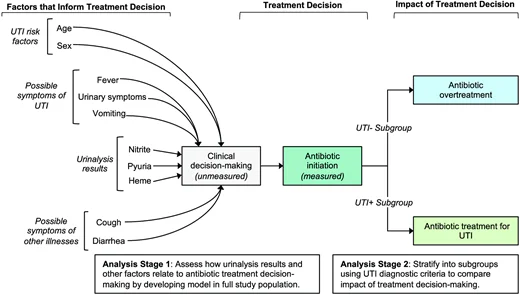
The primary objective was to understand the impact of urinalysis findings—specifically low-level pyuria—on the likelihood of initiating empiric antibiotic treatment in pediatric patients evaluated outside inpatient settings. The authors hypothesized that low pyuria levels disproportionately contribute to overtreatment, defined as antibiotic use when urine cultures exclude UTI.
Methods
A cross-sectional analysis was conducted using electronic health record data combined with abstracted clinical symptoms from emergency department and urgent care encounters at four distinct Northern California healthcare sites. The study period spanned two years, from January 1, 2022, through December 31, 2023.
Included were pediatric patients who underwent urinalysis during ambulatory visits. Pyuria levels were categorized based on leukocyte esterase presence and white blood cell counts per cubic millimeter (WBC/mm3) or per high-power field (HPF) on microscopy:
– No pyuria
– Low pyuria (trace leukocyte esterase, 10-69 WBC/mm3, or 5-10 WBC/HPF)
– Higher pyuria levels
Multivariable logistic regression models adjusted for age and other clinical covariates were used to assess the association between urinalysis results and empiric antibiotic initiation. The study estimated the attributable fractions of antibiotic overtreatment among patients with negative urine cultures and the impact on treatment in those with culture-confirmed UTI.
Results
A total of 1,150 pediatric patients with a median age of 6.3 years were analyzed. Among them, 191 (16.6%) received antibiotics.
Low-level pyuria, characterized by trace leukocyte esterase or 5-10 WBC/HPF, was significantly associated with antibiotic initiation compared with no pyuria. The adjusted odds ratio (aOR) for prescribing antibiotics at low pyuria levels was 6.62 (95% CI 3.72–11.79), indicating that children with low pyuria were more than six times as likely to receive antibiotics as those without pyuria.
The adjusted attributable fraction (aAF), representing the proportion of antibiotic overtreatment due to low pyuria levels among patients without confirmed UTI, was 17.0% (95% CI 10.3%–23.2%). By contrast, the aAF for appropriate UTI treatment driven by low pyuria was only 1.8% (95% CI 1.1%–2.4%). These differential impacts were consistent across different age groups.
Discussion
The findings highlight a considerable impact of low-level pyuria on clinician decision-making, often leading to overtreatment with antibiotics in children for suspected UTI even when culture results ultimately do not confirm infection. This suggests that minor elevations in white blood cells in urine tests may be overinterpreted as indicative of infection severity or presence, prompting unnecessary antibiotic prescriptions.
The study emphasizes the importance of integrating pyuria levels with clinical context, including the child’s age, presenting symptoms, and risk factors, rather than relying on pyuria alone. Overreliance on minimal pyuria can contribute to antibiotic overuse, increasing risks of adverse drug reactions, disruption of microbiota, and the broader public health threat of antimicrobial resistance.
Clinical Implications
Clinicians should adopt nuanced interpretations of urinalysis results, reserving antibiotic initiation for cases with higher pyuria levels coupled with supportive clinical findings suggestive of UTI. Decisions to treat should consider all aspects of patient presentation rather than isolated laboratory metrics.
Health systems can also support improved stewardship by implementing clinical decision support tools that contextualize pyuria results, provide age-appropriate diagnostic algorithms, and discourage reflexive antibiotic prescribing based on low pyuria alone.
Limitations and Future Directions
While this study benefits from a sizable pediatric sample and robust statistical methods, it is observational and cannot definitively establish causation. The generalizability may be limited to similar healthcare settings and populations. Additional prospective research could validate diagnostic thresholds and evaluate stewardship interventions designed to curb overtreatment.
Conclusion
Low-level pyuria significantly influences antibiotic prescribing patterns for suspected UTI in children, often leading to overtreatment. Careful consideration of pyuria degrees, combined with comprehensive clinical evaluation, is essential to promote targeted antibiotic use and reduce unnecessary exposure. Collaborative efforts in clinical practice and healthcare systems are warranted to enhance diagnostic accuracy and optimize treatment strategies in pediatric urinary infections.
References
Wattier RL, Usac FR, Mama-Farah A, Rodríguez JL, Gordon DM, Green-Hopkins I, Wallin D, Copp HL, Auerbach AD, Hersh AL, Boscardin WJ, Kaiser SV. Low-Level Pyuria and Antibiotic Prescribing for Suspected Urinary Tract Infection in Children. Pediatrics. 2026 Nov 5. PMID: 42982088. Available from: https://pubmed.ncbi.nlm.nih.gov/42982088/