Highlight
Spatial proteomics profiling of nearly 200 NSCLC tumors reveals distinct oncogene-driven remodeling of the immune tumor microenvironment (TME).
EGFR- and KRAS-mutant tumors exhibit reduced cytotoxic T cell infiltration and distinct immunosuppressive niches, including enrichment of M2-like tumor-associated macrophages in EGFR mutants.
Spatial analyses identify immune cell neighborhoods and proximity patterns that significantly correlate with patient prognosis, underscoring the clinical relevance of immune architecture.
Findings suggest that mutation-specific immune microenvironments could inform personalized immunotherapeutic interventions in NSCLC.
Study Background
Non-small cell lung cancer (NSCLC) represents the majority of lung cancer cases worldwide and remains a leading cause of cancer mortality. Despite advances in immunotherapy that have improved outcomes for some patients, the clinical benefit is variably observed. One major challenge is the heterogeneity of the tumor microenvironment (TME), driven in part by underlying oncogenic mutations that modulate immune cell infiltration and function. Among common mutations, epidermal growth factor receptor (EGFR) and Kirsten rat sarcoma viral oncogene homolog (KRAS) are prevalent driver mutations with established prognostic and therapeutic implications. However, how these mutations specifically shape spatial immune contexture within the NSCLC TME remains incompletely understood. Addressing this gap is critical, as the immune composition and cellular organization within tumors influence responses to checkpoint blockade and other immunotherapies.
Study Design and Methods
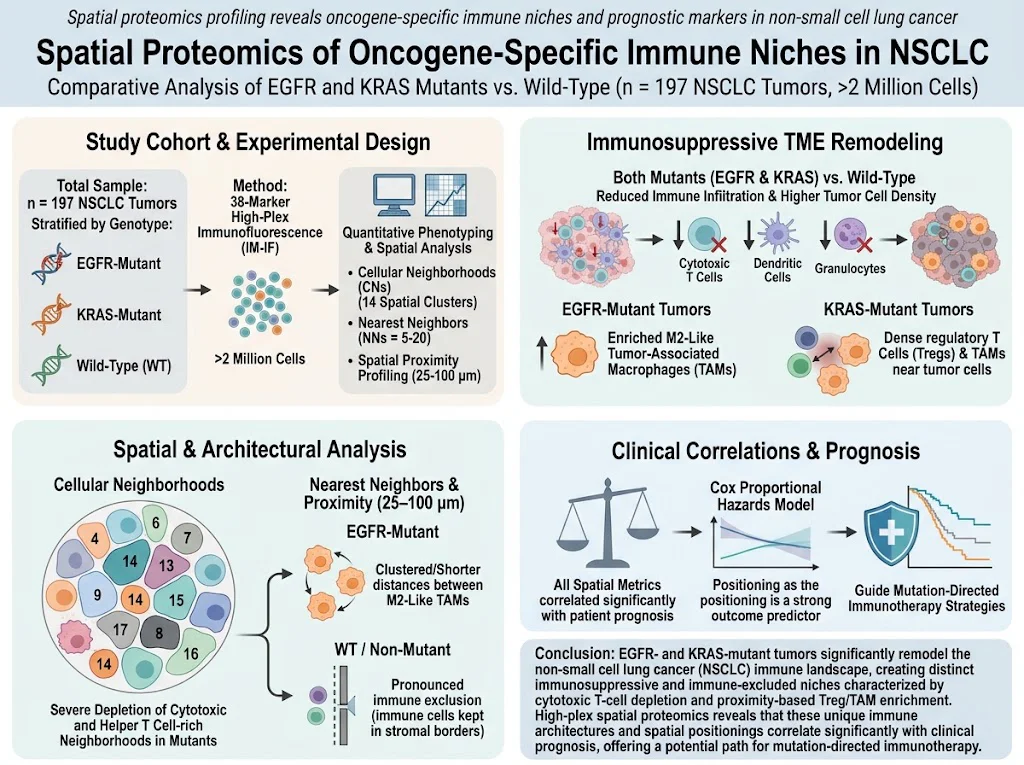
The study conducted by Nandigama et al. employed an advanced spatial proteomics approach using high-plex immunofluorescence staining targeting 38 protein markers on tumor specimens from 197 NSCLC patients. This resulted in single-cell resolution data across more than 2 million cells, stratified according to EGFR and KRAS mutation status as well as wild-type controls.
Their analytic framework included quantitative phenotyping of immune and tumor cells and multipronged spatial analysis workflows: (1) cellular neighborhoods (CNs) clustering immune cells based on spatial proximity and functional phenotype, (2) nearest neighbor (NN) analysis determining physical distances between key immune subsets within 5 to 20 microns, and (3) spatial proximity profiling evaluating immune cell density gradients within 25 to 100 microns from tumor cells. These multidimensional techniques enabled a comprehensive assessment of immune architecture and its association with clinical outcomes using Cox proportional hazards models.
Key Findings
Immune Cell Infiltration and Tumor Density: Both EGFR- and KRAS-mutant NSCLCs exhibited higher tumor cell density accompanied by significant reduction in total immune infiltration relative to wild-type tumors. Specifically, cytotoxic T lymphocytes (CTLs), dendritic cells, and granulocytes were depleted in mutant tumors, suggesting an immunosuppressive milieu.
Unique Immune Niches in Mutation Subgroups: In EGFR-mutant tumors, the authors observed a pronounced enrichment of M2-like tumor-associated macrophages (TAMs), well known to exert immunosuppressive and protumorigenic functions. Cellular neighborhood analysis identified 14 distinct spatial clusters across the cohort, with mutants notably showing a reduction in neighborhoods enriched for cytotoxic and helper T cells, indicative of immune exclusion.
In KRAS-mutant tumors, spatial proximity analysis uncovered higher densities of regulatory T cells (Tregs) and TAMs located near tumor cells. This positioning likely contributes to local immune suppression and contributes to tumor progression.
Spatial Organization and Prognosis: Nearest neighbor analysis in EGFR-mutant tumors showed shorter physical distances between M2-like TAMs, signifying localized immunosuppressive niches. Wild-type tumors displayed greater immune exclusion patterns. Importantly, these spatial metrics—distribution and proximity of immune subsets—were robustly correlated with patient survival outcomes in multivariate Cox models, establishing immune architecture as a clinically relevant prognostic marker beyond traditional immune cell counts.
Expert Commentary
This study represents a significant advance in comprehending the complex interplay between oncogenic mutations and the immune landscape in NSCLC. By leveraging high-plex spatial proteomics, the investigators uncovered distinct immune microenvironments driven by EGFR and KRAS mutations, which may underpin differential responses to immunotherapy observed clinically. The enrichment of immunosuppressive TAMs in EGFR mutants aligns with previous reports linking EGFR activity to immune evasion mechanisms. Meanwhile, the prominence of Tregs and TAMs proximal to tumor cells in KRAS mutants suggests potential targets for combinatory therapies that could disrupt these suppressive niches.
These findings capacitate a precision medicine approach whereby mutation-defined immune profiles guide tailored immunotherapeutic strategies. However, the study’s cross-sectional design limits causal inference. Prospective validation and functional assays will be invaluable to confirm mechanistic underpinnings and therapeutic implications. Additionally, integrating spatial transcriptomics and single-cell RNA sequencing could further elucidate functional states of immune cells within these niches.
Conclusions
In summary, the spatial proteomics profiling by Nandigama et al. elucidates how EGFR and KRAS oncogenic mutations distinctly remodel the immune TME in NSCLC, producing unique immunosuppressive and immune-excluded niches. These spatial immune architectures are significant prognostic markers that hold promise to refine patient stratification and inform mutation-directed immunotherapy design. This work underscores the critical importance of spatial context in tumor immunology and paves the way for more precise immune-targeted interventions in lung cancer.
Funding and Clinical Trials
The article does not specify funding sources or clinical trial registration numbers. Future research would benefit from longitudinal clinical trials testing mutation-tailored immunotherapies based on spatial microenvironment profiling.
References
1. Nandigama R, Cheikh BB, Wilhelm J, et al. Spatial proteomics profiling reveals oncogene-specific immune niches and prognostic markers in non-small cell lung cancer. Am J Respir Crit Care Med. 2026;212(11):2778-2791. PMID: 42363408.
2. Binnewies M, Roberts EW, Kersten K, et al. Understanding the tumor immune microenvironment (TIME) for effective therapy. Nat Med. 2018;24(5):541-550.
3. Herbst RS, Morgensztern D, Boshoff C. The biology and management of non-small cell lung cancer. Nature. 2018;553(7689):446-454.
4. Quail DF, Joyce JA. Microenvironmental regulation of tumor progression and metastasis. Nat Med. 2013;19(11):1423-1437.
5. Rotte A, Jin JY, Lemaire V. Mechanistic overview of immune checkpoints to support the rational design of their combinations in cancer immunotherapy. Ann Oncol. 2018;29(1):71-83.