Highlights
Ruzaltatug rezetecan, a HER3-directed antibody-drug conjugate (ADC), demonstrates superior progression-free survival (PFS) compared to standard chemotherapy in EGFR-mutated advanced NSCLC patients resistant to EGFR tyrosine kinase inhibitors (TKIs).
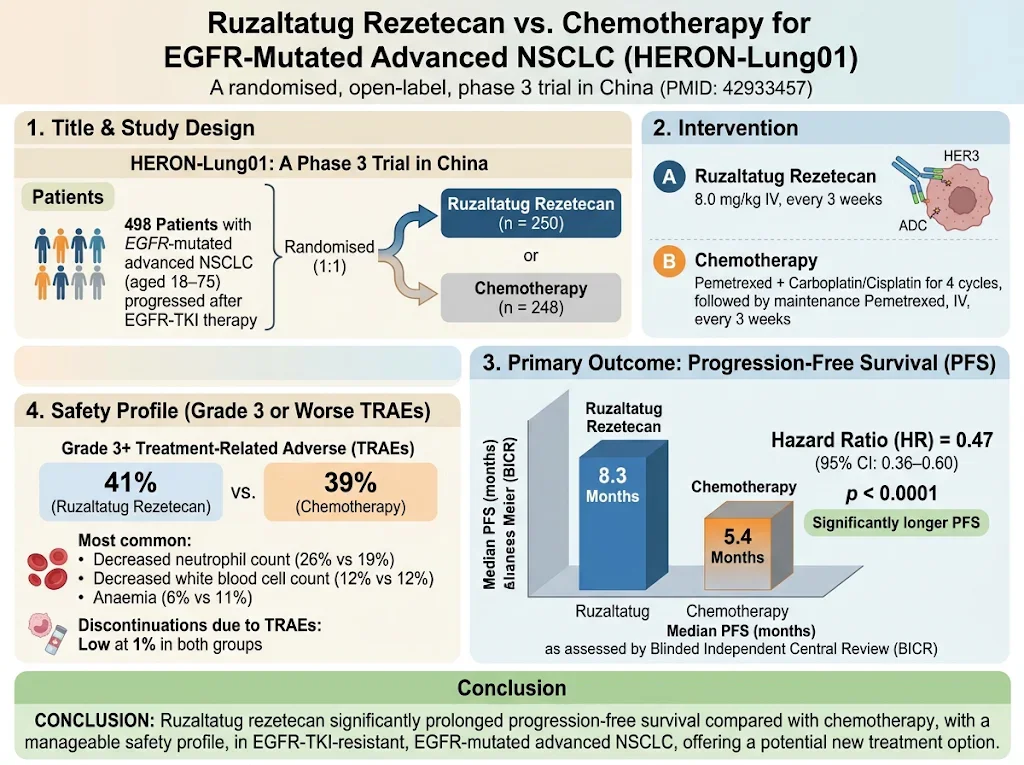
The phase 3 HERON-Lung01 trial conducted in China enrolled 498 patients, showing a near 53% reduction in risk of progression or death with ruzaltatug rezetecan.
Adverse event profiles were manageable and comparable between treatment arms; hematologic toxicities predominated.
HER3 targeting provides a novel therapeutic avenue addressing EGFR-TKI resistance, with translational relevance supported by previous early-phase studies.
Background
Non-small-cell lung cancer (NSCLC) with activating epidermal growth factor receptor (EGFR) mutations—primarily exon 19 deletions or L858R point mutations—represent a major molecular subtype, especially prevalent in Asian populations. EGFR tyrosine kinase inhibitors (TKIs) are established first-line therapies that improve survival, but resistance inevitably develops, commonly leading to disease progression. After progression on EGFR TKIs, treatment options are limited and include platinum-based chemotherapy. However, the efficacy of chemotherapy remains modest, and novel targeted therapeutic strategies are urgently needed to address this unmet clinical need.
HER3 (ErbB3), a member of the ErbB receptor family, has emerged as a validated oncologic target due to its role in signaling pathways that drive tumor growth and resistance mechanisms. HER3 is frequently overexpressed in EGFR-mutated NSCLC, and its interaction with ligand and other ErbB receptors modulates downstream PI3K/AKT signaling implicated in tumor cell survival. Antibody-drug conjugates (ADCs) targeting HER3 combine specificity of HER3-directed antibodies with cytotoxic payloads to enhance antitumor efficacy while limiting off-target toxicity.
Ruzaltatug rezetecan is a novel HER3-directed ADC conjugated to a potent cytotoxic agent. Early phase 1 studies showed promising antitumor activity and a manageable safety profile in pretreated EGFR-mutated NSCLC, providing rationale to evaluate it in a pivotal phase 3 setting.
Key Content
HERON-Lung01 Trial Design and Patient Population
The HERON-Lung01 was a randomized, open-label, phase 3 trial conducted across 62 centers in China (ClinicalTrials.gov NCT06671379). Eligible patients included adults aged 18 to 75 years with locally advanced or metastatic non-squamous NSCLC harboring EGFR activating mutations (exon 19 deletion or L858R), who had clinical or radiographic progression during or after prior EGFR TKI therapy. Patients with brain metastases were eligible, with stratification by this factor alongside EGFR mutation subtype and use of first-line third-generation EGFR-TKI.
Participants (n=498) were randomized 1:1 to receive either:
Ruzaltatug rezetecan at 8.0 mg/kg intravenously on day 1 of each 3-week cycle.
Standard platinum-based chemotherapy (pemetrexed 500 mg/m2 plus carboplatin [AUC 5] or cisplatin 75 mg/m2) for four cycles, followed by maintenance pemetrexed.
Treatment exposure continued until disease progression or unacceptable toxicity.
Primary and Secondary Endpoints
The primary endpoint was progression-free survival (PFS) assessed by blinded independent central review (BICR) in the intention-to-treat population. Secondary endpoints included safety and tolerability, overall survival (OS), objective response rate (ORR), and quality of life measures (pending).
Interim Analysis Findings
With a median follow-up of 7.7 months, the interim PFS analysis revealed:
Median PFS was significantly longer in the ruzaltatug rezetecan group versus chemotherapy (8.3 months [95% CI 7.1–8.3] vs. 5.4 months [95% CI not specified]).
The hazard ratio (HR) for disease progression or death was 0.47 (95% CI 0.36–0.60), favoring ruzaltatug rezetecan (one-sided p < 0.0001), indicating a 53% risk reduction.
Adverse events of grade 3 or higher related to treatment occurred comparably (41% ruzaltatug rezetecan vs. 39% chemotherapy). The most common severe treatment-related adverse events were hematologic: neutrophil count decrease (26% vs. 19%), white blood cell count decrease (12% vs. 12%), and anemia (6% vs. 11%). Treatment discontinuation due to adverse events was low (1% in both groups). One death of unknown cause in the ruzaltatug rezetecan arm was possibly treatment-related.
Comparison with Other HER3-Targeted ADCs
The HERON-Lung01 results are consistent with prior early-phase data on HER3-directed ADCs like patritumab deruxtecan (HER3-DXd), which demonstrated promising antitumor activity in EGFR-mutated NSCLC refractory to EGFR TKIs and chemotherapy (PMID 37212796). While these agents differ in payload and linker technology, both exploit HER3 overexpression to selectively deliver cytotoxic agents, highlighting HER3 as a critical target in this resistant setting.
Expert Commentary
EGFR-mutated NSCLC patients progressing after TKIs have an unmet need for effective and tolerable therapies. The HERON-Lung01 interim results position ruzaltatug rezetecan as a significant advancement over chemotherapy, nearly doubling median PFS.
Mechanistically, HER3 targeting is rational because of the receptor’s role in bypass signaling contributing to TKI resistance. ADCs serve as next-generation targeted delivery systems, increasing therapeutic index through tumor-selective cytotoxicity.
Safety profiles between arms suggest manageable toxicity, although hematologic suppression remains a concern requiring proactive monitoring and supportive care. The low discontinuation rate attests to tolerability.
While the trial is ongoing and overall survival data are awaited, these interim findings align with an emerging paradigm where HER3-directed ADCs may serve as second-line or later therapies for EGFR-TKI resistant disease. This approach may complement or succeed existing TKI and chemotherapy strategies.
Limitations include the exclusive enrollment in China, which may limit generalization due to different genetic and environmental backgrounds influencing outcomes. Moreover, the open-label design could introduce bias, though the primary endpoint was independently adjudicated.
Future research should explore biomarkers predicting response, combinatorial regimens involving HER3 ADCs with immunotherapy or TKIs, and the impact on quality of life and OS.
Conclusion
HERON-Lung01 interim analysis demonstrates that ruzaltatug rezetecan significantly prolongs progression-free survival with manageable safety relative to platinum-based chemotherapy in patients with EGFR-mutated advanced NSCLC refractory to EGFR-TKI therapy. The novel HER3-directed ADC approach validates targeting HER3 as an effective strategy to overcome TKI resistance. These data support further development and potential regulatory consideration of ruzaltatug rezetecan as an important treatment option in this challenging clinical scenario.
References
Xu CR, et al. Ruzaltatug rezetecan versus chemotherapy for EGFR-mutated advanced non-small-cell lung cancer progressing after EGFR tyrosine kinase inhibitor therapy (HERON-Lung01): interim analysis of a randomised, open-label, phase 3 trial in China. Lancet. 2026 Oct 26;408(10567):1969-1978. PMID: 42933457.
Kimura H, et al. HERTHENA-Lung01: a phase II study of patritumab deruxtecan (HER3-DXd) in previously treated metastatic EGFR-mutated NSCLC. Future Oncol. 2023 Jun;19(19):1319-1329. PMID: 37212796.